Stock Analysis · Worthington Steel Inc (WS)
Overview
Worthington Steel Inc. is a U.S. steel processor focused on value-added steel products rather than basic steelmaking. In simple terms, it buys steel, improves it through processing and specialized treatments, and sells it to manufacturers that need consistent quality, lighter-weight components, or parts engineered for demanding uses. Its customers are mainly in automotive, construction, agriculture, heavy truck, and industrial markets.
The company became a standalone public business after being separated from Worthington Enterprises, which makes its recent financial history important to read with some caution. The business model is tied to manufacturing activity, but it is more specialized than a commodity steel producer because processing, technical know-how, and customer relationships matter.
Based on the company’s latest annual filing, revenue is concentrated in two operating segments.
- Direct steel processing – about 80% to 85%: This is the core business. It includes toll processing, slitting, cutting, blanking, and related services that prepare steel for customer production lines.
- Electrical steel – about 15% to 20%: This segment serves motors, transformers, and other electrification-related applications. It includes processing and sale of electrical steel products used where magnetic performance matters.
Within those segments, end-market exposure is broad, but the automotive industry is especially important. That gives Worthington Steel meaningful scale in a large market, while also tying results to auto production cycles and customer build schedules.
The long-term financial pattern shows a business with very high revenue passing through cost of goods sold, which is normal in steel processing. Sales recovered in fiscal 2026 after several years of decline, but profit conversion weakened sharply as interest expense and operating costs rose faster than earnings.
Key Figures
| Metric | Value | Sector ⓘ |
|---|---|---|
| Date | Oct 17, 2026 | |
| Context | ||
| Sector | Basic Materials | |
| Industry | Steel | |
| Market Cap ⓘ | $1.96B | |
| Beta ⓘ | 2.23 | |
Value (Cheapness) | ||
| P/E Ratio ⓘ | 224.65 | 16.90 |
| P/B Ratio ⓘ | 1.88 | 1.65 |
| FCF Yield ⓘ | 5.09% | 5.76% |
| Dividend Yield ⓘ | 1.68% | 2.13% |
| EBIT / EV ⓘ | 6.50% | 6.30% |
| PEG ⓘ | N/A | |
Growth (Business expansion) | ||
| Revenue Growth ⓘ | 212.40% | 11.10% |
| RPS Growth (5Y CAGR) ⓘ | -3.98% | 4.49% |
| EPS Growth (5Y CAGR) ⓘ | -54.42% | -13.47% |
| BVPS Growth (5Y CAGR) ⓘ | -6.22% | 5.51% |
| Margin Growth (5Y Trend) ⓘ | -3.27% | -1.54% |
| FCF Growth (5Y CAGR) ⓘ | 126.33% | 0.37% |
| DPS Growth (5Y CAGR) ⓘ | N/A | 6.08% |
Quality (Business durability) | ||
| ROIC (Latest) ⓘ | 7.93% | 9.26% |
| ROA (Latest) ⓘ | -0.72% | 4.91% |
| ROIC (5Y Median) ⓘ | 10.60% | 7.70% |
| ROA (5Y Median) ⓘ | 5.78% | 3.86% |
| Net Debt / EBIT (Latest) ⓘ | 17.63 | 1.40 |
| Net Debt / EBIT (5Y Median) ⓘ | 0.83 | 1.70 |
| Net Debt / EBITDA (Latest) ⓘ | 10.39 | 0.95 |
| Net Debt / Assets ⓘ | 38.79% | 13.69% |
| EBITDA / Interest ⓘ | 3.58 | 12.34 |
| Operating Margin (Latest) ⓘ | 2.50% | 13.20% |
| Operating Margin (5Y Median) ⓘ | 5.02% | 11.80% |
| Debt to Equity (Latest) ⓘ | 250.31% | 40.56% |
| Profit Margin (Latest) ⓘ | -0.72% | 6.43% |
| Free Cash Flow (Latest) ⓘ | $99.90M | |
Momentum (Price trend) | ||
| 3Y Return ⓘ | N/A | +68.89% |
| 12M Return (excl. last month) ⓘ | -1.67% | +30.21% |
| 6M Return ⓘ | +15.44% | -4.16% |
| Price vs. 200-Day MA ⓘ | +4.62% | -1.27% |
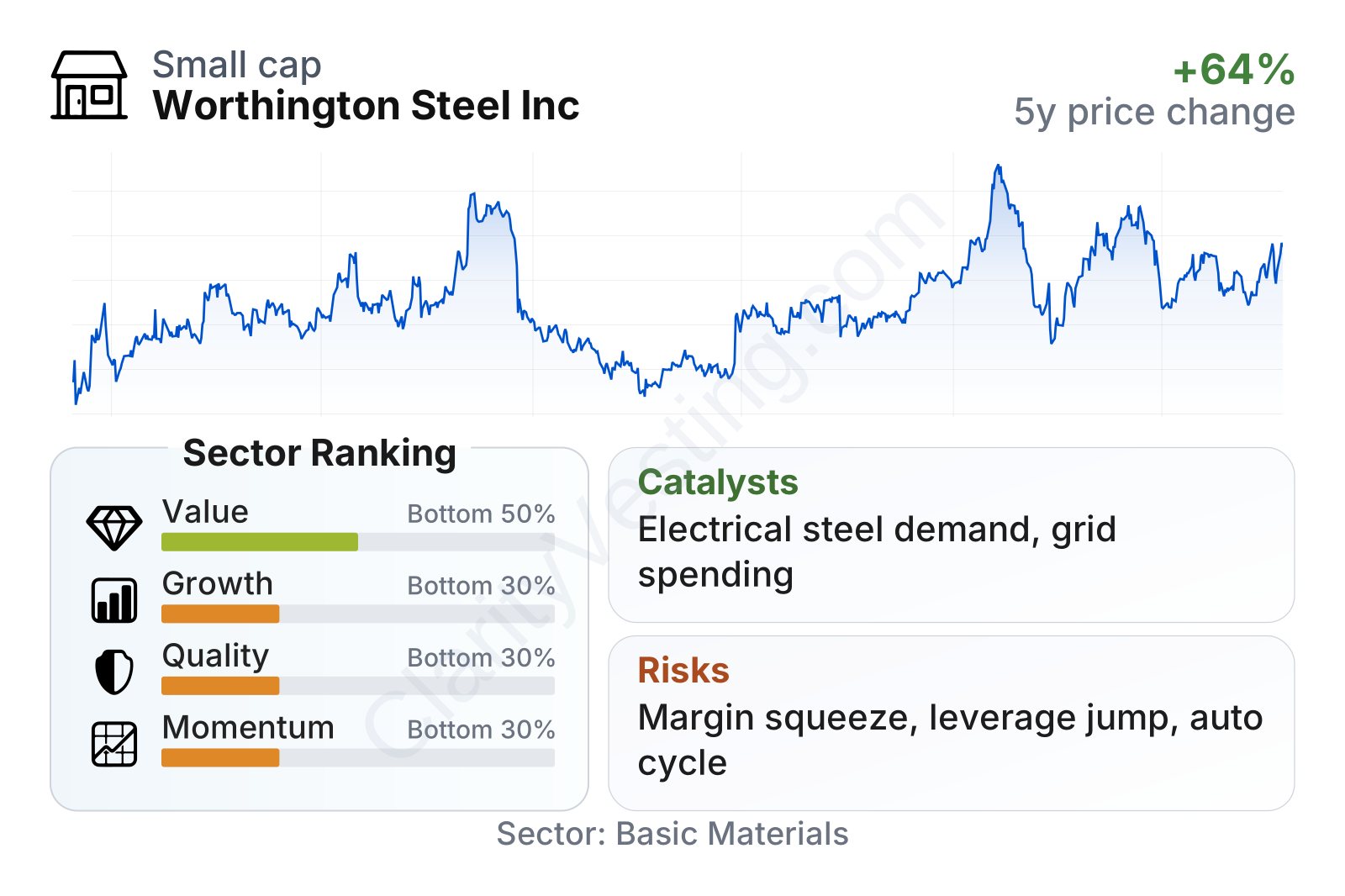
Worthington Steel is a mid-sized steel company by market value, and its share price has been volatile, which fits a cyclical industrial business with a beta above 2. On valuation factors, the picture is mixed rather than clearly cheap or clearly expensive. Traditional earnings multiples look distorted because recent net income dropped sharply, while asset-based valuation is close to the sector median and cash-flow yield is also near typical industry levels. The broader factor view is weaker on growth, quality, and momentum, with leverage and profitability standing out as the main pressure points.
Growth
Worthington Steel operates in parts of the steel market that have better long-term logic than commodity sheet alone. Direct processing benefits from outsourcing by manufacturers that prefer reliable local service rather than building all capabilities in-house. The electrical steel business has a clearer structural tailwind because electrification, grid upgrades, motor efficiency standards, and transformer demand all support usage over time.
The company’s strategy also makes sense in practical terms. Instead of competing primarily on raw steel production scale, it focuses on processing, engineered solutions, and niche products that can matter more to customers than headline steel prices alone. That approach can support stickier relationships, especially where production quality and delivery timing are critical.
Recent revenue trends suggest the top line has improved after a weak stretch. Fiscal 2026 revenue moved back up into positive year-over-year territory, and the latest quarterly comparison was unusually strong. That very high recent growth rate likely reflects a combination of easier comparisons, shifting customer orders, and possible acquisition or business mix effects rather than a new steady-state growth rate. Even so, it shows that demand has not disappeared and that the company can recover volume when conditions improve.
Cash generation has been more resilient than earnings. Free cash flow over the trailing period remains meaningful for a company of this size, and the multi-year trend shows a strong improvement from earlier periods. That matters because industrial businesses with uneven accounting profits can still create value if they convert operations into cash and avoid excessive capital intensity.
A notable catalyst is the company’s exposure to electrical steel and other products tied to energy infrastructure and electrification. The U.S. power system needs more transformers, grid equipment, and efficient motors, and those trends can support processing demand. In addition, if North American manufacturing continues to localize supply chains, domestic processors with established customer relationships may benefit.
Recent company updates have also emphasized continued investment in value-added capabilities and partnerships. For a processor, that is important: growth is less about building a giant blast furnace footprint and more about gaining specialized capacity where customers need technical service and dependable delivery.
Risks
This article is for informational purposes only and does not constitute financial advice. Some content is AI-generated. See Disclaimer


