Stock Analysis · Wereldhave N.V (WRDEF)
Overview
Wereldhave N.V. is a Dutch real estate company focused on owning, operating, and upgrading shopping centers in Europe. Its properties are mainly located in the Netherlands and Belgium, and the company has increasingly centered its strategy on what it calls full-service centers: retail locations designed to combine daily shopping, services, food, health, and leisure in one place. In simple terms, Wereldhave is not just collecting rent from stores. It is trying to make its centers more useful for everyday needs so they stay relevant even as online shopping grows.
The business model is fairly straightforward. Wereldhave buys or develops shopping properties, leases space to tenants, manages the centers, and seeks to raise rents and occupancy over time. As with most retail-focused property owners, income is influenced by tenant demand, rental agreements, property valuations, financing costs, and local consumer spending.
The company’s revenue mainly comes from recurring rental income and property-related services tied to its shopping centers. Based on recent annual reporting, the broad sources of revenue can be summarized as follows:
- Rental income from retail units: approximately 80% to 90% — base rent paid by shops, supermarkets, restaurants, and service tenants in the company’s centers.
- Service charges and tenant recoveries: approximately 10% to 15% — reimbursements and charges linked to maintenance, common areas, utilities, security, and center operations.
- Parking, specialty leasing, and other property income: less than 10% — smaller streams such as parking, temporary leasing, advertising, and other center-related fees.
Geographically, the portfolio is concentrated rather than global. That makes the business easier to understand, but it also means performance is closely tied to the Dutch and Belgian consumer and retail property markets.
The profit profile has improved markedly since 2021. Revenue has moved higher again, operating profitability has strengthened, and net income turned from a loss in 2021 to positive earnings in later years, although annual earnings still move around because property owners are affected by valuation changes and financing costs.
Over the last several years, the business has shown a clear recovery in revenue and gross profit, while operating income improved strongly. That suggests better property performance and tighter cost control, even though interest expense has also climbed as borrowing became more expensive.
Key Figures
| Metric | Value | Sector ⓘ |
|---|---|---|
| Date | Oct 17, 2026 | |
| Context | ||
| Sector | Real Estate | |
| Industry | REIT - Retail | |
| Market Cap ⓘ | $1.20B | |
| Beta ⓘ | 0.91 | |
Value (Cheapness) | ||
| P/E Ratio ⓘ | 15.33 | 17.38 |
| P/B Ratio ⓘ | 1.66 | 0.85 |
| FCF Yield ⓘ | 16.35% | 7.38% |
| Dividend Yield ⓘ | 5.05% | 4.85% |
| EBIT / EV ⓘ | N/A | 3.78% |
| PEG ⓘ | N/A | |
Growth (Business expansion) | ||
| Revenue Growth ⓘ | 5.80% | 5.30% |
| RPS Growth (5Y CAGR) ⓘ | -0.19% | 6.02% |
| EPS Growth (5Y CAGR) ⓘ | N/A | -11.37% |
| BVPS Growth (5Y CAGR) ⓘ | -4.21% | 0.45% |
| Margin Growth (5Y Trend) ⓘ | 49.74% | -0.22% |
| FCF Growth (5Y CAGR) ⓘ | 6.90% | 5.40% |
| DPS Growth (5Y CAGR) ⓘ | 16.06% | 5.02% |
Quality (Business durability) | ||
| ROIC (Latest) ⓘ | 11.03% | 5.69% |
| ROE (Latest) ⓘ | 19.46% | 7.56% |
| ROA (Latest) ⓘ | 6.30% | 2.85% |
| ROIC (5Y Median) ⓘ | 5.79% | 4.22% |
| ROE (5Y Median) ⓘ | 9.10% | 6.03% |
| ROA (5Y Median) ⓘ | 2.94% | 2.44% |
| Net Debt / EBIT (Latest) ⓘ | 4.08 | 7.59 |
| Net Debt / EBIT (5Y Median) ⓘ | 7.87 | 8.40 |
| Net Debt / EBITDA (Latest) ⓘ | 4.04 | 5.27 |
| Net Debt / Assets ⓘ | 41.54% | 37.76% |
| EBITDA / Interest ⓘ | N/A | 4.10 |
| Operating Margin (Latest) ⓘ | 61.82% | 35.29% |
| Operating Margin (5Y Median) ⓘ | 61.29% | 37.31% |
| Debt to Equity (Latest) ⓘ | 101.46% | 88.87% |
| Profit Margin (Latest) ⓘ | 30.13% | 19.61% |
| Free Cash Flow (Latest) ⓘ | $196.40M | |
Momentum (Price trend) | ||
| 3Y Return ⓘ | +240.12% | +30.75% |
| 12M Return (excl. last month) ⓘ | +105.70% | +4.36% |
| 6M Return ⓘ | +29.39% | -2.52% |
| Price vs. 200-Day MA ⓘ | +36.95% | -2.34% |
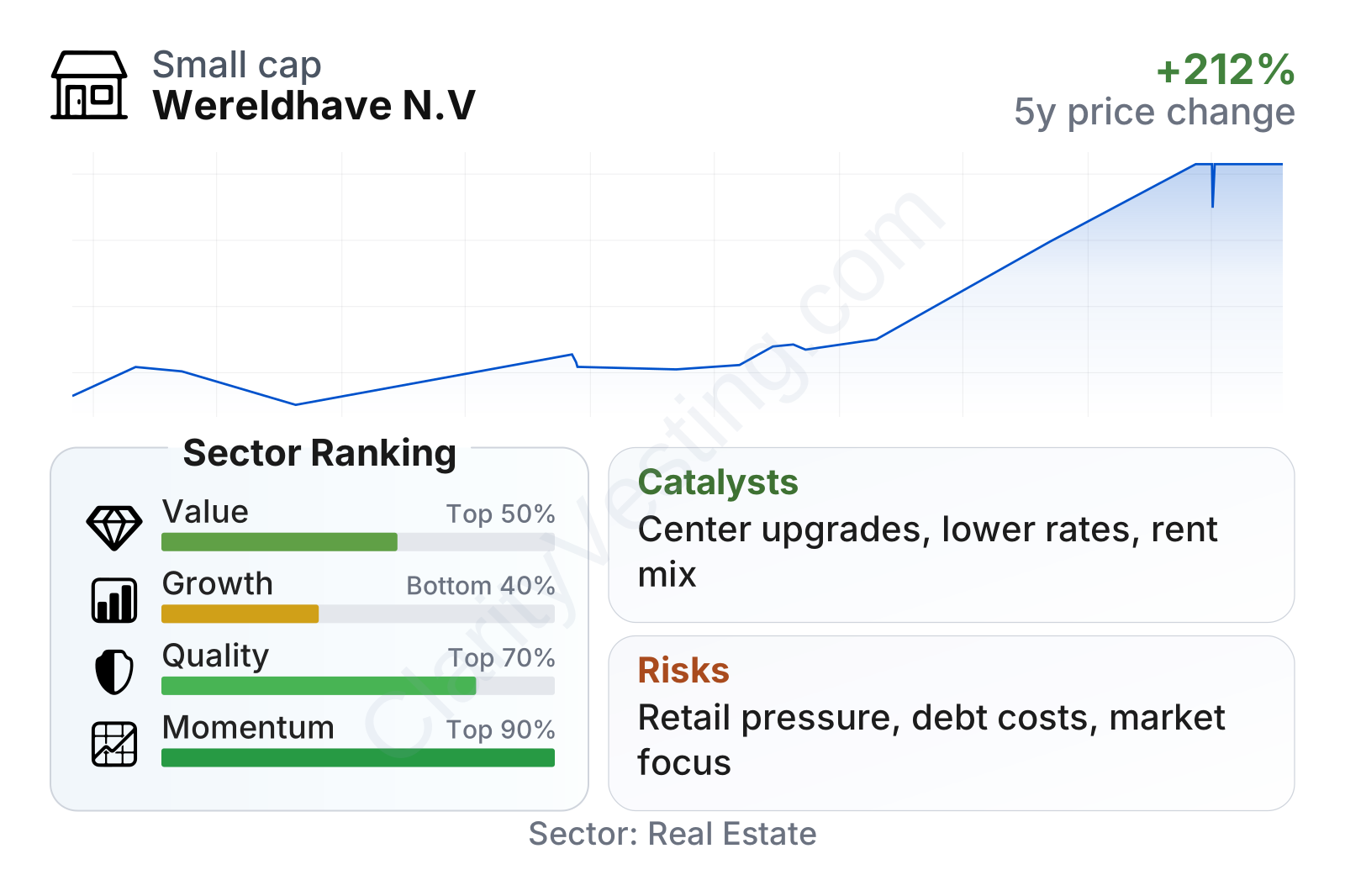
Wereldhave is a mid-sized listed real estate company with a market value a little above $1 billion and a beta just below 1, which suggests share price swings have been close to, but slightly lower than, the broader market. On valuation metrics, it looks mixed: earnings and cash flow measures are relatively supportive, with free cash flow yield standing well above the sector median and the dividend yield slightly above the typical retail REIT level. By contrast, the stock trades at a price-to-book multiple above the sector median, so the market is placing a higher value on the assets than it does for many peers.
Quality metrics are one of the stronger parts of the profile. Profitability ratios and operating margins are comfortably ahead of the sector median, and debt relative to EBIT and EBITDA is lower than many peers, even though debt-to-equity remains somewhat elevated. Growth is less impressive. Recent yearly revenue growth has been decent, but the longer five-year trend in revenue per share and book value per share has been weak compared with the wider real estate group. Share-price momentum, however, has been very strong over the past three years, meaning the market has already recognized a meaningful part of the company’s operational improvement.
Growth
Wereldhave operates in a sector that is no longer a simple growth market. Traditional shopping-center real estate faces pressure from e-commerce, changing consumer habits, and the need for constant reinvestment. However, that does not mean there is no growth path. The part of retail real estate tied to daily needs, convenience, local services, and mixed-use destinations has been more resilient than fashion-led or purely discretionary shopping locations. Wereldhave’s strategy is built around that distinction.
The company has been repositioning its centers toward everyday relevance: supermarkets, health services, dining, leisure, and practical services that are harder to replace online. That strategy makes sense for future growth because it aims to protect foot traffic and tenant demand in a retail environment where pure comparison shopping has become less dependable. The approach is less about rapid expansion and more about improving asset quality, occupancy, rental mix, and valuation resilience.
Revenue per share has been broadly stable rather than consistently rising. There was a decline after 2021, followed by a recovery, leaving the recent level close to where it stood several years ago. That pattern suggests the company is improving, but not yet delivering the kind of steady compounding seen in faster-growing property segments such as logistics or data centers.
A more encouraging sign is the sharp improvement in operating margin over the last five years. That indicates the centers may be generating more efficient income, whether through better tenant mix, stronger rent capture, disciplined costs, or a combination of all three. Free cash flow growth over five years also compares favorably with the sector median, which is important for a landlord because it supports reinvestment, debt management, and dividends.
The dividend trend has been uneven year to year, which is normal for property companies during restructuring periods, but the broader direction over five years has been upward. That points to a business that has regained distribution capacity after a weaker period. For a retail-focused REIT, the ability to rebuild payouts while also maintaining property investment is a meaningful signal of improving operating health.
One of the main catalysts is execution on the company’s center-upgrading strategy. If Wereldhave continues to lift occupancy, attract service-oriented tenants, and increase rents through refurbishment and repositioning, the market may keep assigning more value to the portfolio. Another catalyst is the interest-rate backdrop. Real estate companies are highly sensitive to financing conditions, so a more favorable rate environment could support asset values and reduce pressure from interest expense over time.
Recent company reporting has also emphasized portfolio focus and operational progress rather than aggressive expansion. That is significant because disciplined capital allocation often matters more than size growth in listed real estate. For Wereldhave, the opportunity is not becoming much bigger; it is becoming more productive per property.
Risks
This article is for informational purposes only and does not constitute financial advice. Some content is AI-generated. See Disclaimer


