Stock Analysis · WPP plc (WPPGF)
Overview
WPP plc is one of the world’s largest advertising and marketing services groups. It helps companies build brands, plan and buy media, create advertising campaigns, manage public relations, develop digital experiences, and use data and technology to improve marketing results. Its client base includes large multinational consumer brands, healthcare companies, technology firms, financial institutions, and public-sector organizations.
Over the past several years, WPP has simplified its structure around a smaller number of large agency networks and a stronger technology platform. The business is now centered on services such as media planning and buying, creative work, public relations, commerce, and data-driven marketing. The company also continues to invest in artificial intelligence tools and internal platforms designed to improve how campaigns are produced and personalized.
WPP reports revenue primarily by geography rather than by service line, and that is the most reliable way to describe where its business comes from. Based on recent annual reporting, the revenue mix is approximately:
- North America: about 39% to 41%. This is WPP’s largest region and includes major media, creative, healthcare, and digital marketing work for U.S. and Canadian clients.
- Western Continental Europe: about 20% to 22%. This includes large operations across markets such as Germany, France, Italy, and Spain.
- United Kingdom: about 14% to 16%. This reflects both domestic client activity and the group’s historical base in London.
- Asia Pacific, Latin America, Africa & the Middle East, and Central & Eastern Europe combined: about 22% to 26%. These markets include faster-growing digital and commerce opportunities, although they are smaller individually.
By capability rather than formal reporting segment, media buying and planning is generally viewed as the largest earnings engine through GroupM, followed by creative and brand strategy, then public relations, specialist communications, and experience, commerce, and technology-related marketing services through networks such as VML, Ogilvy, Burson, and AKQA.
Recent revenue flow shows a large cost base typical of agency groups, with operating profit recovering after the 2023 dip but net profit remaining more volatile because of restructuring charges, impairments, financing costs, and taxes. That pattern matters because WPP’s cash generation has held up better than its accounting profit.
Key Figures
| Metric | Value | Sector ⓘ |
|---|---|---|
| Date | Oct 10, 2026 | |
| Context | ||
| Sector | Communication Services | |
| Industry | Advertising Agencies | |
| Market Cap ⓘ | $5.35B | |
| Beta ⓘ | 0.74 | |
Value (Cheapness) | ||
| P/E Ratio ⓘ | N/A | 17.88 |
| FCF Yield ⓘ | 33.36% | 14.65% |
| Dividend Yield ⓘ | 3.02% | 2.79% |
| EBIT / EV ⓘ | N/A | 4.81% |
| PEG ⓘ | 4.63 | |
Growth (Business expansion) | ||
| Revenue Growth ⓘ | -4.40% | 5.50% |
| RPS Growth (5Y CAGR) ⓘ | 4.59% | 4.60% |
| EPS Growth (5Y CAGR) ⓘ | -49.63% | -17.78% |
| Margin Growth (5Y Trend) ⓘ | -0.65% | 1.54% |
| FCF Growth (5Y CAGR) ⓘ | -22.34% | 6.01% |
| DPS Growth (5Y CAGR) ⓘ | 5.35% | 5.09% |
Quality (Business durability) | ||
| ROIC (Latest) ⓘ | -9.15% | 8.61% |
| ROIC (5Y Median) ⓘ | 6.97% | 8.32% |
| Net Debt / EBIT (Latest) ⓘ | 2.78 | 2.01 |
| Net Debt / EBIT (5Y Median) ⓘ | 3.09 | 2.88 |
| Net Debt / EBITDA (Latest) ⓘ | 1.91 | 1.27 |
| Net Debt / Assets ⓘ | 20.44% | 18.77% |
| EBITDA / Interest ⓘ | 3.43 | 8.49 |
| Operating Margin (Latest) ⓘ | 6.28% | 15.56% |
| Operating Margin (5Y Median) ⓘ | 9.51% | 13.53% |
| Debt to Equity (Latest) ⓘ | 276.02% | 59.65% |
| Profit Margin (Latest) ⓘ | -1.81% | 8.78% |
| Free Cash Flow (Latest) ⓘ | $1.78B | |
Momentum (Price trend) | ||
| 3Y Return ⓘ | -32.35% | +44.29% |
| 12M Return (excl. last month) ⓘ | +7.89% | +2.52% |
| 6M Return ⓘ | +61.71% | +2.69% |
| Price vs. 200-Day MA ⓘ | -1.76% | +0.77% |
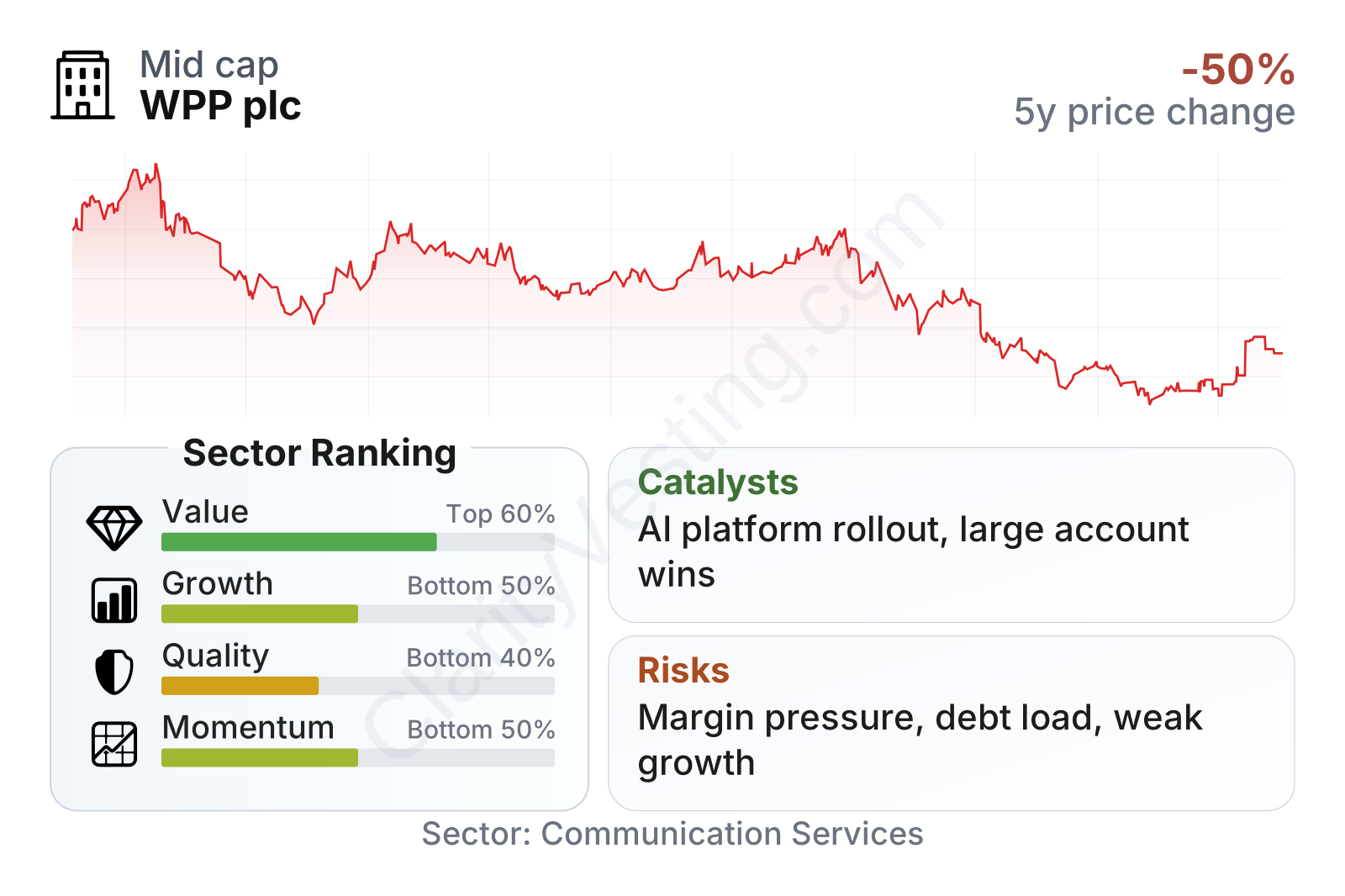
WPP is a large global company, but its market value has fallen sharply from levels seen a few years ago, reflecting weaker growth and lower confidence in traditional agency models. The stock has rebounded strongly over the last six months, yet it still sits well below its 2021 range, which shows how much skepticism remains.
The latest factor profile is mixed. On valuation, WPP screens relatively inexpensive, helped by a very high free cash flow yield and a dividend yield slightly above the sector median. On growth and quality, the picture is weaker: recent revenue growth is negative, profit margins are below the sector median, leverage is somewhat elevated, and interest coverage is thinner than many peers. Momentum has improved recently, but the longer-term share price record remains weak compared with the broader communication services sector.
One important distinction is that cash flow looks stronger than earnings. Free cash flow remains sizable, while reported profit has been pressured by charges and margin pressure. For a business like WPP, that gap can be meaningful because market sentiment often reacts to earnings weakness faster than to underlying cash generation.
Growth
WPP operates in a sector with durable long-term demand, because companies will continue to spend on brand building, customer acquisition, digital content, and media placement. The more attractive part of that sector is not traditional advertising alone, but digitally led marketing services: connected TV, retail media, first-party data activation, AI-assisted content production, performance marketing, and commerce. WPP’s future growth depends on whether it can shift its mix toward those areas fast enough.
Its strategy broadly fits that direction. The group has reorganized around larger, more integrated agency brands, while pushing technology and AI deeper into campaign development and media operations. The launch and expansion of its AI-enabled marketing platform, WPP Open, is a notable strategic move because it aims to improve productivity, speed up creative work, and make the company more relevant to clients looking for personalized campaigns at scale. Partnerships with major technology companies also support that approach.
Another potential growth driver is client consolidation. Large global advertisers often prefer fewer marketing partners that can handle creative, media, data, and commerce across multiple countries. WPP’s global footprint and broad service menu are advantages in that kind of procurement environment. If the company wins larger integrated accounts, the benefit can extend beyond one agency unit into multiple parts of the group.
There is also industry support from healthcare communications, retail media, and commerce-related services, which tend to be more resilient than cyclical brand advertising. WPP has meaningful exposure to those categories. That said, the near-term challenge is clear: sector growth is increasingly going to digital-first specialists, platforms, and consultancies, so WPP must prove that its modernization can translate into sustained organic growth rather than simply operational restructuring.
Risks
This article is for informational purposes only and does not constitute financial advice. Some content is AI-generated. See Disclaimer


