Stock Analysis · Worthington Industries Inc (WOR)
Overview
Worthington Industries, now operating as Worthington Enterprises after major portfolio changes, is an industrial manufacturer best known for pressure cylinders, building products, and consumer and specialty products built around steel and other metals. The company has shifted away from being a broad steel-processing business and today is more focused on higher-value manufactured products. That change matters for long-term analysis because it reduces direct exposure to low-margin commodity processing and puts more weight on branded, engineered, and niche industrial products.
The company’s revenue base is now concentrated in its Consumer Products segment, with Building Products as the second pillar. Based on the latest annual results for the fiscal year ended May 31, 2026, the revenue mix is approximately:
- Consumer Products: about 79% of revenue. This includes cylinders for propane, refrigerants, industrial gases, and related products, along with tools, outdoor living, and specialty consumer offerings.
- Building Products: about 21% of revenue. This includes ceiling suspension systems, architectural grid products, and other metal framing and construction-related products sold into commercial building markets.
That mix shows a business that is no longer primarily dependent on raw steel volume. It is now more exposed to replacement demand, housing and remodeling trends, commercial construction activity, and specialty product niches where design, safety, distribution, and customer relationships matter more than simple metal price spreads.
Over the last several years, revenue dropped sharply after portfolio simplification, then began rebuilding. More recently, sales have recovered while gross profit has improved faster than revenue, suggesting a better business mix than the one the company had before the reshaping of its operations.
The operating picture has become more focused: sales are well below the level seen before the business overhaul, but profitability per dollar of revenue has improved, helped by stronger gross margins and relatively low interest burden.
Key Figures
| Metric | Value | Sector ⓘ |
|---|---|---|
| Date | Oct 17, 2026 | |
| Context | ||
| Sector | Industrials | |
| Industry | Metal Fabrication | |
| Market Cap ⓘ | $3.14B | |
| Beta ⓘ | 1.19 | |
Value (Cheapness) | ||
| P/E Ratio ⓘ | 19.26 | 22.10 |
| P/B Ratio ⓘ | 2.95 | 1.97 |
| FCF Yield ⓘ | 7.51% | 6.38% |
| Dividend Yield ⓘ | 1.23% | 1.94% |
| EBIT / EV ⓘ | 5.63% | 4.79% |
| PEG ⓘ | 1.97 | |
Growth (Business expansion) | ||
| Revenue Growth ⓘ | 13.20% | 9.30% |
| RPS Growth (5Y CAGR) ⓘ | -27.66% | 7.81% |
| EPS Growth (5Y CAGR) ⓘ | -45.29% | -13.06% |
| BVPS Growth (5Y CAGR) ⓘ | -5.66% | 6.14% |
| Margin Growth (5Y Trend) ⓘ | -4.38% | 0.88% |
| FCF Growth (5Y CAGR) ⓘ | N/A | 11.01% |
| DPS Growth (5Y CAGR) ⓘ | -9.53% | 9.48% |
Quality (Business durability) | ||
| ROIC (Latest) ⓘ | N/A | 10.84% |
| ROA (Latest) ⓘ | 9.10% | 5.41% |
| ROIC (5Y Median) ⓘ | 6.07% | 9.38% |
| ROA (5Y Median) ⓘ | 7.03% | 4.95% |
| Net Debt / EBIT (Latest) ⓘ | 1.62 | 2.08 |
| Net Debt / EBIT (5Y Median) ⓘ | 1.48 | 2.27 |
| Net Debt / EBITDA (Latest) ⓘ | 1.22 | 1.39 |
| Net Debt / Assets ⓘ | 15.89% | 19.28% |
| EBITDA / Interest ⓘ | 29.06 | 9.58 |
| Operating Margin (Latest) ⓘ | 12.72% | 10.50% |
| Operating Margin (5Y Median) ⓘ | 10.41% | 10.29% |
| Debt to Equity (Latest) ⓘ | 33.19% | 65.48% |
| Profit Margin (Latest) ⓘ | 11.50% | 6.67% |
| Free Cash Flow (Latest) ⓘ | $235.74M | |
Momentum (Price trend) | ||
| 3Y Return ⓘ | +6.19% | +61.68% |
| 12M Return (excl. last month) ⓘ | -12.17% | +12.58% |
| 6M Return ⓘ | +14.17% | 0.00% |
| Price vs. 200-Day MA ⓘ | +13.19% | +0.02% |
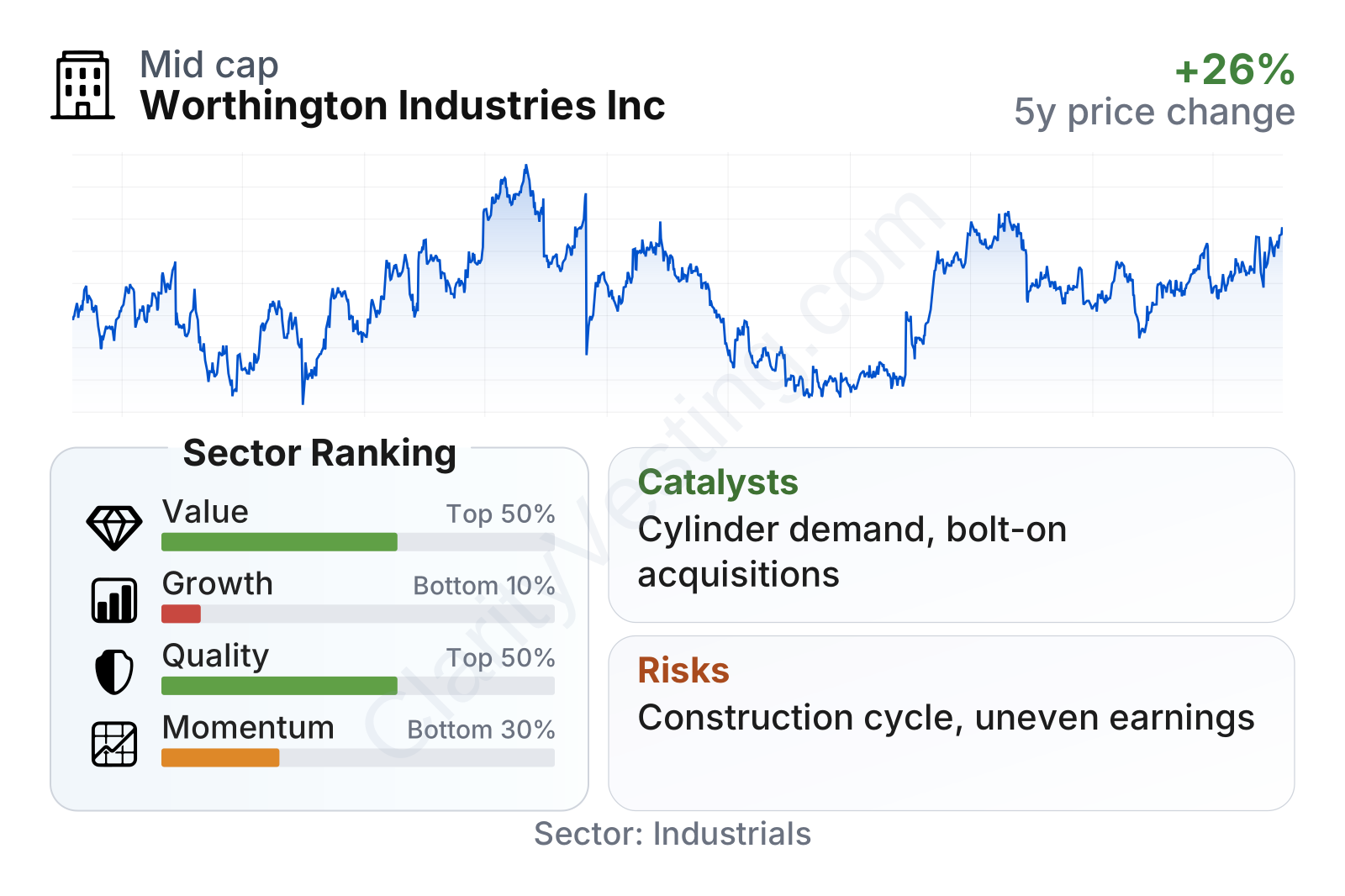
Worthington is a mid-sized industrial company with a stock that has been volatile over the last few years. The share price fell sharply during 2024, then rebounded strongly in 2025 before stabilizing in 2026. That pattern fits a cyclical industrial name rather than a steady compounder.
On core metrics, the company looks mixed but generally solid. Valuation measures place it around the better half of the industrial sector, with a price-to-earnings ratio below the sector median and free cash flow yield above the median. Quality is also respectable: debt levels are moderate, interest coverage is very strong, and current operating and profit margins are above typical sector levels. The weak point is longer-term growth. Recent year-over-year revenue has turned positive again, but five-year trends for revenue per share, earnings per share, and book value remain poor because of the business restructuring and uneven earnings base.
Growth
Worthington operates in markets that are mature rather than explosive, but several of them still have durable demand. Pressure cylinders benefit from recurring replacement cycles, safety standards, refrigerant handling, and industrial gas usage. Building products are tied to commercial construction and renovation, which can be cyclical but also supported by aging building stock and efficiency upgrades. These are not high-growth digital markets, yet they can still produce steady expansion when paired with product innovation and disciplined acquisitions.
The company’s current strategy is easier to understand than its old structure. Management has concentrated the portfolio around categories where Worthington can use manufacturing know-how, distribution relationships, and product engineering rather than chasing commodity volume. That makes strategic sense for future growth because it can support better margins and more predictable cash generation, even if top-line growth is not always smooth.
Revenue momentum has improved meaningfully. After a long stretch of contraction tied to portfolio changes and weaker comparisons, annual sales growth turned positive again and has recently been running in the low-to-mid teens. That is better than the sector median at the moment, showing that the company is no longer shrinking in the way its five-year averages still suggest.
Cash generation remains an important support for the growth case. Free cash flow has been positive and substantial after a weak period earlier in the cycle, although it has not moved in a straight line. For an industrial manufacturer, this matters because internally generated cash can fund bolt-on acquisitions, product development, plant investment, and shareholder returns without forcing a large increase in debt.
A notable catalyst is the company’s acquisition-led expansion in categories close to its existing operations. Worthington has been building out its consumer and specialty product reach, and that can create cross-selling opportunities through established channels. Another positive element is that the simplified company now has less exposure to the lower-margin steel-processing activities that once made results more dependent on commodity conditions.
Recent company communications have also emphasized operational improvement, category focus, and capital deployment into adjacencies rather than unrelated expansion. For a long-term reader, the key opportunity is not a sudden transformation but the possibility that a more focused industrial portfolio can produce better returns than the market historically associated with the old Worthington structure.
Risks
This article is for informational purposes only and does not constitute financial advice. Some content is AI-generated. See Disclaimer


