Stock Analysis · Woodside Petroleum Ltd (WOPEF)
Overview
Woodside Petroleum Ltd, now operating as Woodside Energy in its corporate branding, is a large Australian oil and gas producer with global operations. The company explores for hydrocarbons, develops large energy projects, produces liquefied natural gas (LNG), pipeline gas, crude oil, condensate, and natural gas liquids, and then sells those volumes into domestic and export markets. Its portfolio is centered on Australia, but it also has material interests in the Gulf of Mexico and development-stage projects in other regions.
For long-term readers, the key point is that Woodside is not a small explorer depending on one discovery. It is a scaled producer with existing cash-generating assets, especially in LNG, and with a project pipeline that could materially change production over time. Its business is still clearly tied to commodity prices, but it has more diversification than a single-field operator.
The latest full-year mix is still dominated by LNG and gas-related sales. Based on company reporting by product and portfolio mix, the main revenue sources are approximately:
- LNG: about 50% to 60% of revenue. This includes cargoes sold from major projects such as Pluto, North West Shelf, Wheatstone, and other LNG interests.
- Crude oil and condensate: about 25% to 35%. This reflects liquids production from legacy Australian assets and international operations.
- Pipeline gas and domestic gas: about 10% to 15%. This includes gas supplied into Australian domestic markets.
- Natural gas liquids and other products: generally under 10%. This includes LPG and related hydrocarbon products.
That revenue structure matters because LNG usually drives both earnings quality and strategic positioning. LNG contracts can provide some stability compared with purely spot-exposed producers, while oil-linked pricing can still create large swings in realized prices and cash flow.
The multi-year financial flow also shows how cyclical the company is. Revenue and profit surged in 2022 during the energy price spike, then moderated afterward as prices normalized. Even so, profitability remained solid by sector standards, which suggests Woodside’s asset base still generates meaningful earnings through the cycle.
Over the last few years, the business has shown very high operating leverage: earnings expanded sharply when prices were strong, then pulled back as prices cooled. At the same time, operating costs have remained manageable enough for Woodside to keep relatively healthy margins for a large upstream producer.
Key Figures
| Metric | Value | Sector ⓘ |
|---|---|---|
| Date | Oct 17, 2026 | |
| Context | ||
| Sector | Energy | |
| Industry | Oil & Gas E&P | |
| Market Cap ⓘ | $48.76B | |
| Beta ⓘ | -0.16 | |
Value (Cheapness) | ||
| P/E Ratio ⓘ | 15.48 | 15.44 |
| P/B Ratio ⓘ | 1.44 | 1.73 |
| FCF Yield ⓘ | -2.53% | 8.20% |
| Dividend Yield ⓘ | 5.10% | 3.59% |
| EBIT / EV ⓘ | 15.13% | 7.46% |
| PEG ⓘ | 1.33 | |
Growth (Business expansion) | ||
| Revenue Growth ⓘ | 13.00% | 26.90% |
| RPS Growth (5Y CAGR) ⓘ | -0.55% | 6.90% |
| EPS Growth (5Y CAGR) ⓘ | -46.07% | -15.73% |
| BVPS Growth (5Y CAGR) ⓘ | 4.86% | 6.07% |
| Margin Growth (5Y Trend) ⓘ | -17.97% | 0.58% |
| FCF Growth (5Y CAGR) ⓘ | -11.88% | 1.86% |
| DPS Growth (5Y CAGR) ⓘ | 38.30% | 16.79% |
Quality (Business durability) | ||
| ROIC (Latest) ⓘ | 12.64% | 11.40% |
| ROA (Latest) ⓘ | 9.19% | 6.06% |
| ROIC (5Y Median) ⓘ | 9.27% | 10.30% |
| ROA (5Y Median) ⓘ | 6.13% | 5.42% |
| Net Debt / EBIT (Latest) ⓘ | 1.20 | 1.64 |
| Net Debt / EBIT (5Y Median) ⓘ | 1.39 | 1.83 |
| Net Debt / EBITDA (Latest) ⓘ | 0.51 | 1.08 |
| Net Debt / Assets ⓘ | 13.78% | 17.29% |
| EBITDA / Interest ⓘ | N/A | 9.64 |
| Operating Margin (Latest) ⓘ | 28.12% | 16.27% |
| Operating Margin (5Y Median) ⓘ | 35.69% | 20.39% |
| Debt to Equity (Latest) ⓘ | 37.91% | 54.76% |
| Profit Margin (Latest) ⓘ | 22.21% | 8.82% |
| Free Cash Flow (Latest) ⓘ | -$1.23B | |
Momentum (Price trend) | ||
| 3Y Return ⓘ | +52.27% | +67.38% |
| 12M Return (excl. last month) ⓘ | +61.03% | +49.19% |
| 6M Return ⓘ | +4.14% | +7.07% |
| Price vs. 200-Day MA ⓘ | +40.33% | +9.56% |
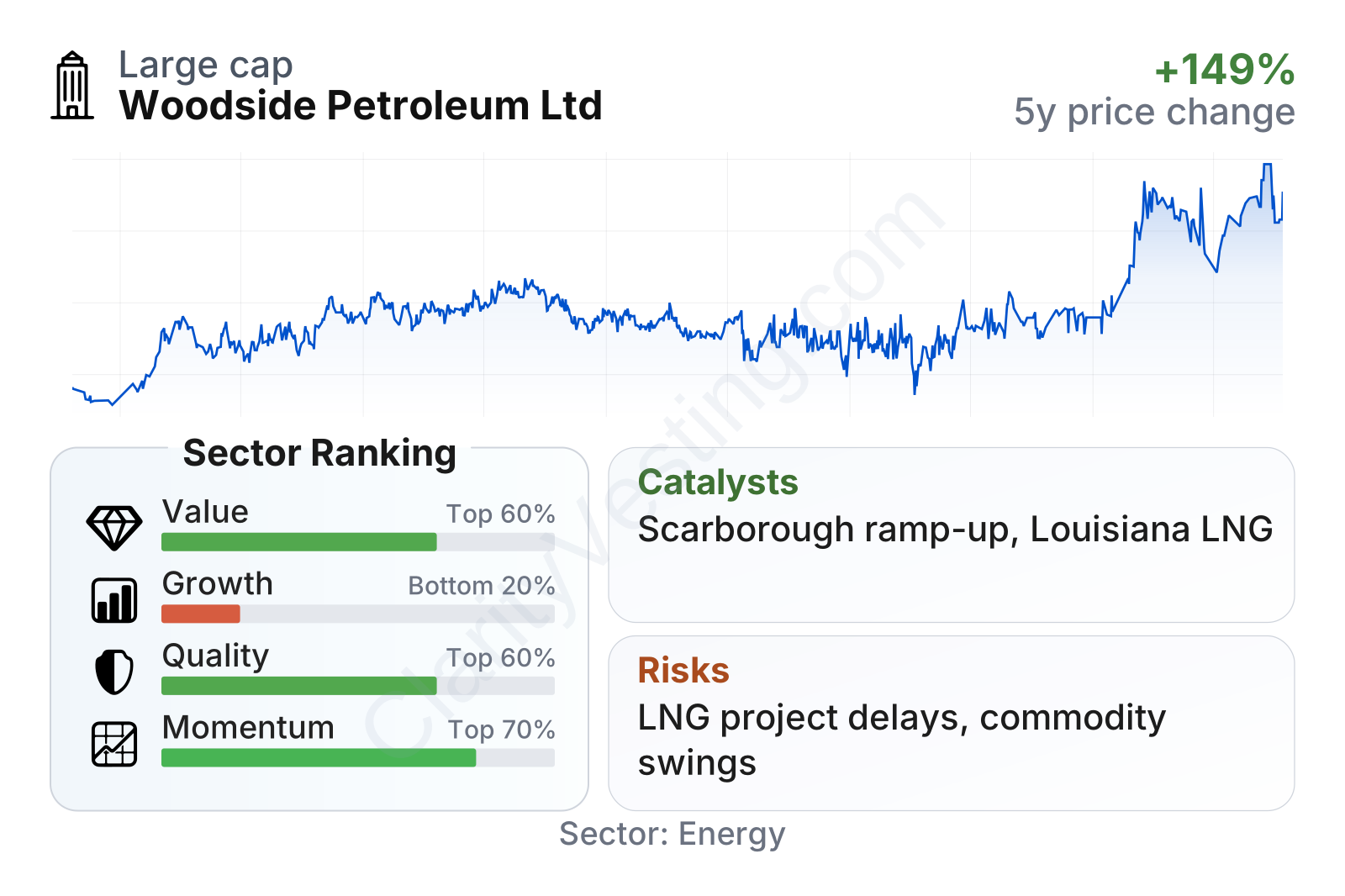
Woodside sits in the large-cap range within the energy sector. The stock’s recent market performance has been strong, with the share price well above its longer-term trend line and recent 6- to 12-month returns ahead of many sector peers. On valuation, the picture is mixed rather than uniformly cheap or expensive: earnings multiples are close to sector norms, book value is somewhat lower than the median, and the dividend yield remains above the sector median. A notable weak point is cash generation over the trailing period, with free cash flow currently negative, which likely reflects heavy capital spending rather than weak accounting profits alone.
On business quality, Woodside compares well with much of the exploration and production group. Returns on assets and invested capital are respectable, leverage is lower than many peers, and operating as well as net margins remain comfortably above sector medians. The weakest area is growth: recent year-over-year revenue growth is positive, but the longer five-year record for revenue per share, earnings, margin trend, and free cash flow has lagged much of the sector.
Growth
Woodside operates in a sector that is mature overall, but some parts of it still offer growth. Oil demand growth is modest and exposed to the long-term energy transition, while LNG remains one of the more resilient fossil-fuel segments because it is used for electricity generation, industrial demand, and energy security. In Asia especially, LNG continues to play an important role as countries balance affordability, emissions, and reliability.
Woodside’s strategy is built around that LNG theme. The company has focused on expanding its LNG platform through both project development and portfolio management. The strongest long-term growth driver is the Louisiana LNG project in the United States, which could give Woodside a major foothold in a globally important export basin. If the project advances on time and within budget, it could materially increase future production, reserve life, and access to customers beyond Australia.
Another important catalyst is the ramp-up and optimization of Scarborough gas and Pluto Train 2 in Australia. These are central projects for the next phase of the company’s production base. Their appeal is straightforward: they are large, long-life assets that can replace declining output elsewhere and strengthen Woodside’s position in LNG, where scale and reliability matter.
Recent growth, however, needs to be read carefully. Near-term revenue expansion exists, but the longer trend has been uneven because commodity prices move much faster than production volumes. In other words, Woodside’s reported growth is influenced not just by selling more energy, but by what the market is willing to pay for it at any given time. That makes project execution more important than short-term top-line momentum.
Recent company updates have also highlighted commercial progress around LNG marketing and project development. For a business like Woodside, signing customers, maintaining partner alignment, and keeping regulatory momentum are often as important as headline production numbers. These developments support the idea that the company is trying to convert its existing scale into a longer runway of cash-generating assets.
Risks
This article is for informational purposes only and does not constitute financial advice. Some content is AI-generated. See Disclaimer


