Stock Analysis · Woolworths Group Limited (WOLWF)
Overview
Woolworths Group Limited is one of the largest food and everyday-needs retailers in Australia and New Zealand. Its core business is selling groceries through supermarkets, but the group also operates discount department stores, liquor retailing, and a fast-growing business-to-business food distribution arm. For long-term analysis, the main point is that Woolworths sits in a defensive part of retail: people keep buying food, household essentials, and basic consumer goods in both strong and weak economic periods.
The company’s revenue base is broad, but it is still clearly centered on food retail. Based on the group’s recent annual reporting structure, the main sources of sales are approximately:
- Australian Food: about 65% to 70% of group sales. This includes Woolworths supermarkets and related food retail activities in Australia.
- BIG W: about 5% to 7% of sales. This is the discount department store chain focused on general merchandise.
- New Zealand Food: about 10% to 12% of sales. This includes the group’s supermarket operations in New Zealand.
- Endeavour Group ownership history: no longer a current operating revenue source after the demerger, so it should not be treated as part of Woolworths’ present sales mix.
- Woolworths MarketPlus and other emerging businesses: a smaller contribution, likely in the low single-digit percentage range, including marketplaces, media, and adjacent retail services.
- Woolworths at Work and PFD-related food distribution exposure: a meaningful but still smaller share than the supermarket division, tied to business customers and wholesale-style supply.
The attraction of this structure is its mix of stable supermarket demand and selected adjacent businesses that can expand margins or open new channels over time. At the same time, the business remains low-margin by nature, which means operational discipline matters a great deal.
The long-term pattern shows a company with steadily rising revenue, moving from roughly $61 billion to more than $71 billion over several years. However, the path from sales to profit is not smooth. Gross profit and operating earnings have not expanded as consistently as revenue, which highlights how sensitive grocery retail can be to pricing pressure, labor costs, supply chain expenses, and competition.
Key Figures
| Metric | Value | Sector ⓘ |
|---|---|---|
| Date | Oct 10, 2026 | |
| Context | ||
| Sector | Consumer Defensive | |
| Industry | Grocery Stores | |
| Market Cap ⓘ | $25.96B | |
| Beta ⓘ | 0.26 | |
Value (Cheapness) | ||
| P/E Ratio ⓘ | 30.00 | 17.64 |
| P/B Ratio ⓘ | 6.74 | 1.27 |
| FCF Yield ⓘ | 17.47% | 12.68% |
| Dividend Yield ⓘ | 4.58% | 2.85% |
| EBIT / EV ⓘ | N/A | 6.32% |
| PEG ⓘ | N/A | |
Growth (Business expansion) | ||
| Revenue Growth ⓘ | 3.80% | 3.85% |
| RPS Growth (5Y CAGR) ⓘ | 4.09% | 6.20% |
| EPS Growth (5Y CAGR) ⓘ | -7.19% | -14.31% |
| BVPS Growth (5Y CAGR) ⓘ | -5.98% | 3.33% |
| Margin Growth (5Y Trend) ⓘ | -0.94% | -0.17% |
| FCF Growth (5Y CAGR) ⓘ | 27.13% | 4.37% |
| DPS Growth (5Y CAGR) ⓘ | -6.69% | 6.68% |
Quality (Business durability) | ||
| ROIC (Latest) ⓘ | N/A | 12.58% |
| ROA (Latest) ⓘ | 6.17% | 6.32% |
| ROIC (5Y Median) ⓘ | 14.15% | 10.38% |
| ROA (5Y Median) ⓘ | 3.35% | 5.44% |
| Net Debt / EBIT (Latest) ⓘ | N/A | 1.92 |
| Net Debt / EBIT (5Y Median) ⓘ | 7.70 | 2.32 |
| Net Debt / EBITDA (Latest) ⓘ | 1.57 | 1.36 |
| Net Debt / Assets ⓘ | 44.04% | 21.29% |
| EBITDA / Interest ⓘ | 5.67 | 9.52 |
| Operating Margin (Latest) ⓘ | N/A | 8.88% |
| Operating Margin (5Y Median) ⓘ | 2.59% | 9.53% |
| Debt to Equity (Latest) ⓘ | 344.11% | 71.95% |
| Profit Margin (Latest) ⓘ | 1.59% | 5.37% |
| Free Cash Flow (Latest) ⓘ | $4.54B | |
Momentum (Price trend) | ||
| 3Y Return ⓘ | +29.06% | +18.12% |
| 12M Return (excl. last month) ⓘ | +92.54% | +2.64% |
| 6M Return ⓘ | +15.50% | +1.32% |
| Price vs. 200-Day MA ⓘ | +25.85% | +0.17% |
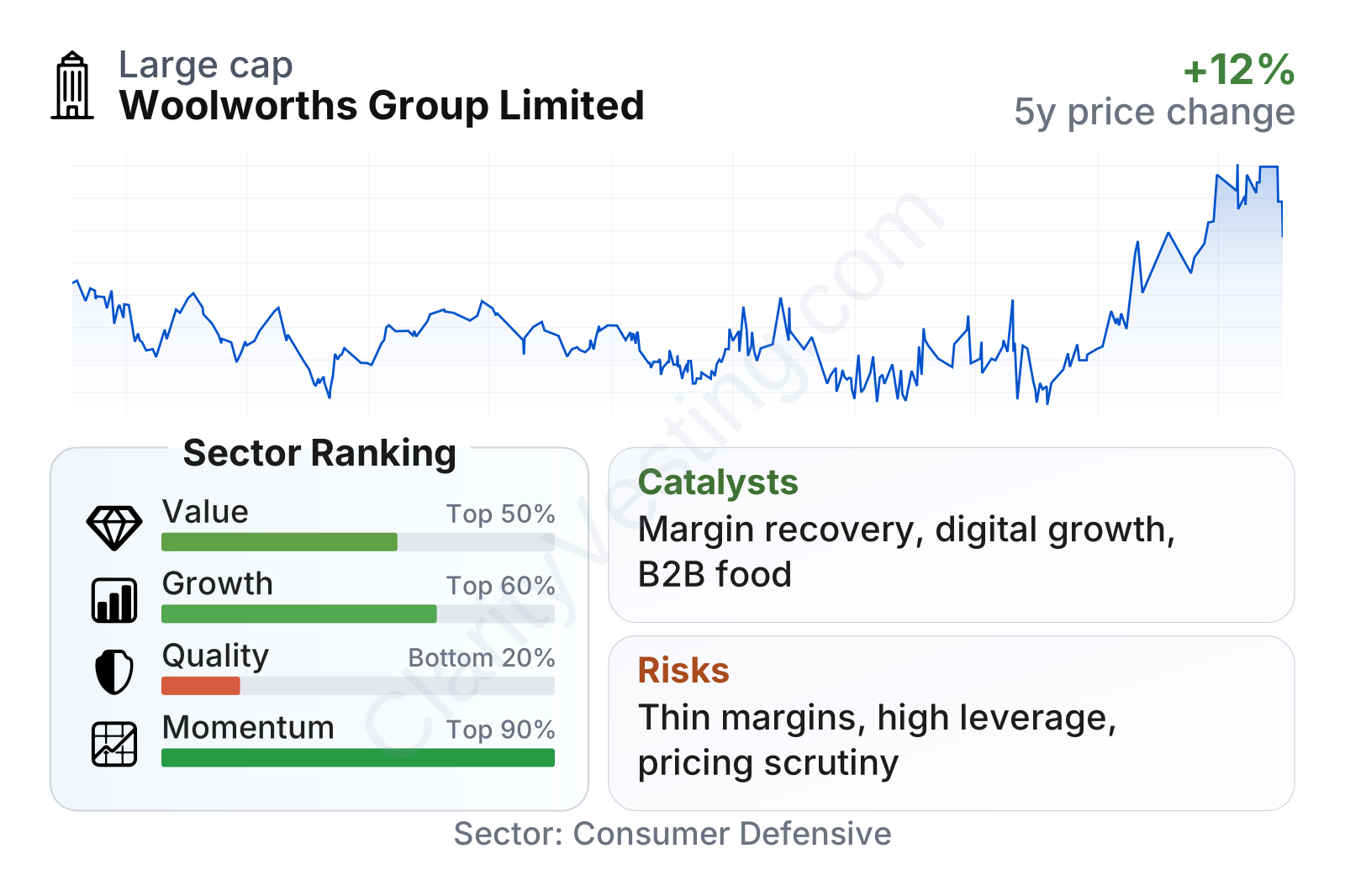
Woolworths is a very large defensive retailer with unusually low share-price volatility, as shown by its beta well below 1. In the factor breakdown, value looks mixed: the dividend yield and free cash flow yield are stronger than many peers, but the earnings multiple and especially the price-to-book multiple are elevated. Growth is moderate rather than exceptional, with revenue expansion around the sector median, while free cash flow has improved much faster than many peers over five years. Quality is the weakest area in the table, mainly because leverage and margins compare poorly with the sector. Momentum is clearly strong, with the stock outperforming many consumer defensive names over recent periods.
Growth
Woolworths operates in a sector that tends to grow steadily rather than explosively. Grocery retail benefits from population growth, food inflation over time, and recurring consumer demand. That makes it a durable sector, but not one that usually produces rapid expansion unless a company gains market share, expands into higher-margin services, or improves productivity.
The group’s strategy broadly makes sense for future growth. Its strongest engine remains the Australian supermarket network, where scale can support pricing, private-label expansion, logistics efficiency, and digital fulfillment. On top of that, management has been building additional growth paths through e-commerce, retail media, marketplace activity, and food services. These areas matter because they can strengthen customer loyalty and, in some cases, carry better economics than traditional grocery sales.
Recent top-line growth appears steady rather than spectacular. That is not unusual for a mature grocery chain. The more important question is whether Woolworths can turn sales growth into cleaner profit growth after the operational disruption seen in the last few years. Revenue has kept rising, but earnings conversion has been less consistent, so future progress depends less on opening a completely new market and more on execution.
Free cash flow is one of the more encouraging parts of the picture. The company has generated strong cash relative to its size, and its five-year free cash flow growth rate stands out positively versus much of the sector. For a business with thin margins, dependable cash generation is important because it supports reinvestment, debt service, and shareholder distributions without needing aggressive assumptions.
As for recent developments, the most significant opportunities are tied to supply chain modernization, digital sales expansion, and the continued development of business-facing food distribution. These are not dramatic one-off catalysts, but they are the kind of operational improvements that can matter meaningfully over a long period in grocery retail. If execution improves, Woolworths has room to recover profit levels more than it has room to radically accelerate revenue.
Risks
This article is for informational purposes only and does not constitute financial advice. Some content is AI-generated. See Disclaimer