Stock Analysis · Wolters Kluwer N.V (WOLTF)
Overview
Wolters Kluwer is a Dutch information-services company that sells software, databases, workflow tools, and expert content to professionals who work in areas where mistakes are costly and rules change often. Its customers include doctors, nurses, hospitals, accountants, tax advisers, lawyers, compliance teams, banks, insurers, and corporate finance departments. The company’s role is not to provide broad consumer media, but to embed specialized knowledge into the daily work of professionals.
The business is organized around five divisions, and the mix shows why the company is usually viewed more like a recurring-software and professional-information provider than a traditional publisher. Based on the latest annual reporting, revenue is spread approximately as follows:
- Health: about 31% of revenue. This includes clinical decision support, medical education, and workflow tools used by physicians, nurses, and health systems, with brands such as UpToDate and Medi-Span.
- Tax & Accounting: about 21%. This division provides tax preparation, compliance, audit, and practice-management software for accounting firms, tax professionals, and small businesses.
- Financial & Corporate Compliance: about 19%. This covers regulatory reporting, compliance software, legal-entity management, and finance, risk, and ESG-related tools for companies and financial institutions.
- Corporate Performance & ESG: about 15%. This unit focuses on enterprise performance management, budgeting, consolidation, reporting, and ESG disclosure solutions, including the CCH Tagetik platform.
- Legal & Regulatory: about 14%. This segment supplies legal research, regulatory intelligence, and workflow products for law firms, corporate legal teams, and government users.
A large share of sales comes from digital subscriptions, cloud software, and recurring contracts, which makes revenue steadier than in advertising-driven or transaction-heavy businesses. Over the last several years, the company has also been shifting further toward expert solutions and away from lower-growth print activities. That shows up in its financial profile: revenue has moved upward from roughly €4.8 billion in 2021 to just above €6.1 billion in 2025, while profitability has remained strong.
The business model is attractive because the content is specialized, embedded in customer workflows, and often linked to regulation or clinical practice. That tends to make switching more difficult and supports pricing power, especially when the product saves time, reduces compliance risk, or improves decision-making.
The long-term pattern is encouraging: revenue and gross profit have expanded steadily since 2021, while operating income has also grown. Research and development spending has increased along the way, suggesting the company is reinvesting to keep its products relevant rather than simply harvesting legacy content.
Key Figures
| Metric | Value | Sector ⓘ |
|---|---|---|
| Date | Oct 31, 2026 | |
| Context | ||
| Sector | Industrials | |
| Industry | Specialty Business Services | |
| Market Cap ⓘ | $21.51B | |
| Beta ⓘ | 0.18 | |
Value (Cheapness) | ||
| P/E Ratio ⓘ | 13.91 | 21.91 |
| P/B Ratio ⓘ | 22.80 | 1.97 |
| FCF Yield ⓘ | 12.93% | 6.34% |
| Dividend Yield ⓘ | 2.78% | 1.88% |
| EBIT / EV ⓘ | N/A | 4.83% |
| PEG ⓘ | 2.19 | |
Growth (Business expansion) | ||
| Revenue Growth ⓘ | -0.60% | 9.50% |
| RPS Growth (5Y CAGR) ⓘ | 9.72% | 7.67% |
| EPS Growth (5Y CAGR) ⓘ | -31.98% | -11.63% |
| BVPS Growth (5Y CAGR) ⓘ | -21.86% | 6.14% |
| Margin Growth (5Y Trend) ⓘ | 2.49% | 0.71% |
| FCF Growth (5Y CAGR) ⓘ | 6.74% | 11.01% |
| DPS Growth (5Y CAGR) ⓘ | 14.25% | 9.31% |
Quality (Business durability) | ||
| ROIC (Latest) ⓘ | 42.59% | 10.70% |
| ROA (Latest) ⓘ | 24.90% | 5.45% |
| ROIC (5Y Median) ⓘ | 20.27% | 9.33% |
| ROA (5Y Median) ⓘ | 11.08% | 4.94% |
| Net Debt / EBIT (Latest) ⓘ | 1.30 | 2.03 |
| Net Debt / EBIT (5Y Median) ⓘ | 2.06 | 2.28 |
| Net Debt / EBITDA (Latest) ⓘ | 0.99 | 1.37 |
| Net Debt / Assets ⓘ | 39.31% | 19.16% |
| EBITDA / Interest ⓘ | 18.27 | 9.73 |
| Operating Margin (Latest) ⓘ | 25.50% | 10.49% |
| Operating Margin (5Y Median) ⓘ | 23.82% | 10.30% |
| Debt to Equity (Latest) ⓘ | 587.66% | 65.91% |
| Profit Margin (Latest) ⓘ | 21.86% | 6.61% |
| Free Cash Flow (Latest) ⓘ | $2.78B | |
Momentum (Price trend) | ||
| 3Y Return ⓘ | -20.17% | +69.18% |
| 12M Return (excl. last month) ⓘ | -39.16% | +12.04% |
| 6M Return ⓘ | +24.70% | +0.22% |
| Price vs. 200-Day MA ⓘ | +26.65% | +0.19% |
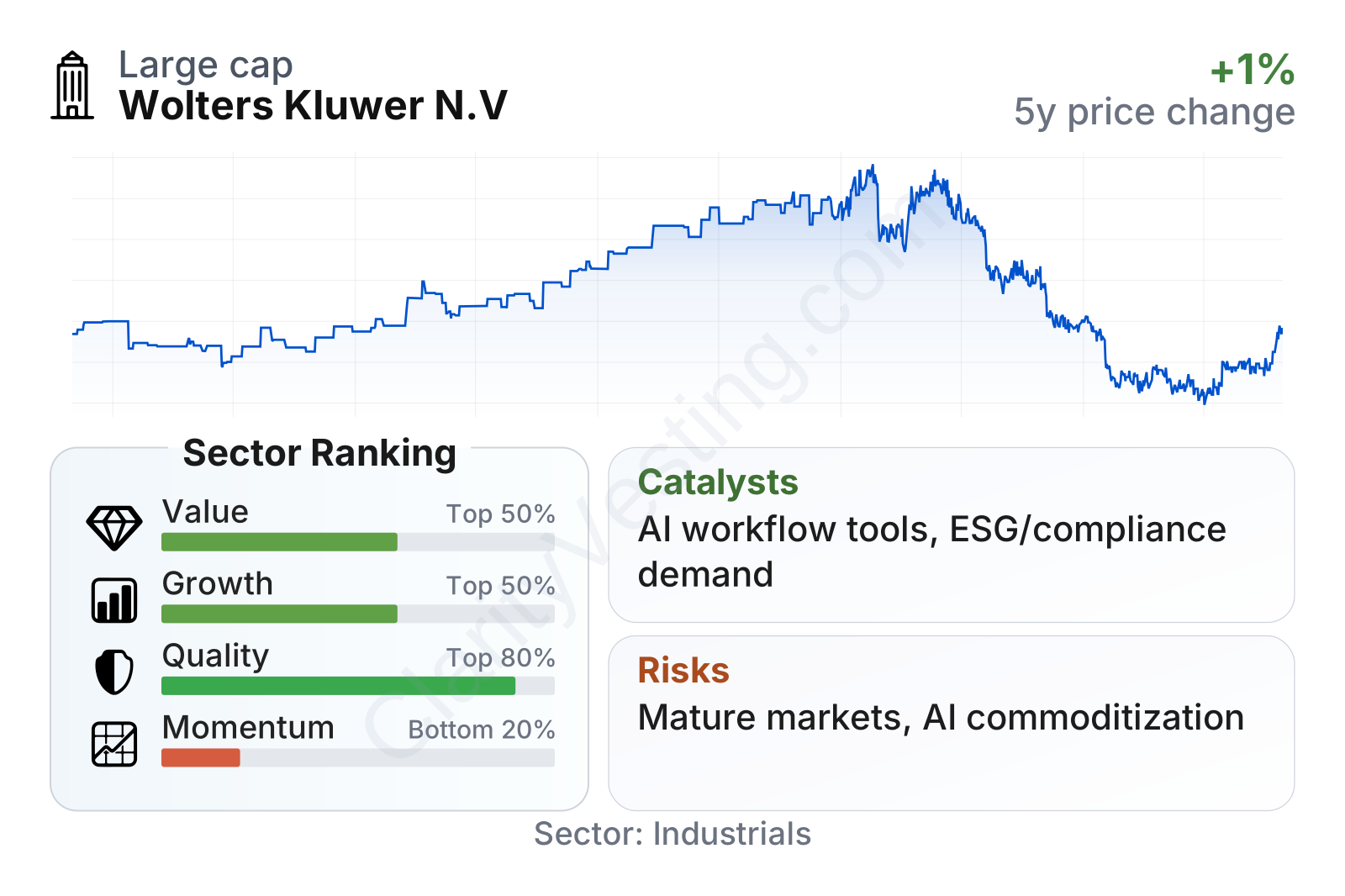
Wolters Kluwer combines a large-company profile with unusually defensive trading characteristics. Its beta is very low, indicating that the shares have historically moved less than the broader market. Profitability is a clear strength: operating margin is around 26% and profit margin is above 20%, both well ahead of the sector median. Returns on capital are also notably high, which is usually a sign of strong pricing, efficient operations, and products that are difficult to replace.
Cash generation also stands out. Free cash flow is strong in absolute terms and the free-cash-flow yield is well above the sector median, while dividend yield is also above the sector norm. Growth metrics are more mixed. The most recent year-over-year revenue change is roughly flat to slightly negative, but the five-year revenue-per-share trend remains solid and margins have improved over time. Share-price momentum has been weak over longer periods, although the more recent six-month trend shows some recovery after a sharp decline.
One figure needs context: debt-to-equity looks extremely high, but for companies with large intangible assets, share repurchases, and accounting effects on equity, that measure can be misleading on its own. Leverage looks more comfortable when measured against earnings, with net debt below 1.0 times EBITDA and interest coverage comfortably above sector levels.
Growth
Wolters Kluwer operates in several areas that have durable structural demand. Healthcare systems need tools that support clinical decisions and drug information. Tax and accounting work continues to become more digital and automated. Financial institutions and corporations face a rising compliance burden, especially in reporting, risk, and ESG disclosure. Legal and regulatory information also becomes more valuable as rules become more complex and more frequently updated.
The company’s strategy fits these trends well. Management has spent years moving the portfolio toward subscription-based software and expert solutions with recurring revenue. This matters because workflow software and decision-support products usually carry better retention and stronger margins than one-time content sales. The company is also investing heavily in product development, including artificial intelligence features designed to improve search, drafting, research, clinical support, and workflow automation.
One of the strongest catalysts is the combination of regulation and automation. In tax, accounting, compliance, and ESG reporting, new rules often force customers to update systems regardless of the economic cycle. In healthcare, clinicians need trusted and current evidence integrated into their workflow, which supports demand for products such as UpToDate. These are not purely optional spending areas.
Another opportunity is cross-selling. Wolters Kluwer already serves customers across finance, compliance, tax, legal, and health. Once a company trusts a vendor for one critical workflow, expanding into adjacent modules can be easier than winning a brand-new account. That can support steady revenue growth without requiring dramatic customer expansion.
Recent company updates have also emphasized continued investment in cloud-based solutions, AI-enabled capabilities, and product-led expansion in corporate performance management and compliance. None of that guarantees fast growth, but it does support the case for gradual expansion in markets where customers value accuracy, auditability, and embedded expertise.
Risks
This article is for informational purposes only and does not constitute financial advice. Some content is AI-generated. See Disclaimer


