Stock Analysis · Weis Markets Inc (WMK)
Overview
Weis Markets is a regional grocery chain in the United States, operating supermarkets, fuel centers, pharmacies, and related food retail services. The company is concentrated in the Mid-Atlantic region, with stores across Pennsylvania and nearby states. Its business is straightforward: it buys food and household goods from suppliers, sells them through its store network, and also earns additional income from pharmacy, prepared foods, and fuel-related activity.
Revenue is overwhelmingly generated by selling groceries and everyday consumer products through its supermarkets. Based on company disclosures, Weis Markets reports its business as a single operating segment, so exact revenue by category is not fully broken out in the same way a diversified company might present separate divisions. Still, the business mix can be described in practical terms:
- Food and grocery products: the largest source of revenue, likely well above 70% of sales. This includes fresh produce, meat, dairy, frozen foods, packaged groceries, and beverages.
- Non-food household items: a meaningful secondary source, likely around 10% to 20% of sales. This includes health and beauty, paper goods, cleaning supplies, seasonal merchandise, and general household products.
- Pharmacy, prepared foods, and other in-store services: a smaller but recurring contribution. This includes prescriptions, deli, bakery, ready-to-eat meals, and related convenience offerings.
- Fuel and other miscellaneous revenue: a small contribution tied to fuel centers and incidental store-related sales.
Over the last several years, sales have generally moved upward, rising from about $4.2 billion in 2021 to nearly $5.0 billion in 2025. That shows a stable demand base, but the more important point is that grocery retail remains a high-volume, low-margin business. Weis Markets converts a large revenue base into a relatively modest level of profit, which is normal for the industry.
The business flow highlights that most revenue is absorbed by merchandise costs and store operating expenses. Gross profit has been fairly stable in dollar terms, but operating income and net income have been more pressured recently as selling and administrative expenses have risen faster than profit.
Key Figures
| Metric | Value | Sector ⓘ |
|---|---|---|
| Date | Oct 03, 2026 | |
| Context | ||
| Sector | Consumer Defensive | |
| Industry | Grocery Stores | |
| Market Cap ⓘ | $1.79B | |
| Beta ⓘ | 0.42 | |
Value (Cheapness) | ||
| P/E Ratio ⓘ | 18.17 | 18.16 |
| P/B Ratio ⓘ | 1.30 | 1.27 |
| FCF Yield ⓘ | 1.42% | 12.39% |
| Dividend Yield ⓘ | 1.87% | 2.83% |
| EBIT / EV ⓘ | 6.62% | 6.45% |
| PEG ⓘ | 1.38 | |
Growth (Business expansion) | ||
| Revenue Growth ⓘ | 4.60% | 3.80% |
| RPS Growth (5Y CAGR) ⓘ | 5.29% | 6.20% |
| EPS Growth (5Y CAGR) ⓘ | -19.70% | -14.64% |
| BVPS Growth (5Y CAGR) ⓘ | 3.80% | 3.26% |
| Margin Growth (5Y Trend) ⓘ | -1.01% | -0.25% |
| FCF Growth (5Y CAGR) ⓘ | -49.75% | 4.65% |
| DPS Growth (5Y CAGR) ⓘ | 2.27% | 6.86% |
Quality (Business durability) | ||
| ROIC (Latest) ⓘ | 6.29% | 12.58% |
| ROA (Latest) ⓘ | 4.80% | 6.35% |
| ROIC (5Y Median) ⓘ | 7.80% | 10.36% |
| ROA (5Y Median) ⓘ | 5.30% | 5.44% |
| Net Debt / EBIT (Latest) ⓘ | 0.24 | 1.91 |
| Net Debt / EBIT (5Y Median) ⓘ | 0.17 | 2.32 |
| Net Debt / EBITDA (Latest) ⓘ | 0.13 | 1.36 |
| Net Debt / Assets ⓘ | 1.32% | 21.25% |
| EBITDA / Interest ⓘ | N/A | 9.61 |
| Operating Margin (Latest) ⓘ | 2.25% | 8.96% |
| Operating Margin (5Y Median) ⓘ | 3.14% | 9.53% |
| Debt to Equity (Latest) ⓘ | 9.41% | 71.66% |
| Profit Margin (Latest) ⓘ | 1.96% | 5.40% |
| Free Cash Flow (Latest) ⓘ | $25.37M | |
Momentum (Price trend) | ||
| 3Y Return ⓘ | +22.53% | +15.25% |
| 12M Return (excl. last month) ⓘ | +1.31% | +2.63% |
| 6M Return ⓘ | +7.00% | +2.43% |
| Price vs. 200-Day MA ⓘ | +2.46% | +0.43% |
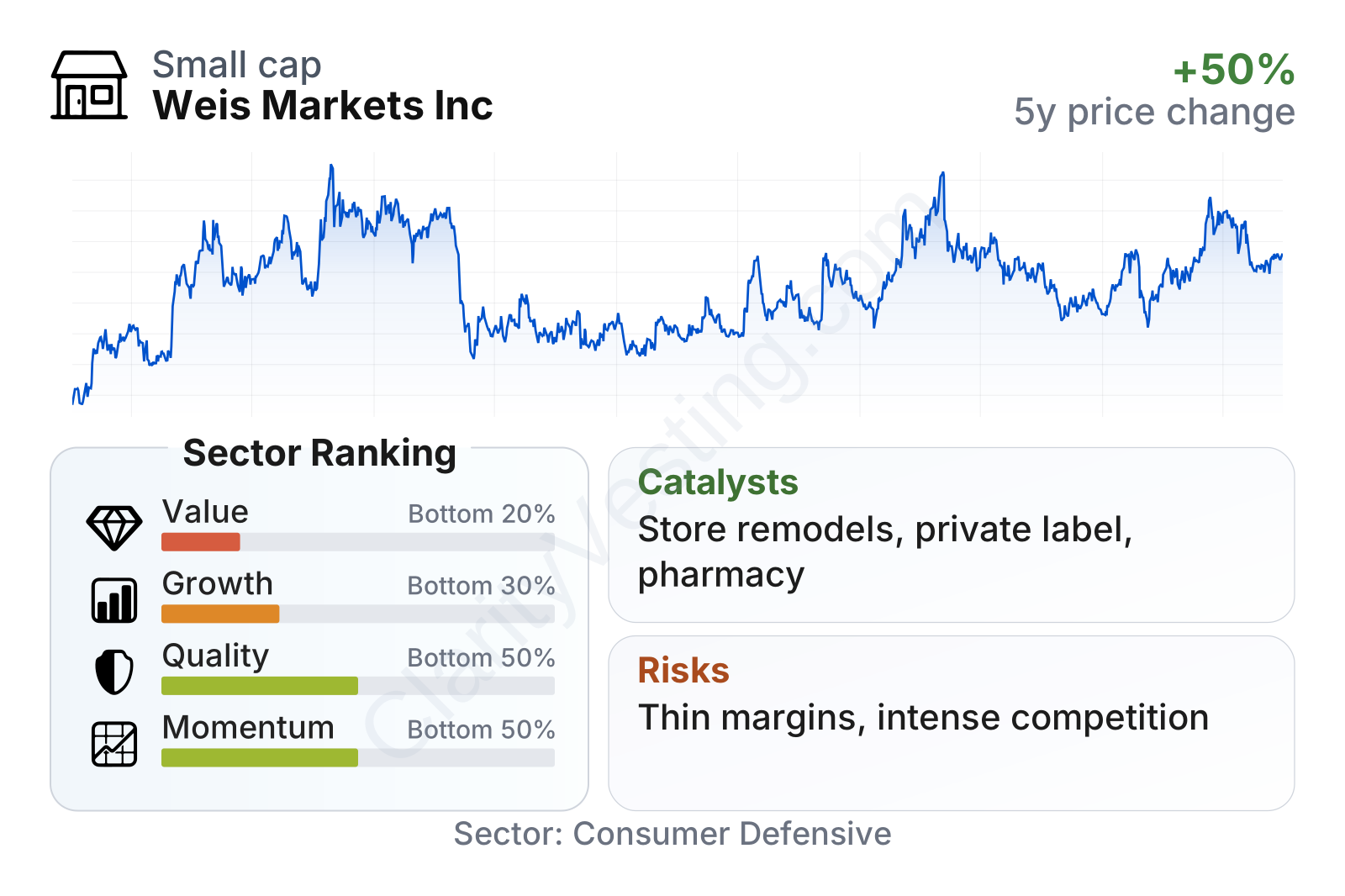
Weis Markets is a small-cap consumer defensive company with a relatively low stock volatility, reflected in a beta of about 0.42. The balance sheet stands out positively, with debt far below the sector median, but the broader profile is mixed. Growth and quality rank in the lower part of the sector because profitability is thin and cash generation has been inconsistent. Valuation multiples are close to sector norms rather than clearly discounted, which matters because the company’s margins and returns on capital trail many peers.
Growth
The grocery sector is not a fast-growth industry, but it is one of the most resilient. People continue buying food in strong and weak economies, which gives supermarket operators a dependable demand base. Long-term growth usually comes from store modernization, market share gains, private-label expansion, pharmacy traffic, prepared meals, digital ordering, and better execution rather than from rapid industry expansion.
Weis Markets’ strategy broadly fits that pattern. The company has continued investing in store upgrades, technology, distribution capabilities, and customer convenience. That approach makes sense for a regional grocer because operational quality can matter as much as store count. A cleaner store base, stronger fresh-food offering, improved digital tools, and better inventory management can help defend sales even without dramatic expansion.
Recent sales growth has been positive again, running in the mid-4% range in the latest periods, which is slightly ahead of the sector median. That is encouraging because it suggests the business is still finding ways to expand revenue despite the mature nature of grocery retail. The longer-term picture is more modest, however, with five-year revenue-per-share growth trailing the broader sector.
Cash generation has been less steady than revenue. Free cash flow moved from healthy positive levels to a negative period and then back to positive territory. That pattern often reflects capital spending swings, working capital needs, and margin pressure. For a grocery chain, this means growth is present, but it is not translating smoothly into surplus cash.
A practical catalyst for Weis Markets is that it operates in a non-discretionary category and has room to improve execution rather than needing a major reinvention. Expansion in own-brand products, continued store remodels, pharmacy services, and digital fulfillment can all support incremental gains. The company has also historically benefited from a conservative financial structure, which gives it flexibility to keep investing when weaker operators become more constrained.
Recent company updates have continued to emphasize capital investment in stores and infrastructure, along with regular shareholder distributions. None of this points to a dramatic transformation, but it does support the view of Weis Markets as a steady operator working on gradual improvement in a necessary industry.
Risks
This article is for informational purposes only and does not constitute financial advice. Some content is AI-generated. See Disclaimer