Stock Analysis · Waste Management Inc (WM)
Overview
Waste Management, now branded as WM, is the largest waste and environmental services company in North America. Its core business is straightforward: it collects trash and recyclable materials from homes, businesses, industrial sites, and public entities, then transports, processes, recycles, or disposes of that material. The company also operates transfer stations, recycling facilities, landfill gas projects, and a growing healthcare waste business.
What makes WM especially important for long-term analysis is that waste collection is not a discretionary activity. Cities, households, restaurants, offices, hospitals, and factories need these services in almost every economic environment. That gives the business a recurring revenue base and allows WM to build dense route networks, long-term municipal contracts, and ownership of disposal assets that are difficult and expensive for rivals to replicate.
Based on the company’s reporting structure in recent filings, WM’s revenue sources can be summarized approximately as follows:
- Collection – about 55% to 60%: pickup services for residential, commercial, industrial, and municipal customers. This is the company’s largest activity and the foundation of its route density and customer relationships.
- Landfill – about 10% to 15%: fees from disposing waste at company-owned landfills. Ownership of these sites is strategically important because permitted landfill capacity is hard to replace.
- Transfer – about 10% to 15%: moving waste from local collection points to disposal or processing sites through transfer stations.
- Recycling processing and sales – about 5% to 10%: sorting recyclables and selling recovered commodities such as paper, cardboard, plastics, and metals. Results here can be more volatile because commodity prices move.
- Other businesses – about 10% to 15%: includes renewable natural gas and landfill-gas-related activities, intermodal and other services, and the recently expanded healthcare waste platform.
Over the last several years, WM has also been increasing its exposure to higher-growth environmental services beyond traditional trash hauling. That matters because it broadens the business from a mature utility-like base into areas tied to sustainability, recycling upgrades, and energy recovery.
The financial flow has been moving in a favorable direction over the past few years: revenue has climbed steadily, operating income has expanded, and net income has also risen over time. The main caution visible in that progression is interest expense, which has increased noticeably and reduces part of the benefit from higher operating profit.
Key Figures
| Metric | Value | Sector ⓘ |
|---|---|---|
| Date | Nov 02, 2026 | |
| Context | ||
| Sector | Industrials | |
| Industry | Waste Management | |
| Market Cap ⓘ | $92.83B | |
| Beta ⓘ | 0.43 | |
Value (Cheapness) | ||
| P/E Ratio ⓘ | 30.64 | 21.83 |
| P/B Ratio ⓘ | 9.46 | 1.99 |
| FCF Yield ⓘ | 4.03% | 6.37% |
| Dividend Yield ⓘ | 1.59% | 1.89% |
| EBIT / EV ⓘ | 4.14% | 4.92% |
| PEG ⓘ | 2.12 | |
Growth (Business expansion) | ||
| Revenue Growth ⓘ | 6.30% | 9.50% |
| RPS Growth (5Y CAGR) ⓘ | 10.12% | 7.67% |
| EPS Growth (5Y CAGR) ⓘ | 1.82% | -10.54% |
| BVPS Growth (5Y CAGR) ⓘ | 10.06% | 6.14% |
| Margin Growth (5Y Trend) ⓘ | 2.08% | 0.71% |
| FCF Growth (5Y CAGR) ⓘ | 3.71% | 11.01% |
| DPS Growth (5Y CAGR) ⓘ | 9.52% | 9.31% |
Quality (Business durability) | ||
| ROIC (Latest) ⓘ | 11.46% | 10.76% |
| ROA (Latest) ⓘ | 6.65% | 5.50% |
| ROIC (5Y Median) ⓘ | 11.65% | 9.33% |
| ROA (5Y Median) ⓘ | 7.10% | 4.94% |
| Net Debt / EBIT (Latest) ⓘ | 4.81 | 2.06 |
| Net Debt / EBIT (5Y Median) ⓘ | 4.90 | 2.28 |
| Net Debt / EBITDA (Latest) ⓘ | 2.92 | 1.39 |
| Net Debt / Assets ⓘ | 49.71% | 19.23% |
| EBITDA / Interest ⓘ | 8.62 | 9.73 |
| Operating Margin (Latest) ⓘ | 18.43% | 10.50% |
| Operating Margin (5Y Median) ⓘ | 17.21% | 10.30% |
| Debt to Equity (Latest) ⓘ | 236.85% | 66.45% |
| Profit Margin (Latest) ⓘ | 11.78% | 6.61% |
| Free Cash Flow (Latest) ⓘ | $3.74B | |
Momentum (Price trend) | ||
| 3Y Return ⓘ | +48.73% | +69.58% |
| 12M Return (excl. last month) ⓘ | -6.12% | +11.43% |
| 6M Return ⓘ | +1.27% | +0.29% |
| Price vs. 200-Day MA ⓘ | +4.33% | +0.41% |
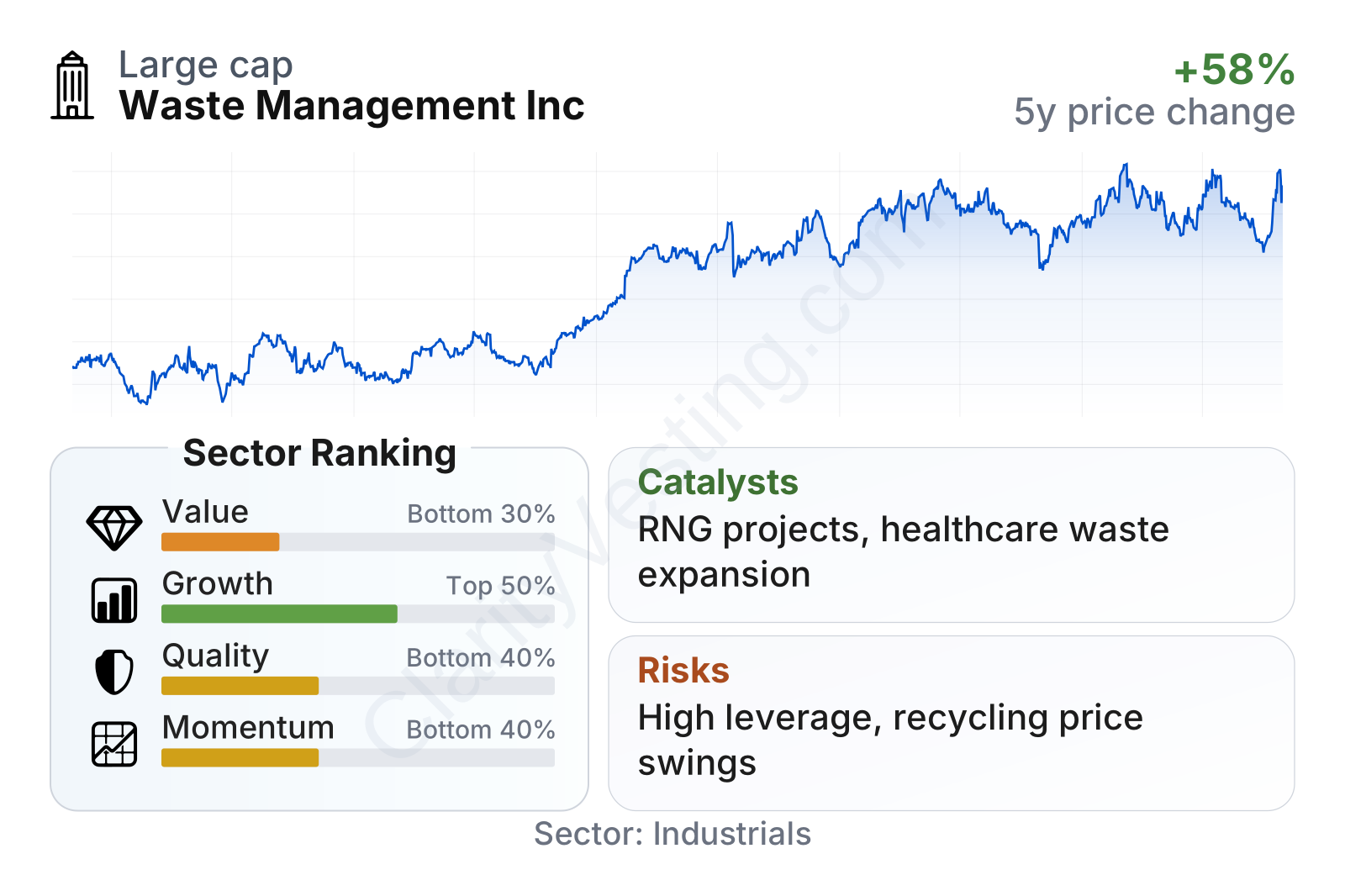
WM is a very large company with unusually low share-price volatility for an industrial business, as reflected by a beta well below 1. The overall profile is mixed but understandable: growth and profitability metrics are generally solid, while valuation looks rich relative to the broader sector and leverage is heavier than average. The company’s margins and returns on capital stand above many peers, but that strength is balanced by a premium price and a debt load that is clearly higher than the sector median.
The stock’s longer-term path has been upward, although not in a straight line. Recent price action shows that the market continues to treat WM as a durable, defensive business rather than a high-cyclicality industrial name.
Growth
Waste management is not a flashy sector, but it benefits from durable demand. Population growth, urbanization, tighter environmental regulation, outsourcing by municipalities and businesses, and the need for modern recycling and disposal infrastructure all support steady long-term activity. In that sense, WM operates in a sector with modest but persistent structural growth rather than boom-and-bust expansion.
WM’s strategy for future growth is logical. The company is using its scale to improve pricing, raise efficiency on collection routes, automate recycling operations, expand renewable natural gas projects at landfill sites, and build out healthcare waste services. Those initiatives matter because they can add revenue streams with better economics than plain volume growth alone.
Revenue growth has slowed from the unusually strong levels seen in earlier periods, but it remains positive. More importantly, WM has shown that it can grow through a combination of pricing, acquisitions, and service expansion rather than relying only on increases in waste volumes. Over five years, revenue per share growth has been stronger than the sector median, which suggests the business has been compounding at a healthy pace even if the latest year-over-year growth rate is not among the fastest in the industry.
Free cash flow has been uneven at times, which is common in a capital-intensive business, but the recent trend shows a meaningful rebound into the multi-billion-dollar range. That is important because free cash flow funds acquisitions, infrastructure investments, dividends, and debt service. WM’s free-cash-flow growth over five years has trailed the sector median, yet the absolute cash generation remains substantial and supports the company’s broader expansion plans.
A notable recent growth driver is the integration of healthcare waste operations following major acquisitions in that niche. This business can offer cross-selling opportunities, tighter customer relationships, and exposure to a specialized market with stricter handling requirements than ordinary solid waste. In parallel, renewable natural gas projects create an additional way to monetize landfill assets that already exist, turning a disposal network into an energy platform as well.
Risks
This article is for informational purposes only and does not constitute financial advice. Some content is AI-generated. See Disclaimer