Stock Analysis · Wilmar International Ltd (WLMIY)
Overview
Wilmar International Ltd is a large agribusiness and food processing company headquartered in Singapore. Its business sits across the full agricultural value chain: sourcing crops, processing them, refining edible oils, manufacturing consumer food products, producing ingredients for food and industrial use, and operating plantations. In simple terms, Wilmar helps move agricultural commodities from farms and ports into cooking oil, flour, sugar, packaged foods, biodiesel, oleochemicals, and feed products used by households and industries.
The company’s revenue base is broad, but edible oils and food products are the core engine. Based on Wilmar’s segment reporting in recent annual disclosures, the main sources of revenue are approximately:
- Food Products: about 50% to 60% of revenue. This includes consumer-pack oils, flour, rice, noodles, sugar, specialty fats, and other branded and industrial food products.
- Feed and Industrial Products: about 30% to 40% of revenue. This covers oilseed crushing, animal feed, oleochemicals, biodiesel, and related industrial applications.
- Plantation and Sugar Milling: about 5% to 10% of revenue. This includes palm plantations, fresh fruit bunches, and milling activities.
- Others and investment activities: a smaller contribution, typically below 5%, depending on the year.
Geographically, China is a major earnings center because of Wilmar’s large food processing and distribution presence there, while Southeast Asia remains important through palm operations and regional consumer brands. The company’s model is built on scale, logistics, refining capacity, and the ability to make money at multiple points in the supply chain rather than depending only on raw commodity prices.
That integrated structure gives Wilmar diversification, but it also means results can look less stable than those of a simple branded food company. Revenue stays very large because the business handles high volumes, yet margins are naturally thin since agricultural processing is capital-intensive and competitive.
The long-term pattern shows a business with massive revenue but limited room for error: cost of goods absorbs most sales, while interest expense has become more meaningful in recent years. Net income has remained positive, but profit conversion from revenue is modest, which is typical for a large commodity-linked processor.
Key Figures
| Metric | Value | Sector ⓘ |
|---|---|---|
| Date | Oct 17, 2026 | |
| Context | ||
| Sector | Consumer Defensive | |
| Industry | Packaged Foods | |
| Market Cap ⓘ | $16.89B | |
| Beta ⓘ | 0.13 | |
Value (Cheapness) | ||
| P/E Ratio ⓘ | 11.86 | 17.88 |
| P/B Ratio ⓘ | 0.89 | 1.29 |
| FCF Yield ⓘ | -0.85% | 12.39% |
| Dividend Yield ⓘ | 4.35% | 2.85% |
| EBIT / EV ⓘ | 7.48% | 6.43% |
| PEG ⓘ | 9.09 | |
Growth (Business expansion) | ||
| Revenue Growth ⓘ | 17.20% | 4.10% |
| RPS Growth (5Y CAGR) ⓘ | 2.04% | 6.18% |
| EPS Growth (5Y CAGR) ⓘ | 2.64% | -13.59% |
| BVPS Growth (5Y CAGR) ⓘ | -1.32% | 3.20% |
| Margin Growth (5Y Trend) ⓘ | -1.55% | -0.15% |
| FCF Growth (5Y CAGR) ⓘ | N/A | 4.10% |
| DPS Growth (5Y CAGR) ⓘ | -8.73% | 6.79% |
Quality (Business durability) | ||
| ROIC (Latest) ⓘ | N/A | 12.34% |
| ROA (Latest) ⓘ | 2.15% | 6.30% |
| ROIC (5Y Median) ⓘ | 4.89% | 10.49% |
| ROA (5Y Median) ⓘ | 2.50% | 5.44% |
| Net Debt / EBIT (Latest) ⓘ | 10.61 | 1.96 |
| Net Debt / EBIT (5Y Median) ⓘ | 8.52 | 2.35 |
| Net Debt / EBITDA (Latest) ⓘ | 6.99 | 1.38 |
| Net Debt / Assets ⓘ | 44.27% | 21.51% |
| EBITDA / Interest ⓘ | N/A | 9.46 |
| Operating Margin (Latest) ⓘ | 3.67% | 8.87% |
| Operating Margin (5Y Median) ⓘ | 4.43% | 9.53% |
| Debt to Equity (Latest) ⓘ | 146.40% | 72.35% |
| Profit Margin (Latest) ⓘ | 1.87% | 5.40% |
| Free Cash Flow (Latest) ⓘ | -$142.96M | |
Momentum (Price trend) | ||
| 3Y Return ⓘ | +19.02% | +20.92% |
| 12M Return (excl. last month) ⓘ | +32.11% | +2.13% |
| 6M Return ⓘ | -7.31% | +1.26% |
| Price vs. 200-Day MA ⓘ | -2.88% | +1.39% |
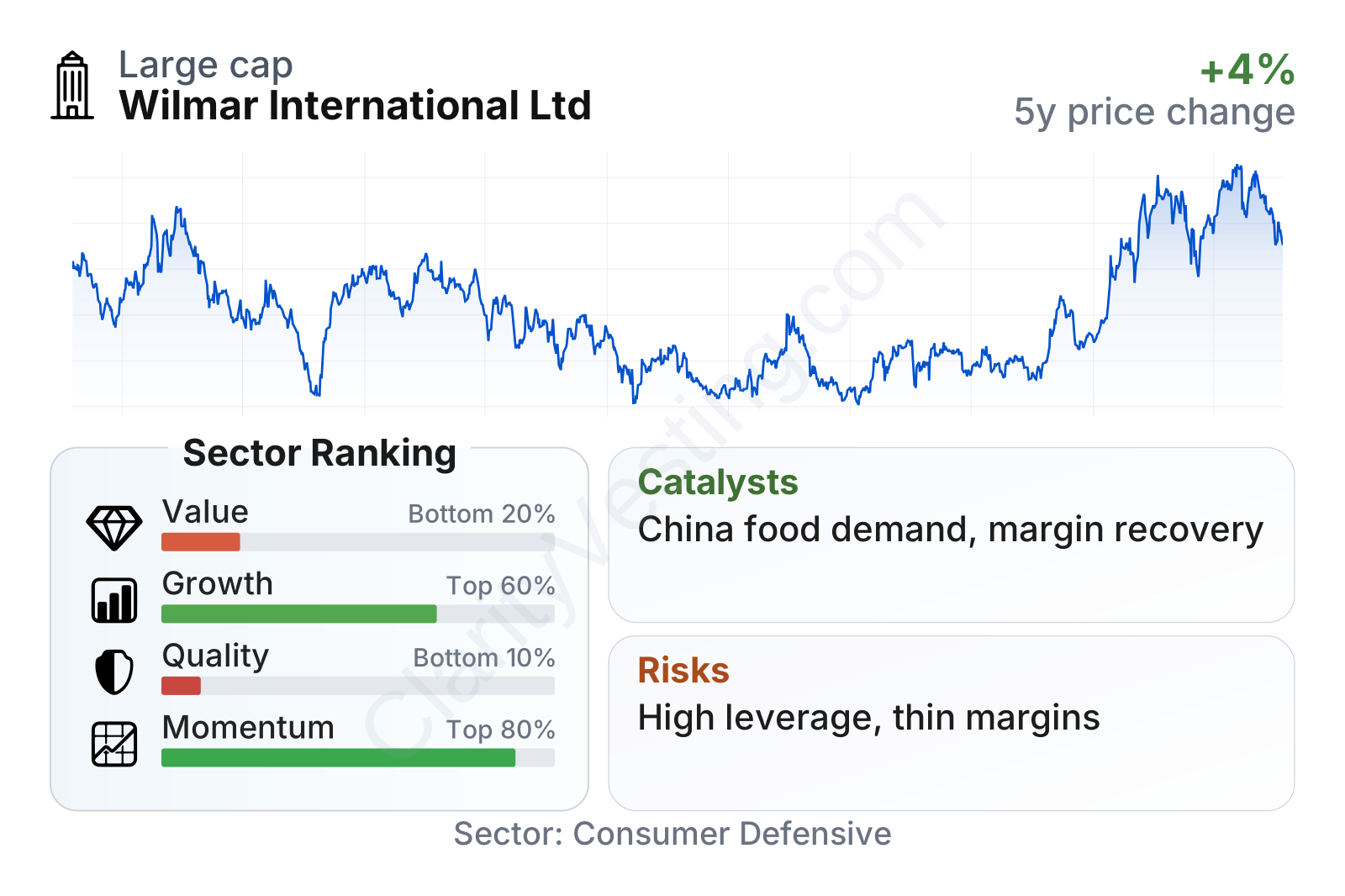
Wilmar is a large-cap consumer defensive name with unusually low share-price volatility, as reflected by a beta close to zero. The valuation profile looks cheaper than much of the sector on earnings and book value, and the dividend yield is above the sector median. The trade-off is that quality metrics are weak: profitability, returns on assets, and leverage are materially less favorable than many peers. Growth is mixed rather than strong across the board, with recent revenue momentum improving but longer-term per-share progress remaining more subdued.
The stock’s multi-year price trend has improved noticeably into 2026 after a long period of sideways movement. That shift suggests the market has started to price in better near-term operating conditions, even though the business still screens as operationally lower quality than the typical packaged food company.
Growth
Wilmar operates in sectors that should remain relevant for a long time: edible oils, staple foods, feed ingredients, and agricultural processing. These are not fast-moving technology markets, but they benefit from durable demand drivers such as population growth, urbanization, protein consumption, and food security priorities across Asia. That gives the company exposure to structural demand rather than a short-lived trend.
The company’s strategy also makes industrial sense. Wilmar has spent years building scale in crushing, refining, distribution, and downstream food products. This matters because the strongest positions in agribusiness often come from logistics networks, port access, processing assets, procurement reach, and customer relationships rather than from one breakthrough product. Its China platform is especially important because it connects imported agricultural commodities to one of the world’s largest end markets for cooking oils, flour, feed, and food ingredients.
Recent revenue growth has turned positive again and is running ahead of the sector median. That does not automatically mean a lasting acceleration, since commodity prices and trading volumes can swing from year to year, but it does indicate that the business has regained some top-line momentum after a more difficult period.
A more cautious point is cash generation. Free cash flow has recently been negative, which reduces the strength of the growth case because expanding volumes are more attractive when they convert cleanly into cash. For Wilmar, working capital swings can be large due to inventory, commodity financing, and trade flows, so cash flow should be watched alongside accounting profit.
As for catalysts, several stand out. First, any improvement in crushing margins, refining margins, and downstream food demand in China can have an outsized effect because Wilmar’s network there is extensive. Second, lower financing pressure would help because interest costs have been a drag on earnings. Third, continued movement toward higher-value consumer and food ingredient products could gradually make the earnings mix more resilient than pure commodity processing.
Recent company communications and annual reporting have also continued to emphasize optimization of downstream businesses, cost discipline, and portfolio management. Those are not dramatic one-off events, but for a company of this size, small operational improvements across a huge asset base can matter meaningfully.
Risks
This article is for informational purposes only and does not constitute financial advice. Some content is AI-generated. See Disclaimer


