Stock Analysis · Westlake Chemical Corporation (WLK)
Overview
Westlake Chemical Corporation, usually referred to as Westlake, is a large U.S.-based chemicals manufacturer. The company turns basic raw materials such as ethane, chlorine, salt, and building-product inputs into plastics, chemicals, and construction materials used in everyday products. Its operations reach packaging, automotive parts, appliances, medical products, wire and cable, pipe, siding, windows, and other residential and commercial building applications.
Westlake reports its business through two main segments. Based on the latest annual filing structure and recent annual revenue mix, the largest source of revenue is the housing and infrastructure-focused materials business, followed by the more cyclical petrochemicals business.
- Housing and Infrastructure Products: approximately 55% to 60% of revenue. This segment includes PVC pipe, fittings, siding, trim, stone, roofing, windows, and related compounds used in residential, municipal, and commercial construction.
- Performance and Essential Materials: approximately 40% to 45% of revenue. This segment includes caustic soda, chlorine, vinyls, PVC resin, polyethylene, styrene, and other basic and intermediate chemicals used across manufacturing and industrial markets.
The mix matters because it gives Westlake a broader profile than a pure commodity chemical producer. Construction products can add stability when petrochemical spreads are weak, while integrated chemicals operations can support margins when feedstock conditions are favorable. At the same time, both segments remain exposed to the economic cycle, energy prices, and demand swings in construction and manufacturing.
Over the last several years, the business has gone from exceptionally strong profits in the 2021-2022 upcycle to much weaker earnings as pricing and margins normalized. Revenue stayed above $11 billion in 2025, but profitability dropped sharply, showing how important price spreads and plant utilization are for this company.
The operating picture shows a clear change in earnings quality: sales have remained substantial, but gross profit and operating income have compressed heavily since the 2022 peak. That shift is the central point to understand with Westlake today: this is still a large, integrated industrial company, but current results are far below mid-cycle levels.
Key Figures
| Metric | Value | Sector ⓘ |
|---|---|---|
| Date | Oct 17, 2026 | |
| Context | ||
| Sector | Basic Materials | |
| Industry | Specialty Chemicals | |
| Market Cap ⓘ | $7.91B | |
| Beta ⓘ | 0.69 | |
Value (Cheapness) | ||
| P/E Ratio ⓘ | N/A | 16.90 |
| P/B Ratio ⓘ | 0.97 | 1.65 |
| FCF Yield ⓘ | -3.35% | 5.76% |
| Dividend Yield ⓘ | 3.43% | 2.13% |
| EBIT / EV ⓘ | -9.89% | 6.30% |
| PEG ⓘ | 1.70 | |
Growth (Business expansion) | ||
| Revenue Growth ⓘ | 10.80% | 11.10% |
| RPS Growth (5Y CAGR) ⓘ | -1.36% | 4.49% |
| EPS Growth (5Y CAGR) ⓘ | -50.62% | -13.47% |
| BVPS Growth (5Y CAGR) ⓘ | 2.90% | 5.51% |
| Margin Growth (5Y Trend) ⓘ | -37.08% | -1.54% |
| FCF Growth (5Y CAGR) ⓘ | N/A | 0.37% |
| DPS Growth (5Y CAGR) ⓘ | 16.98% | 6.08% |
Quality (Business durability) | ||
| ROIC (Latest) ⓘ | -6.96% | 9.26% |
| ROA (Latest) ⓘ | -6.29% | 4.91% |
| ROIC (5Y Median) ⓘ | 5.01% | 7.70% |
| ROA (5Y Median) ⓘ | 2.88% | 3.86% |
| Net Debt / EBIT (Latest) ⓘ | N/A | 1.40 |
| Net Debt / EBIT (5Y Median) ⓘ | 1.73 | 1.70 |
| Net Debt / EBITDA (Latest) ⓘ | N/A | 0.95 |
| Net Debt / Assets ⓘ | 21.12% | 13.69% |
| EBITDA / Interest ⓘ | N/A | 12.34 |
| Operating Margin (Latest) ⓘ | -11.22% | 13.20% |
| Operating Margin (5Y Median) ⓘ | 9.03% | 11.80% |
| Debt to Equity (Latest) ⓘ | 66.03% | 40.56% |
| Profit Margin (Latest) ⓘ | -10.94% | 6.43% |
| Free Cash Flow (Latest) ⓘ | -$265.00M | |
Momentum (Price trend) | ||
| 3Y Return ⓘ | -45.30% | +68.89% |
| 12M Return (excl. last month) ⓘ | -19.63% | +30.21% |
| 6M Return ⓘ | -46.56% | -4.16% |
| Price vs. 200-Day MA ⓘ | -28.41% | -1.27% |
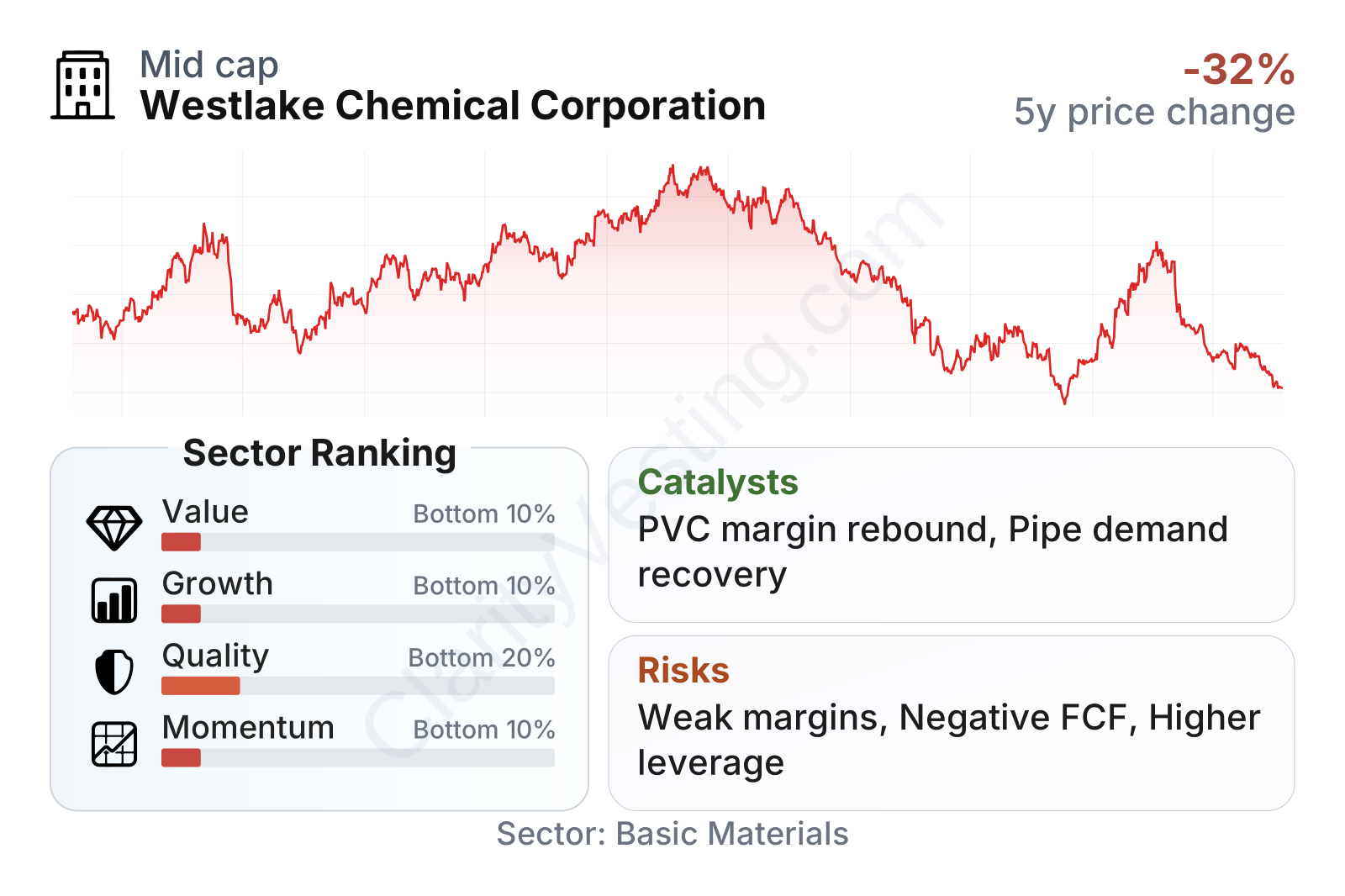
Westlake is a large-cap chemicals company with a market value in the high single-digit billions and a relatively low beta of about 0.63, which suggests the stock has historically moved less than the broader market. That said, lower beta does not mean lower business volatility. The table points to a company that looks inexpensive on book value, with a price-to-book ratio below the sector median, but that apparent cheapness is offset by weak current profitability and negative free cash flow.
The broader pattern is mixed. Dividend yield is above the sector median, which can help signal balance-sheet resilience and management’s willingness to keep returning cash. However, value, growth, quality, and momentum all rank near the bottom of the sector at the moment. In simple terms, the market is not assigning a premium because recent operating performance has been weak, earnings quality has deteriorated, and the share price trend has lagged peers.
The stock-price history also reflects this volatility. Westlake climbed strongly into 2024, then gave back a large portion of those gains through 2025 and remained uneven in 2026. That kind of movement is common in cyclical chemicals businesses, where earnings can change much faster than revenue.
Growth
Westlake operates in sectors that have credible long-term demand drivers, but they are not straight-line growth markets. PVC, building materials, pipe, chlor-alkali products, and polyethylene benefit from population growth, infrastructure renewal, water systems investment, industrial production, and housing activity. In other words, demand can expand over time, but the path is often uneven because these products are tightly linked to construction cycles, manufacturing activity, and global supply additions.
Its strategy for future growth is logical. Westlake has spent years building vertical integration across feedstocks, chlor-alkali, vinyls, and finished building products. That matters because integrated producers can often defend margins better than stand-alone commodity manufacturers. The company also has meaningful exposure to North American building and infrastructure products, which are generally more differentiated than bulk chemicals and can carry better through-cycle economics.
Recent revenue trends show how uneven the environment has been. After very strong growth in 2021 and much of 2022, the company moved into a long period of declines, followed by a return to positive year-over-year growth in the latest period. That rebound is encouraging as a signal that volumes or pricing may be stabilizing, but one quarter alone does not erase the broader slowdown seen over the last several years.
Cash generation has weakened more sharply than revenue. Free cash flow was strongly positive earlier in the cycle, then faded and recently turned negative. For a capital-intensive company, this is important: long-term growth is more attractive when expansion, maintenance spending, and shareholder returns are supported by internally generated cash. Westlake still has strategic assets, but the near-term growth profile depends on a recovery in margins and cash generation rather than simple sales expansion.
A meaningful catalyst is the company’s leverage to any recovery in housing-related demand, municipal pipe spending, and chlor-alkali/vinyl margins. If construction activity improves while feedstock costs remain manageable, earnings can recover faster than revenue because of operating leverage. Another potential opportunity comes from U.S. infrastructure and water-system replacement needs, which support pipe and building-products demand over multiple years rather than only in a single season.
Recent company communications have also continued to emphasize disciplined capital allocation, integration advantages, and the importance of downstream products. That approach makes strategic sense in a cyclical industry: the more Westlake can shift mix toward branded or specification-driven building products, the less dependent it becomes on pure commodity pricing.
Risks
This article is for informational purposes only and does not constitute financial advice. Some content is AI-generated. See Disclaimer


