Stock Analysis · Wilh. Wilhelmsen (WLHSF)
Overview
Wilh. Wilhelmsen is a Norway-based maritime group with a long operating history and a business model that goes well beyond simply owning ships. The company combines maritime services, ship management, product distribution, and strategic investments tied to global shipping and vehicle logistics. That mix matters because it gives the group exposure to world trade while also reducing dependence on a single shipping niche.
The company’s revenue mainly comes from maritime services and operating activities, while a meaningful share of earnings can also come from associates and joint ventures. Based on recent annual reporting, the main business sources can be summarized as follows:
- Maritime services and products: approximately 55% to 65% of revenue. This includes ship agency services, marine products, logistics support, and port-related services provided to vessel owners and operators worldwide.
- Ship management and technical services: approximately 15% to 25% of revenue. This covers crewing, technical management, and related operating support for ships.
- Investments and associates linked to shipping logistics: approximately 10% to 20% of earnings contribution, though this portion is more important for profit than for reported revenue. This includes stakes in large maritime and vehicle logistics businesses.
- Other strategic maritime activities: usually a smaller share, generally below 10% of revenue, including innovation and adjacent marine operations.
For a simple long-term view, the key point is that Wilh. Wilhelmsen is not a pure freight-rate bet. It has operating businesses that serve ships globally, plus investment exposure to shipping segments that can add substantial earnings when market conditions are favorable.
The business mix has been supported by a clear improvement in scale over the last several years. Revenue has moved from under $900 million in 2021 to above $1.2 billion in 2025, while net income expanded much faster than sales. That suggests the group has benefited not only from growth, but also from stronger profitability and contributions from high-margin activities.
Key Figures
| Metric | Value | Sector ⓘ |
|---|---|---|
| Date | Oct 17, 2026 | |
| Context | ||
| Sector | Industrials | |
| Industry | Marine Shipping | |
| Market Cap ⓘ | $3.36B | |
| Beta ⓘ | 0.74 | |
Value (Cheapness) | ||
| P/E Ratio ⓘ | 6.46 | 22.10 |
| P/B Ratio ⓘ | 0.95 | 1.97 |
| FCF Yield ⓘ | 2.23% | 6.38% |
| Dividend Yield ⓘ | 3.49% | 1.94% |
| EBIT / EV ⓘ | 20.11% | 4.79% |
| PEG ⓘ | N/A | |
Growth (Business expansion) | ||
| Revenue Growth ⓘ | 0.90% | 9.30% |
| RPS Growth (5Y CAGR) ⓘ | 10.76% | 7.81% |
| EPS Growth (5Y CAGR) ⓘ | 71.81% | -13.06% |
| BVPS Growth (5Y CAGR) ⓘ | 11.66% | 6.14% |
| Margin Growth (5Y Trend) ⓘ | 10.70% | 0.88% |
| FCF Growth (5Y CAGR) ⓘ | 16.33% | 11.01% |
| DPS Growth (5Y CAGR) ⓘ | 11.05% | 9.48% |
Quality (Business durability) | ||
| ROIC (Latest) ⓘ | 15.74% | 10.84% |
| ROA (Latest) ⓘ | 14.14% | 5.41% |
| ROIC (5Y Median) ⓘ | N/A | 9.38% |
| ROA (5Y Median) ⓘ | 12.52% | 4.95% |
| Net Debt / EBIT (Latest) ⓘ | 0.04 | 2.08 |
| Net Debt / EBIT (5Y Median) ⓘ | 0.36 | 2.27 |
| Net Debt / EBITDA (Latest) ⓘ | 0.04 | 1.39 |
| Net Debt / Assets ⓘ | 0.66% | 19.28% |
| EBITDA / Interest ⓘ | 30.88 | 9.58 |
| Operating Margin (Latest) ⓘ | 57.81% | 10.50% |
| Operating Margin (5Y Median) ⓘ | 52.11% | 10.29% |
| Debt to Equity (Latest) ⓘ | N/A | 65.48% |
| Profit Margin (Latest) ⓘ | 42.27% | 6.67% |
| Free Cash Flow (Latest) ⓘ | $75.00M | |
Momentum (Price trend) | ||
| 3Y Return ⓘ | +406.67% | +61.68% |
| 12M Return (excl. last month) ⓘ | +173.62% | +12.58% |
| 6M Return ⓘ | +166.89% | 0.00% |
| Price vs. 200-Day MA ⓘ | +52.77% | +0.02% |
Wilh. Wilhelmsen stands out on profitability, balance-sheet strength, and market performance relative to much of the industrials universe. Returns on capital and assets are well above sector medians, leverage is very low, and interest coverage is strong. The main weaker point in the current snapshot is that recent revenue growth has slowed versus the sector, while free cash flow yield is not as strong as the low earnings multiple might suggest.
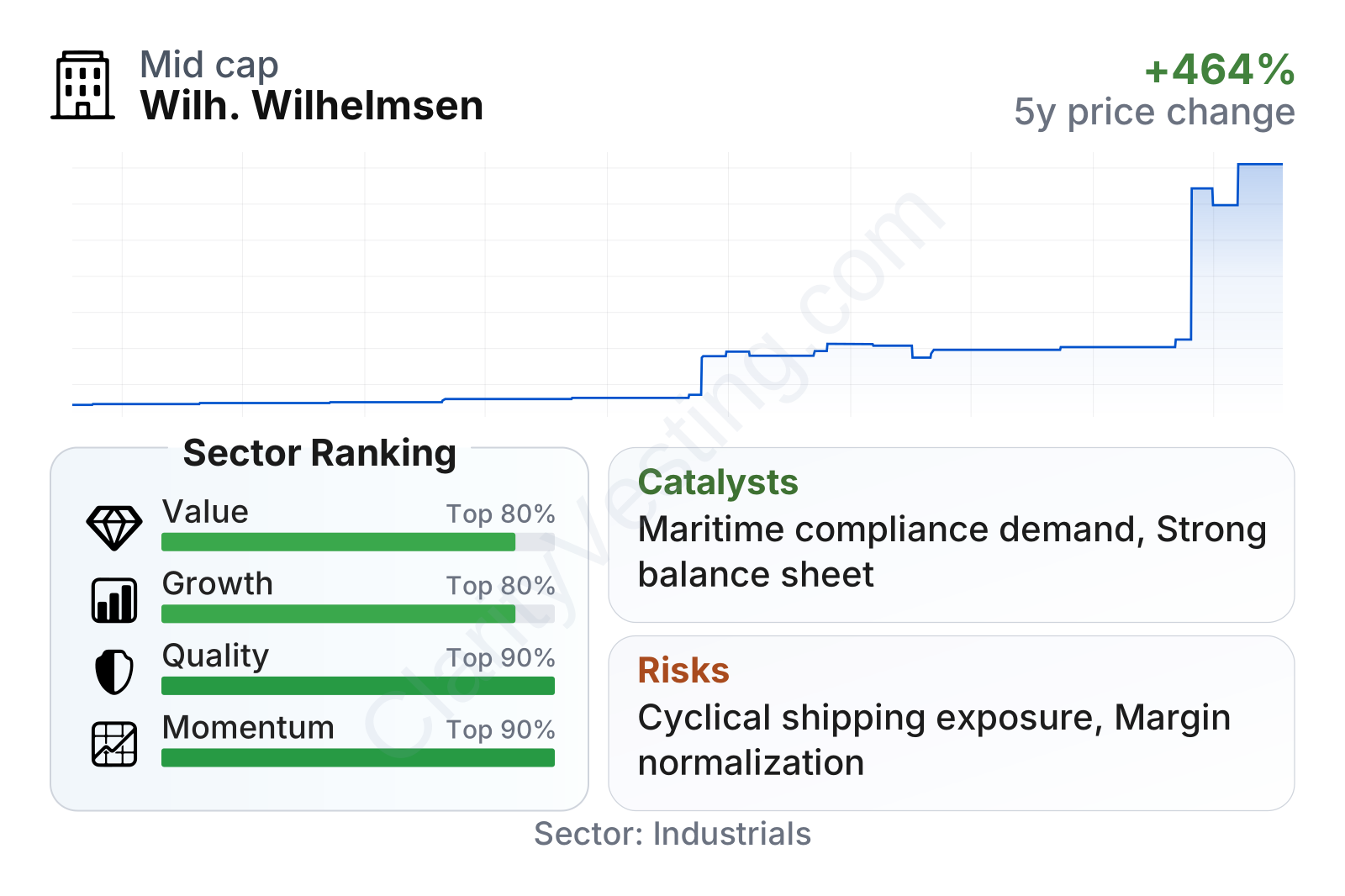
The stock has also had a sharp re-rating. After moving gradually for much of 2021 through early 2024, it accelerated significantly from mid-2024 into 2026. That kind of move often means the market has started to recognize stronger earnings quality, but it also means expectations are no longer as subdued as they were before.
Growth
Wilh. Wilhelmsen operates in a sector with long-term structural support from global trade, fleet complexity, offshore and port-service needs, and tighter environmental standards. Shipping itself can be cyclical, but maritime services tend to be more durable because ships still need agency support, technical assistance, spare parts, compliance work, and crew-related services whether freight rates are booming or cooling.
The company’s strategy appears coherent for long-term expansion because it is built around maritime infrastructure rather than a single vessel market. A broad service network, established relationships with shipowners, and exposure to recurring operational needs can create steadier growth than a pure ship-owning model. On top of that, strategic investments in related logistics businesses give the group another path to earnings growth when those markets are strong.
Recent top-line momentum has remained positive, but the pace has moderated. Revenue growth was stronger through much of 2024 and 2025, then eased to low-single-digit levels in the most recent periods. For a long-term reader, that suggests the company is still growing, but likely from a higher base and in a more normal operating environment.
Cash generation has softened from earlier levels, which is worth watching, but the broader multiyear trend is still constructive. Over five years, the company has delivered double-digit growth in revenue per share, book value per share, free cash flow, and dividend per share. That combination points to a business that has compounded value over time rather than relying only on short bursts of market strength.
A meaningful catalyst is the maritime industry’s rising need for efficiency and compliance support. New environmental regulations, digital vessel operations, and more demanding fleet-management requirements can favor companies with global service networks and technical capabilities. Wilh. Wilhelmsen is positioned in exactly those areas. Another favorable element is its very strong balance sheet, which gives the group room to invest, acquire, or return capital without the pressure that heavily indebted shipping firms often face.
Recent company communications have also continued to emphasize operational development, portfolio discipline, and shareholder distributions, reinforcing the view that management is operating from a position of financial strength rather than repair.
Risks
This article is for informational purposes only and does not constitute financial advice. Some content is AI-generated. See Disclaimer


