Stock Analysis · Demant A/S (WILYY)
Overview
Demant A/S is a Danish hearing healthcare company focused on products and services for people with hearing loss. Its business spans hearing aids, hearing care clinics, diagnostic equipment used by hearing professionals, and communication headsets for gaming and office use. The group is best known for brands such as Oticon, Bernafon, Sonic, Philips Hearing Solutions, and its hearing care network under HearingLife and other local clinic brands.
The company’s revenue is mainly generated from hearing-related products and services, with one smaller segment exposed to headsets and communications equipment. Based on Demant’s recent annual reporting structure, the main revenue streams are approximately:
- Hearing Aids – about 55% to 60%: hearing aids and related fitting solutions sold through hearing care professionals and distribution partners. This is the core business and includes the main premium brands.
- Hearing Care – about 20% to 25%: sales generated through Demant’s owned hearing clinics, where the company provides hearing tests, fitting, follow-up care, and hearing aid sales directly to users.
- Diagnostics – about 10% to 15%: audiometers, middle-ear analyzers, hearing screening tools, and software used by clinics, hospitals, and hearing specialists.
- Communications – about 5% to 10%: headsets and audio equipment, primarily through the EPOS business exposure, serving enterprise and gaming markets.
This mix gives Demant both product revenue and recurring service exposure through its clinic network. It also reduces dependence on a single channel, since the company participates both in manufacturing and in direct hearing care delivery.
The financial flow over recent years shows a business with strong gross profitability and meaningful spending on research and development, which is important in hearing technology. Revenue has broadly expanded since 2021, although net income has been more uneven because financing costs and margin pressure have at times offset operating progress.
Key Figures
| Metric | Value | Sector ⓘ |
|---|---|---|
| Date | Oct 24, 2026 | |
| Context | ||
| Sector | Healthcare | |
| Industry | Medical Devices | |
| Market Cap ⓘ | $11.85B | |
| Beta ⓘ | 0.70 | |
Value (Cheapness) | ||
| P/E Ratio ⓘ | 31.22 | 25.42 |
| P/B Ratio ⓘ | 1.03 | 3.08 |
| FCF Yield ⓘ | 59.51% | 3.12% |
| Dividend Yield ⓘ | N/A | 1.85% |
| EBIT / EV ⓘ | N/A | 0.56% |
| PEG ⓘ | 1.37 | |
Growth (Business expansion) | ||
| Revenue Growth ⓘ | 14.80% | 7.50% |
| RPS Growth (5Y CAGR) ⓘ | 9.27% | 8.60% |
| EPS Growth (5Y CAGR) ⓘ | 39.39% | -17.73% |
| BVPS Growth (5Y CAGR) ⓘ | 8.00% | 3.72% |
| Margin Growth (5Y Trend) ⓘ | -2.08% | -0.57% |
| FCF Growth (5Y CAGR) ⓘ | 5.60% | 0.96% |
| DPS Growth (5Y CAGR) ⓘ | N/A | 6.69% |
Quality (Business durability) | ||
| ROIC (Latest) ⓘ | 25.90% | 3.17% |
| ROA (Latest) ⓘ | 10.87% | 2.98% |
| ROIC (5Y Median) ⓘ | 14.12% | 4.56% |
| ROA (5Y Median) ⓘ | 7.58% | 1.87% |
| Net Debt / EBIT (Latest) ⓘ | 2.21 | 1.34 |
| Net Debt / EBIT (5Y Median) ⓘ | 3.90 | 1.86 |
| Net Debt / EBITDA (Latest) ⓘ | 1.62 | 1.00 |
| Net Debt / Assets ⓘ | 46.94% | 5.06% |
| EBITDA / Interest ⓘ | 7.82 | 9.55 |
| Operating Margin (Latest) ⓘ | 17.86% | 9.25% |
| Operating Margin (5Y Median) ⓘ | 19.10% | 7.33% |
| Debt to Equity (Latest) ⓘ | 180.43% | 26.68% |
| Profit Margin (Latest) ⓘ | 6.55% | 3.34% |
| Free Cash Flow (Latest) ⓘ | $7.05B | |
Momentum (Price trend) | ||
| 3Y Return ⓘ | +34.15% | +51.61% |
| 12M Return (excl. last month) ⓘ | +28.78% | +19.90% |
| 6M Return ⓘ | +60.63% | +10.10% |
| Price vs. 200-Day MA ⓘ | +44.82% | +6.44% |
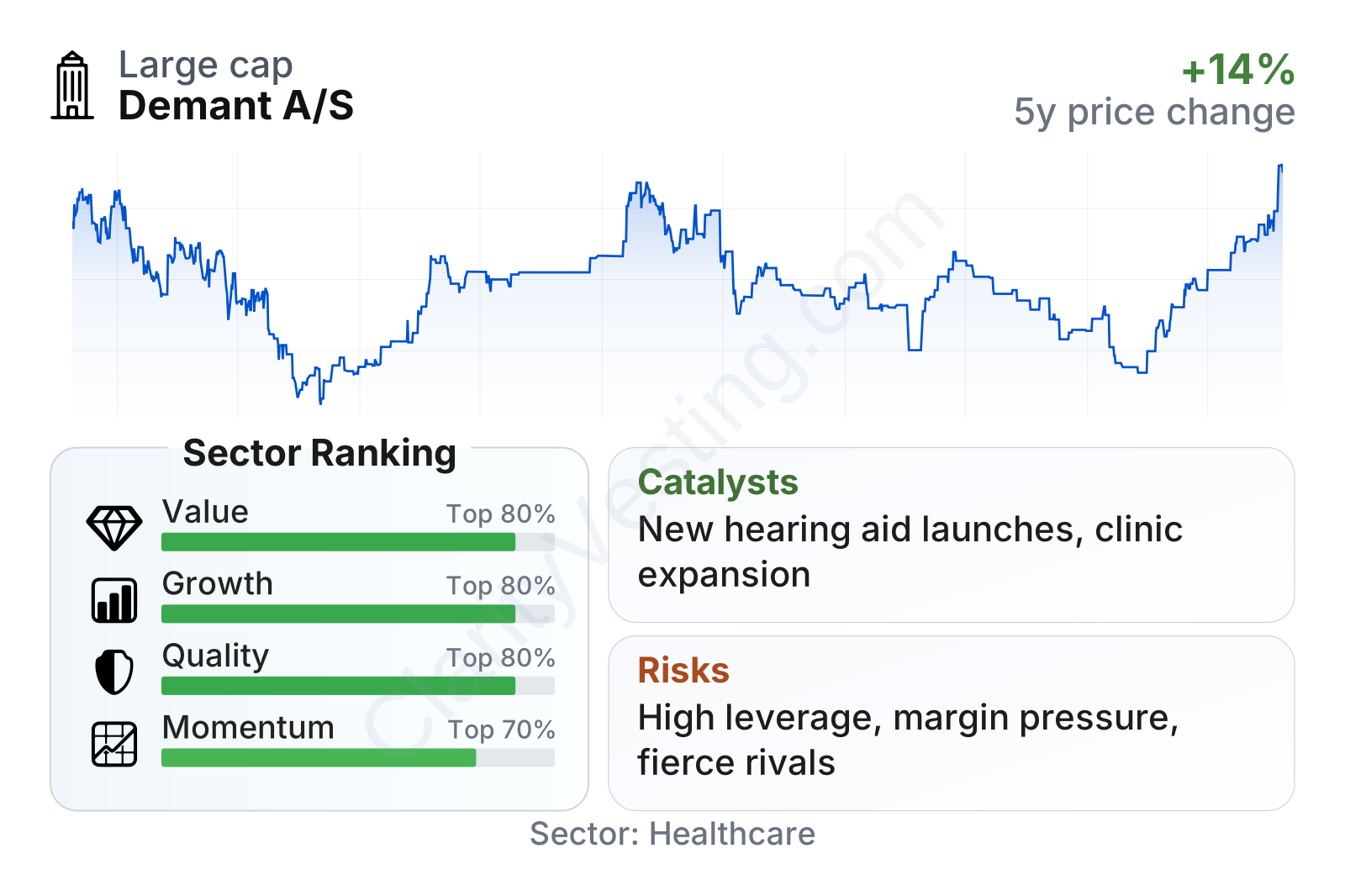
Demant is a mid-sized healthcare company with a market value around $10 billion and a below-market beta, which points to somewhat lower share-price sensitivity than many stocks. The latest factor snapshot is notably strong in quality and growth relative to the healthcare sector, with returns on capital and returns on assets well above sector norms. Free cash flow generation also stands out positively. On the weaker side, leverage is elevated, and recent momentum has improved sharply only over the last several months rather than over the full three-year period.
Growth
Demant operates in a sector with durable structural demand. Hearing loss becomes more common with age, and aging populations in Europe, North America, and parts of Asia support long-term need for hearing care. Awareness is also rising as hearing devices become smaller, more connected, and more consumer-friendly. That backdrop makes hearing healthcare one of the steadier niches within medical devices.
Its strategy for future expansion is logical. Demant combines product development, distribution, and clinic ownership, which gives it direct access to end users as well as professional channels. This setup can help the company launch new devices faster, collect real-world fitting data, and keep a closer link between innovation and patient care. Continued investment in research and development also matters because sound processing, wireless features, rechargeability, AI-supported fitting, and integration with smartphones are now central competitive factors.
Recent growth metrics remain respectable. Year-over-year revenue growth is in the mid-teens in the latest comparative view, comfortably above the healthcare sector median, while five-year revenue-per-share and free-cash-flow growth also compare well. Earnings per share growth over five years looks particularly strong, although that figure has benefited from a low comparison base and should not be read as a straight-line trend.
A meaningful catalyst is product renewal in hearing aids, where each major platform launch can support better pricing, channel adoption, and clinic traffic. Another opportunity comes from the clinic network itself: as Demant expands or improves clinic productivity, it can capture a larger portion of the value chain. Diagnostic equipment also adds a quieter but useful source of growth because audiology professionals need tools for screening and fitting, regardless of which hearing-aid brand is ultimately chosen.
Recent company communications have also highlighted continued focus on efficiency, hearing-aid innovation, and operational execution after a period of mixed profitability. In practical terms, the opportunity is not only selling more units, but also improving the earnings conversion of revenue that is already at a high level.
Risks
This article is for informational purposes only and does not constitute financial advice. Some content is AI-generated. See Disclaimer


