Stock Analysis · Demant A/S (WILLF)
Overview
Demant A/S is a Danish hearing healthcare company focused on products and services for people with hearing loss. Its business spans hearing aids, diagnostic equipment used by hearing care professionals, and hearing care services delivered through clinics. The group operates internationally and owns well-known brands across both devices and care delivery, which gives it exposure to the full hearing health pathway rather than only product manufacturing.
The company’s revenue mainly comes from hearing-related products and services. Based on Demant’s recent annual reporting structure, the business is largely organized around hearing devices and hearing care, with a smaller diagnostics operation.
- Hearing Aids and related hearing devices: approximately 55% to 65% of revenue. This includes branded hearing aids and related accessories sold through professionals and distribution partners.
- Hearing Care services: approximately 25% to 35% of revenue. This covers revenue from company-owned clinics, hearing tests, fittings, and ongoing customer care.
- Diagnostics: approximately 10% to 15% of revenue. This includes equipment and software used to test hearing and balance disorders in clinics and hospitals.
That mix matters because it combines recurring service activity with product sales, while also giving Demant a direct relationship with end users through its clinic network. Over the last several years, revenue has generally expanded from the high teens of billions of Danish kroner to above DKK 23 billion, while gross profit has remained strong. At the same time, profit conversion has been less smooth than sales growth because financing costs and margin pressure have at times weighed on net income.
The financial flow shows a business with consistently high gross profit and meaningful spending on research and commercial activity. Revenue has trended upward over time, but net income has been more volatile than sales, reflecting swings in operating margin and a noticeable increase in interest expense compared with earlier years.
Key Figures
| Metric | Value | Sector ⓘ |
|---|---|---|
| Date | Oct 17, 2026 | |
| Context | ||
| Sector | Healthcare | |
| Industry | Medical Devices | |
| Market Cap ⓘ | $11.08B | |
| Beta ⓘ | 0.70 | |
Value (Cheapness) | ||
| P/E Ratio ⓘ | 29.36 | 24.79 |
| P/B Ratio ⓘ | 0.99 | 3.08 |
| FCF Yield ⓘ | 62.70% | 3.15% |
| Dividend Yield ⓘ | N/A | 1.94% |
| EBIT / EV ⓘ | N/A | 0.57% |
| PEG ⓘ | 1.31 | |
Growth (Business expansion) | ||
| Revenue Growth ⓘ | 14.80% | 7.45% |
| RPS Growth (5Y CAGR) ⓘ | 9.34% | 8.61% |
| EPS Growth (5Y CAGR) ⓘ | -27.70% | -17.81% |
| BVPS Growth (5Y CAGR) ⓘ | 7.94% | 3.72% |
| Margin Growth (5Y Trend) ⓘ | -3.42% | -0.62% |
| FCF Growth (5Y CAGR) ⓘ | 6.58% | 1.04% |
| DPS Growth (5Y CAGR) ⓘ | N/A | 6.77% |
Quality (Business durability) | ||
| ROIC (Latest) ⓘ | 24.98% | 3.24% |
| ROA (Latest) ⓘ | 10.81% | 3.01% |
| ROIC (5Y Median) ⓘ | 12.61% | 4.60% |
| ROA (5Y Median) ⓘ | 7.58% | 1.89% |
| Net Debt / EBIT (Latest) ⓘ | 2.30 | 1.34 |
| Net Debt / EBIT (5Y Median) ⓘ | 4.47 | 1.84 |
| Net Debt / EBITDA (Latest) ⓘ | 1.66 | 1.00 |
| Net Debt / Assets ⓘ | 46.94% | 5.45% |
| EBITDA / Interest ⓘ | 7.63 | 9.64 |
| Operating Margin (Latest) ⓘ | 17.22% | 9.27% |
| Operating Margin (5Y Median) ⓘ | 19.05% | 7.38% |
| Debt to Equity (Latest) ⓘ | 180.43% | 28.58% |
| Profit Margin (Latest) ⓘ | 6.55% | 3.59% |
| Free Cash Flow (Latest) ⓘ | $6.95B | |
Momentum (Price trend) | ||
| 3Y Return ⓘ | +35.01% | +42.80% |
| 12M Return (excl. last month) ⓘ | +18.16% | +18.50% |
| 6M Return ⓘ | +77.33% | +7.57% |
| Price vs. 200-Day MA ⓘ | +40.25% | +5.12% |
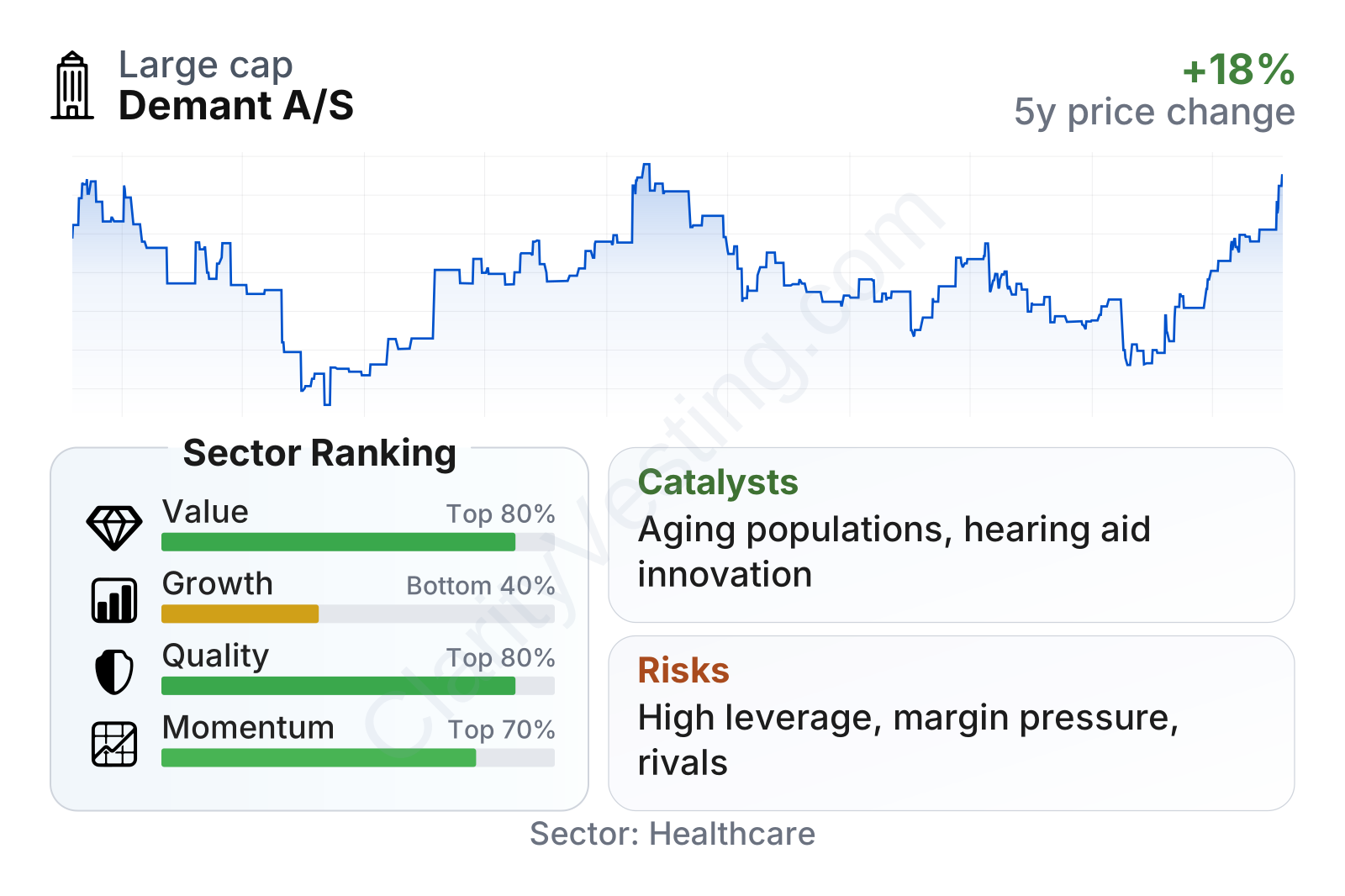
Demant stands out as a mid-to-large medical devices company with relatively low share-price volatility, as shown by a beta around 0.7. Profitability is strong for the sector: returns on capital and assets are well above sector medians, and operating margin is also clearly ahead of many healthcare peers. Cash generation also looks solid, with free cash flow strength standing out positively.
The weaker area is the balance between growth quality and leverage. Revenue growth has been healthy, including recent year-over-year growth above the sector median, but earnings growth over a five-year view has been less convincing, and operating margins have drifted lower from earlier highs. Debt metrics are also heavier than the sector median, with debt to equity above 180% and net debt ratios sitting above many peers. In short, the company combines strong business quality with a more leveraged financial profile and uneven earnings progression.
The share price history shows that the stock has not moved in a straight line. It dropped sharply in 2022, recovered through parts of 2023 and 2024, weakened again, and then rebounded strongly in recent months. That pattern suggests sentiment can change quickly when the market reassesses margin outlook, growth expectations, or acquisition-related concerns.
Growth
Demant operates in a sector with favorable long-term demand drivers. Hearing loss becomes more common with age, and aging populations in Europe, North America, and parts of Asia create a structural tailwind for hearing care. On top of that, hearing aid technology keeps improving through better sound processing, connectivity, rechargeability, and software features, which helps support replacement demand and may broaden adoption over time.
Its strategy also makes sense for long-duration growth because it does not rely on a single business line. Demant participates in devices, diagnostics, and clinics, which creates several ways to expand. New hearing aid product cycles can improve device sales, diagnostics can benefit from healthcare investment, and the clinic network provides direct access to patients and aftercare revenue. This broad setup can also make the business more resilient than a pure hardware model.
A major long-term catalyst is innovation. In hearing healthcare, product launches matter because small technology improvements can influence audiologist preference, user comfort, battery performance, and speech understanding in noisy environments. Demant has maintained material research and development spending, which supports the case for continued competitiveness. Another catalyst is clinic expansion and deeper penetration of underdiagnosed hearing loss, since many people delay treatment for years.
Recent business momentum also appears better than the company’s longer-term earnings record might suggest. Revenue growth has recently outpaced the sector median, and market momentum has improved sharply, with the stock rising strongly over the last six months and trading well above its long-term average trend. That does not prove that business fundamentals have fully turned, but it does suggest the market has become more constructive on near-term prospects.
Another point worth watching is that hearing healthcare remains underpenetrated globally. If awareness rises, reimbursement remains supportive in key countries, and technology continues to reduce stigma and improve usability, Demant could benefit from a wider addressable market rather than only from replacement purchases.
Risks
This article is for informational purposes only and does not constitute financial advice. Some content is AI-generated. See Disclaimer


