Stock Analysis · Whitehaven Coal Limited (WHITF)
Overview
Whitehaven Coal Limited is an Australian mining company focused on producing and selling coal. Its assets are centered in New South Wales and Queensland, and the group now has exposure to both thermal coal used for power generation and metallurgical coal used in steelmaking. For U.S. readers seeing the ticker WHITF, this is the over-the-counter listing of the Australian company.
The business changed meaningfully after Whitehaven completed the acquisition of the Blackwater and Daunia mines from BHP and Mitsubishi in 2024. That deal expanded the company from a mostly thermal-coal producer into a broader coal exporter with larger scale and more product diversity. In simple terms, Whitehaven now earns money by mining coal, transporting it to port, and selling it mainly into Asian export markets.
Revenue is primarily tied to coal sales volumes and the realized price per ton. Based on the company’s recent annual reporting and product mix after the Queensland acquisition, the main sources of revenue are approximately:
- Metallurgical coal: about 45% to 55% of revenue. This includes hard coking coal and PCI products used by steelmakers.
- Thermal coal: about 45% to 55% of revenue. This includes export thermal coal sold to utilities and industrial customers for power generation.
- Other revenue: a very small share, mainly related to by-products and miscellaneous mining-related items.
That split is important because it reduces reliance on one single coal market. Thermal coal is more exposed to long-term decarbonization pressure, while metallurgical coal is tied more closely to steel demand and tends to have a different pricing cycle.
Over the last few years, Whitehaven’s earnings profile has been highly cyclical. Revenue surged during the coal price boom, then margins came back down as prices normalized and financing costs increased after the major acquisition. Even so, the company remains a sizable cash generator relative to its market value.
The operating picture shows how sensitive profits are to coal prices and cost inflation. Revenue stayed high into fiscal 2025 and fiscal 2026, but profitability fell sharply from the extraordinary levels seen in fiscal 2023 because gross profit and operating income narrowed while interest expense moved much higher after the expansion in Queensland.
Key Figures
| Metric | Value | Sector ⓘ |
|---|---|---|
| Date | Oct 17, 2026 | |
| Context | ||
| Sector | Energy | |
| Industry | Thermal Coal | |
| Market Cap ⓘ | $4.60B | |
| Beta ⓘ | -0.18 | |
Value (Cheapness) | ||
| P/E Ratio ⓘ | 17.50 | 15.44 |
| P/B Ratio ⓘ | 0.73 | 1.73 |
| FCF Yield ⓘ | 25.93% | 8.20% |
| Dividend Yield ⓘ | 1.82% | 3.59% |
| EBIT / EV ⓘ | N/A | 7.46% |
| PEG ⓘ | N/A | |
Growth (Business expansion) | ||
| Revenue Growth ⓘ | 21.60% | 26.90% |
| RPS Growth (5Y CAGR) ⓘ | 8.16% | 6.90% |
| EPS Growth (5Y CAGR) ⓘ | 2.80% | -15.73% |
| BVPS Growth (5Y CAGR) ⓘ | 15.02% | 6.07% |
| Margin Growth (5Y Trend) ⓘ | -47.25% | 0.58% |
| FCF Growth (5Y CAGR) ⓘ | N/A | 1.86% |
| DPS Growth (5Y CAGR) ⓘ | 5.40% | 16.79% |
Quality (Business durability) | ||
| ROIC (Latest) ⓘ | N/A | 11.40% |
| ROA (Latest) ⓘ | 8.28% | 6.06% |
| ROIC (5Y Median) ⓘ | 33.03% | 10.30% |
| ROA (5Y Median) ⓘ | 5.26% | 5.42% |
| Net Debt / EBIT (Latest) ⓘ | N/A | 1.64 |
| Net Debt / EBIT (5Y Median) ⓘ | 0.10 | 1.83 |
| Net Debt / EBITDA (Latest) ⓘ | 0.53 | 1.08 |
| Net Debt / Assets ⓘ | 13.15% | 17.29% |
| EBITDA / Interest ⓘ | 6.29 | 9.64 |
| Operating Margin (Latest) ⓘ | N/A | 16.27% |
| Operating Margin (5Y Median) ⓘ | 25.93% | 20.39% |
| Debt to Equity (Latest) ⓘ | 39.27% | 54.76% |
| Profit Margin (Latest) ⓘ | 7.13% | 8.82% |
| Free Cash Flow (Latest) ⓘ | $1.19B | |
Momentum (Price trend) | ||
| 3Y Return ⓘ | +42.26% | +67.38% |
| 12M Return (excl. last month) ⓘ | +49.92% | +49.19% |
| 6M Return ⓘ | -13.49% | +7.07% |
| Price vs. 200-Day MA ⓘ | -6.89% | +9.56% |
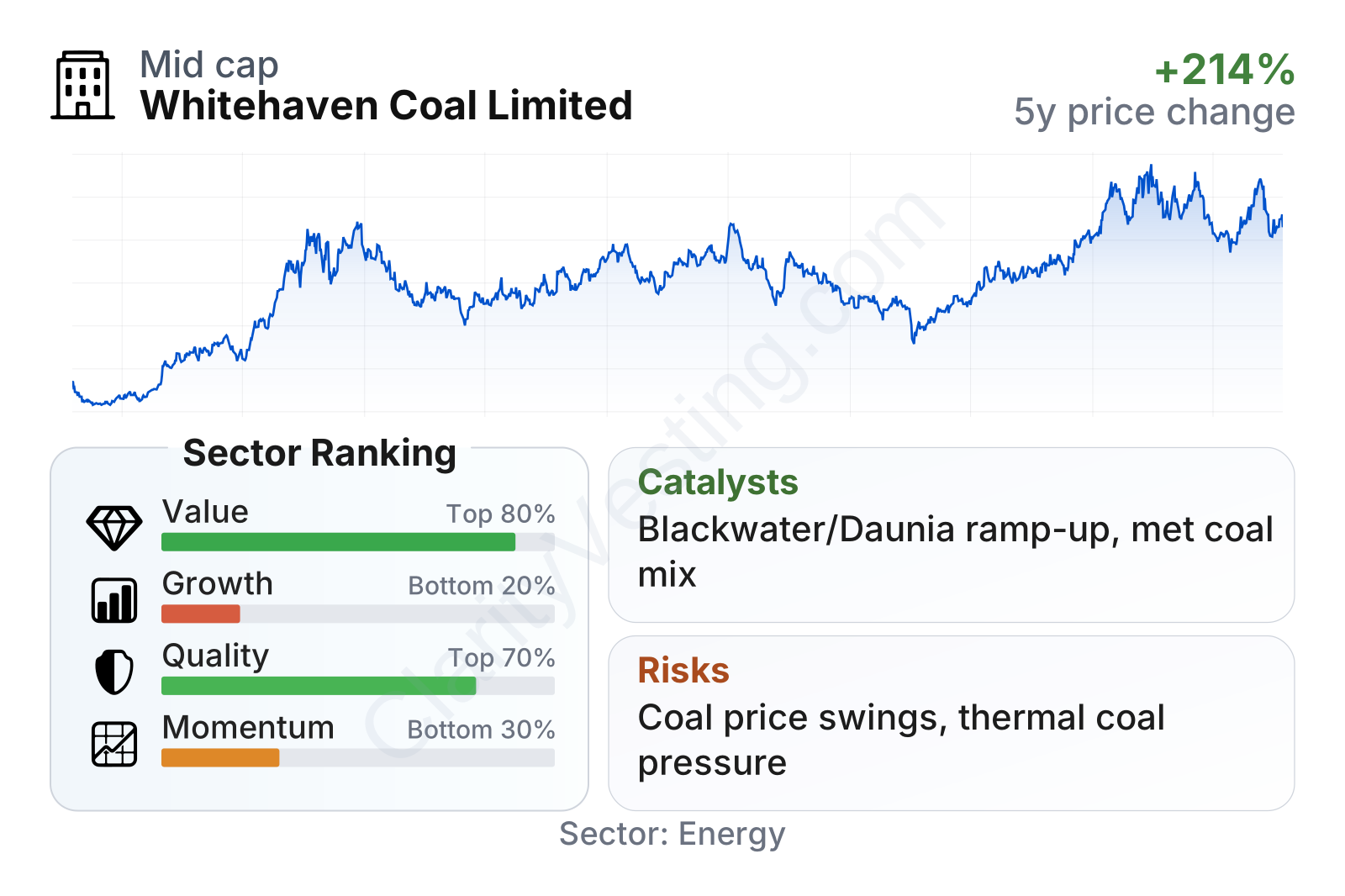
The market is treating Whitehaven as a cyclical commodity producer rather than a steady compounder. Valuation ratios are mixed: earnings are priced near the sector median, but the price-to-book ratio is clearly lower than the sector median and free cash flow yield is far stronger. Quality metrics are generally solid, helped by low leverage relative to peers and a strong multi-year return on invested capital record. The weaker area is growth and share-price momentum, reflecting lower margins after peak coal markets and the market’s caution toward the sector.
The stock chart also highlights the nature of the business. The shares have been volatile, with a sharp rise during the 2022 coal rally, a retreat as coal prices cooled, and a recovery more recently. That pattern fits a company whose profits depend heavily on commodity prices rather than a business with smooth year-to-year expansion.
Growth
Whitehaven operates in a sector with two very different long-term outlooks. Thermal coal faces structural pressure in many developed economies because power systems are gradually shifting toward lower-emission energy sources. That is a headwind for long-duration growth. However, the decline is uneven globally, and Asian demand has remained more resilient than many expected, especially where coal still supports grid stability and industrial activity.
Metallurgical coal offers a stronger strategic angle. Steelmaking still depends heavily on blast furnaces in many regions, and high-quality coking coal remains an essential input for much of the world’s steel production. By adding Blackwater and Daunia, Whitehaven increased its exposure to this market and made its portfolio less dependent on thermal coal alone. That strategy is logical because it broadens the earnings base and gives the company access to a product that is generally viewed as more durable than thermal coal.
Another potential growth driver is operational optimization. Whitehaven has been working on integrating the acquired Queensland mines, lifting production efficiency, and using its larger scale to improve logistics and customer reach. In mining, growth does not always come from launching entirely new products; it often comes from extracting more saleable tons at lower unit cost and shipping them more efficiently. If management executes well, that can support cash generation even without a major rise in coal prices.
A further catalyst is balance-sheet flexibility. Despite taking on acquisition-related debt, leverage remains manageable compared with many sector peers, and the business still produces substantial free cash flow. That gives Whitehaven more room than some competitors to reduce debt, return capital, or fund mine development depending on market conditions.
Recent company communications have also emphasized reserve life, mine planning, and the ramp-up of the enlarged portfolio. For a long-term view, the key opportunity is not simply “higher coal prices,” but whether Whitehaven can turn its larger asset base into consistently stronger through-cycle cash returns.
Risks
This article is for informational purposes only and does not constitute financial advice. Some content is AI-generated. See Disclaimer


