Stock Analysis · WH Group Ltd (WHGLY)
Overview
WH Group Ltd is one of the world’s largest pork and packaged meat companies. It owns hog production, fresh pork operations, and a broad portfolio of branded packaged meats. The group is best known internationally through Smithfield in the United States, while it also has major operations in China and Europe. Its business model covers much of the meat value chain, from raising hogs and processing pork to selling higher-value packaged products such as bacon, ham, sausages, hot dogs, deli meats, and prepared foods.
For long-term analysis, the most important point is that WH Group is not a pure commodity meat producer. It has exposure to volatile livestock and pork cycles, but it also owns branded consumer products that usually carry steadier demand and better margins than fresh meat alone. That mix matters because branded packaged foods often create more durable earnings than raw meat processing by itself.
Based on the company’s recent annual reporting, revenue is primarily generated by geography and product category, with the United States remaining the largest contributor through Smithfield. A practical breakdown is:
- United States operations: approximately 60% to 65% of revenue. This includes packaged meats, fresh pork, and hog production, with packaged meats generally contributing a disproportionate share of profit.
- China operations: approximately 25% to 30% of revenue. This includes fresh pork, packaged meat products, and slaughter operations serving the domestic market.
- Europe and other markets: approximately 10% to 15% of revenue. This includes packaged meats and pork products sold across several European countries and selected international markets.
Within the business mix, packaged meats are typically the most important earnings engine, while fresh pork and hog production are larger sources of sales but more exposed to swings in feed costs, hog prices, and supply-demand conditions. That distinction helps explain why revenue can move differently from profit from one year to the next.
The profit flow over the last several years shows a cyclical business that recovered meaningfully after a weak 2023. Revenue softened from 2022 to 2024 before improving again in 2025, while operating income and net income rebounded much more sharply than sales. That suggests margin recovery, not just top-line expansion, has been a major driver of the recent improvement.
Key Figures
| Metric | Value | Sector ⓘ |
|---|---|---|
| Date | Oct 04, 2026 | |
| Context | ||
| Sector | Consumer Defensive | |
| Industry | Packaged Foods | |
| Market Cap ⓘ | $10.89B | |
| Beta ⓘ | 0.23 | |
Value (Cheapness) | ||
| P/E Ratio ⓘ | 7.02 | 18.17 |
| P/B Ratio ⓘ | 0.97 | 1.27 |
| FCF Yield ⓘ | 34.77% | 12.39% |
| Dividend Yield ⓘ | 9.18% | 2.83% |
| EBIT / EV ⓘ | 36.19% | 6.38% |
| PEG ⓘ | 20.46 | |
Growth (Business expansion) | ||
| Revenue Growth ⓘ | 3.30% | 3.80% |
| RPS Growth (5Y CAGR) ⓘ | 3.22% | 6.20% |
| EPS Growth (5Y CAGR) ⓘ | 9.05% | -14.56% |
| BVPS Growth (5Y CAGR) ⓘ | 4.79% | 3.26% |
| Margin Growth (5Y Trend) ⓘ | 2.37% | -0.25% |
| FCF Growth (5Y CAGR) ⓘ | 21.15% | 4.65% |
| DPS Growth (5Y CAGR) ⓘ | 56.49% | 6.86% |
Quality (Business durability) | ||
| ROIC (Latest) ⓘ | N/A | 12.58% |
| ROA (Latest) ⓘ | 14.99% | 6.32% |
| ROIC (5Y Median) ⓘ | 13.56% | 10.36% |
| ROA (5Y Median) ⓘ | 6.98% | 5.44% |
| Net Debt / EBIT (Latest) ⓘ | 0.64 | 1.91 |
| Net Debt / EBIT (5Y Median) ⓘ | 1.09 | 2.32 |
| Net Debt / EBITDA (Latest) ⓘ | 0.49 | 1.36 |
| Net Debt / Assets ⓘ | 12.08% | 21.25% |
| EBITDA / Interest ⓘ | N/A | 9.61 |
| Operating Margin (Latest) ⓘ | 7.62% | 8.91% |
| Operating Margin (5Y Median) ⓘ | 8.16% | 9.53% |
| Debt to Equity (Latest) ⓘ | 43.98% | 71.66% |
| Profit Margin (Latest) ⓘ | 5.44% | 5.39% |
| Free Cash Flow (Latest) ⓘ | $3.79B | |
Momentum (Price trend) | ||
| 3Y Return ⓘ | +119.97% | +15.25% |
| 12M Return (excl. last month) ⓘ | -4.47% | +2.49% |
| 6M Return ⓘ | -32.73% | +2.26% |
| Price vs. 200-Day MA ⓘ | -21.17% | +0.43% |
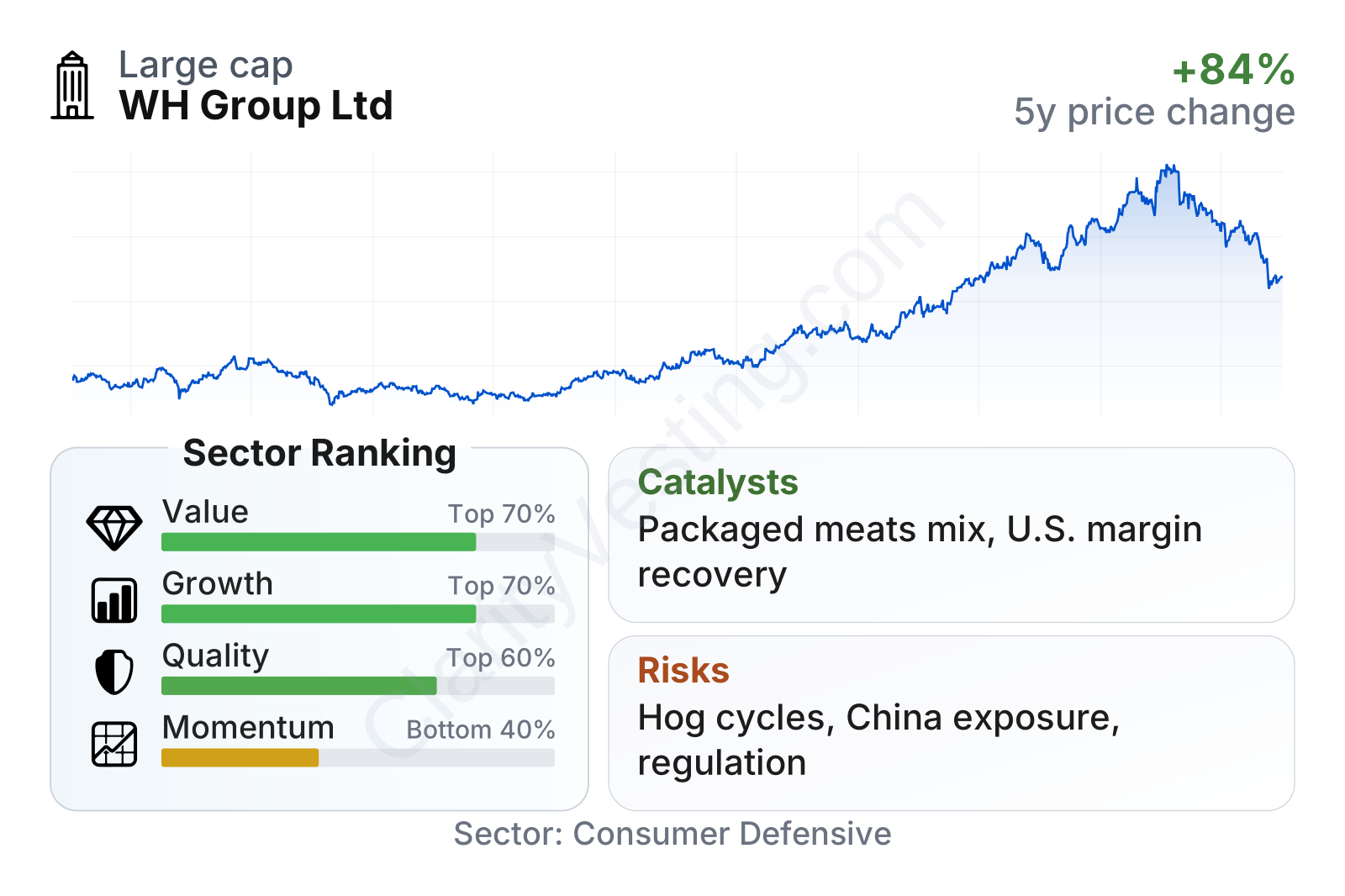
WH Group stands out as a large defensive consumer business with unusually low share-price volatility, reflected in a beta near 0.2. On valuation, several measures look inexpensive versus the broader packaged foods sector: its earnings multiple is far below the sector median, its price-to-book ratio is slightly below the median, and its cash generation relative to market value is notably strong. Income generation is also prominent, with a trailing dividend yield well above the sector norm.
The mixed picture is that growth metrics are respectable rather than exceptional. Revenue growth has been modest, but earnings, free cash flow, and dividends have compounded much faster over the last five years. Quality is also fairly solid overall: leverage is lower than many peers, return on assets is strong, and balance-sheet pressure appears limited. The weaker area is recent momentum, with the stock pulling back over the last six months even after a very strong three-year run.
Growth
WH Group operates in a sector with steady long-term demand rather than explosive expansion. Meat consumption and packaged food demand tend to be driven by population, income levels, urbanization, convenience, and brand preference. That makes the company’s growth profile more about operational execution, product mix, and capital allocation than about participating in a fast-growing new industry.
The company’s strategy makes sense for that environment. Management has consistently emphasized branded packaged meats, product upgrades, efficiency, and disciplined use of cash. This matters because packaged meats usually offer better pricing power and more stable profitability than fresh pork or hog farming. In other words, future progress is likely to depend less on simply selling more volume and more on improving the share of sales coming from higher-margin categories.
Recent growth has been moderate on the revenue line, with year-over-year sales growth around the low-single-digit range and a five-year revenue-per-share growth rate below the sector median. However, earnings growth has been stronger than revenue growth, which suggests better cost control and margin normalization. The rebound after 2023 is especially relevant: sales did not surge, but profitability improved materially, showing that the company can lift results even in a slower top-line environment.
Free cash flow is one of the stronger parts of the investment case. Over five years, cash generation has expanded much faster than the typical company in the sector, and the current free cash flow level is high for a business of this size. That supports dividends, debt reduction, and potential strategic investments. For a mature food company, this kind of cash profile is often more meaningful than headline revenue growth.
Potential catalysts are fairly specific. Continued recovery in U.S. hog production economics, better fresh pork spreads, and further expansion of packaged meats in China could all help. Another positive factor is the company’s ability to keep returning cash to shareholders while still maintaining a conservative balance sheet. In a lower-growth consumer staples setting, consistent cash returns and margin improvement can be powerful drivers of long-term value creation.
Risks
This article is for informational purposes only and does not constitute financial advice. Some content is AI-generated. See Disclaimer


