Stock Analysis · Cactus Inc (WHD)
Overview
Cactus Inc. is an oilfield equipment company focused mainly on wellhead and pressure control products used in onshore oil and gas production, especially in the United States. In simple terms, it sells critical hardware that helps operators control pressure and safely manage the flow of oil and gas at the well site. The company has built its position around products that are essential to drilling and production activity, and it also provides related field services and aftermarket support.
Cactus generates most of its revenue from equipment and services tied to customer spending in U.S. land drilling and completions. Based on recent company reporting, revenue is primarily organized around pressure control and, following acquisitions, flexible pipe systems used in production infrastructure.
- Pressure Control: approximately 70% to 80% of revenue in recent periods. This includes wellheads, frac equipment, production tree systems, and related installation and service work.
- Spoolable Technologies: approximately 20% to 30% of revenue in recent periods. This business includes flexible pipe and associated products used for production, gathering, and water-related applications.
- Field service and aftermarket activity: not always disclosed as a stand-alone line, but embedded within the operating segments and important because it can support repeat business and margins.
The business mix matters because it gives Cactus exposure both to new well activity and to installed equipment that needs service, replacement parts, and follow-on products. Over the last several years, revenue has expanded strongly, and profitability has remained solid even through normal industry swings, suggesting the company has been able to convert demand into earnings rather efficiently.
The long-term pattern shows a company that scaled revenue sharply from 2021 through 2024, kept operating profitability strong, and still produced meaningful net income even when top-line growth became less steady. One notable shift is that gross profit remained robust despite softer revenue in 2025, which points to a mix and margin profile that can be more resilient than a simple volume-driven business.
Key Figures
| Metric | Value | Sector ⓘ |
|---|---|---|
| Date | Oct 17, 2026 | |
| Context | ||
| Sector | Energy | |
| Industry | Oil & Gas Equipment & Services | |
| Market Cap ⓘ | $4.47B | |
| Beta ⓘ | 1.43 | |
Value (Cheapness) | ||
| P/E Ratio ⓘ | 53.84 | 15.44 |
| P/B Ratio ⓘ | 5.64 | 1.73 |
| FCF Yield ⓘ | 7.20% | 8.20% |
| Dividend Yield ⓘ | 0.89% | 3.59% |
| EBIT / EV ⓘ | 5.22% | 7.46% |
| PEG ⓘ | N/A | |
Growth (Business expansion) | ||
| Revenue Growth ⓘ | 64.30% | 26.90% |
| RPS Growth (5Y CAGR) ⓘ | 28.34% | 6.90% |
| EPS Growth (5Y CAGR) ⓘ | -3.04% | -15.73% |
| BVPS Growth (5Y CAGR) ⓘ | 34.63% | 6.07% |
| Margin Growth (5Y Trend) ⓘ | 7.36% | 0.58% |
| FCF Growth (5Y CAGR) ⓘ | 44.50% | 1.86% |
| DPS Growth (5Y CAGR) ⓘ | 17.30% | 16.79% |
Quality (Business durability) | ||
| ROIC (Latest) ⓘ | 16.51% | 11.40% |
| ROA (Latest) ⓘ | 3.68% | 6.06% |
| ROIC (5Y Median) ⓘ | 24.34% | 10.30% |
| ROA (5Y Median) ⓘ | 10.49% | 5.42% |
| Net Debt / EBIT (Latest) ⓘ | -1.19 | 1.64 |
| Net Debt / EBIT (5Y Median) ⓘ | -1.72 | 1.83 |
| Net Debt / EBITDA (Latest) ⓘ | -0.84 | 1.08 |
| Net Debt / Assets ⓘ | -11.98% | 17.29% |
| EBITDA / Interest ⓘ | N/A | 9.64 |
| Operating Margin (Latest) ⓘ | 19.12% | 16.27% |
| Operating Margin (5Y Median) ⓘ | 24.56% | 20.39% |
| Debt to Equity (Latest) ⓘ | 4.53% | 54.76% |
| Profit Margin (Latest) ⓘ | 11.98% | 8.82% |
| Free Cash Flow (Latest) ⓘ | $321.56M | |
Momentum (Price trend) | ||
| 3Y Return ⓘ | +27.62% | +67.38% |
| 12M Return (excl. last month) ⓘ | +69.53% | +49.19% |
| 6M Return ⓘ | +19.09% | +7.07% |
| Price vs. 200-Day MA ⓘ | +9.07% | +9.56% |
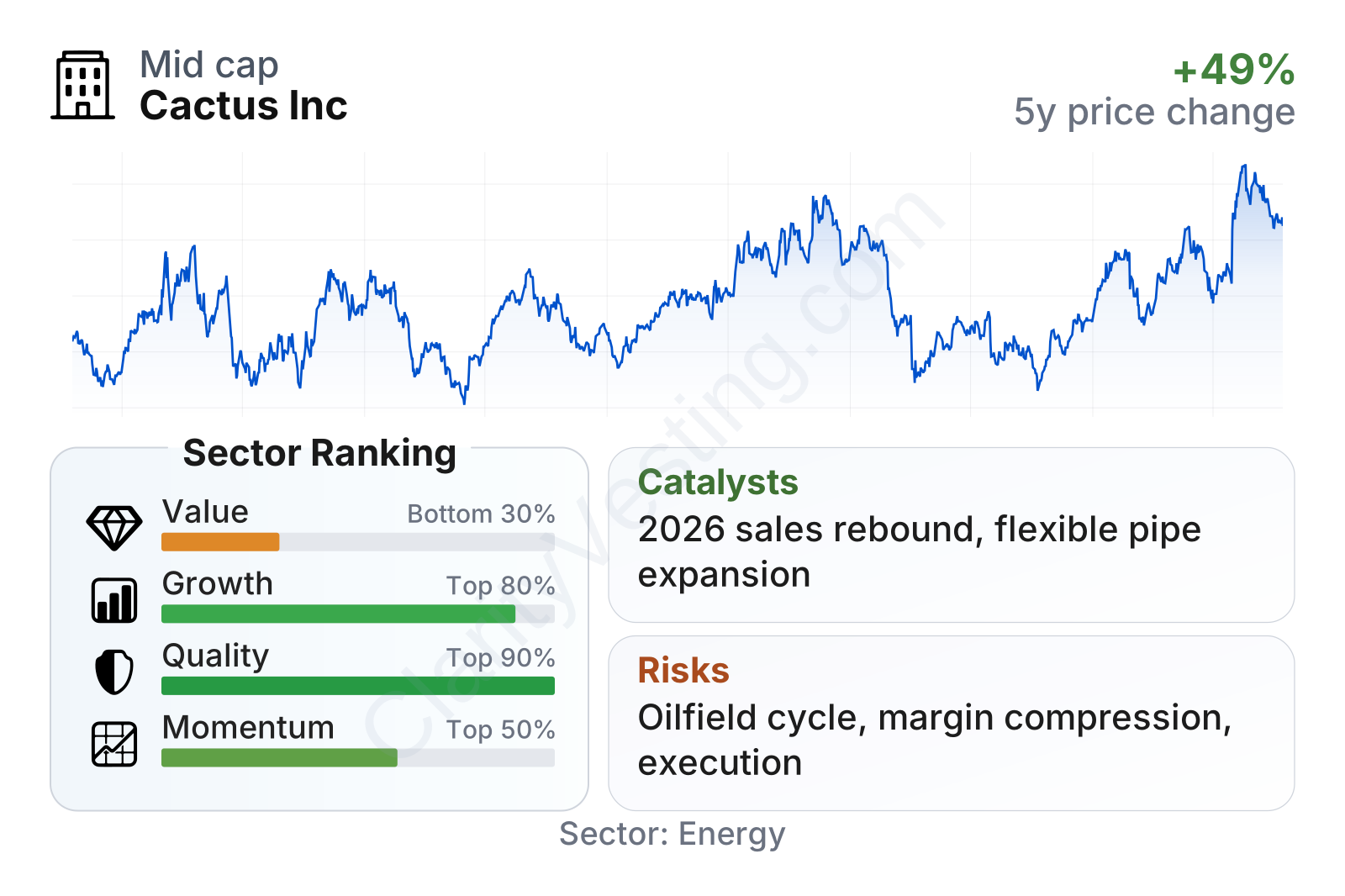
Cactus sits in the mid-cap range within energy services. The overall picture is unusual in a good way operationally, but more demanding from a valuation perspective. Quality ranks near the top of the sector, supported by strong returns on invested capital, low leverage, and healthy margins. Growth metrics are also solid, with revenue and free cash flow compounding well above sector medians over five years. By contrast, the valuation section looks expensive relative to many peers, with earnings and book multiples well above the sector median and a lower ranking on traditional value measures.
The stock has also been more volatile than the market overall, as reflected by a beta above 1, which is common in energy-linked industrial names. Recent price momentum has been favorable, but that strength comes after a business period in which margins have cooled from prior highs, so the market appears to be giving significant credit to future execution.
Growth
Cactus operates in a sector that is not a classic secular growth market in the way software or digital payments might be, but it does sit in a part of the energy value chain where operational efficiency, reliability, and equipment performance matter a great deal. North American shale production remains a large and strategically important source of oil and gas supply, and that creates continued demand for wellhead systems, pressure control equipment, and production-related infrastructure. As long as U.S. land activity stays meaningful, Cactus has a real market to serve.
The company’s strategy appears sensible for long-term development because it is not relying only on cyclical drilling activity. Its pressure control franchise gives it a strong position in core wellsite hardware, while expansion into flexible pipe broadens the revenue base into production and infrastructure applications. That matters because it can reduce dependence on one narrow product category and can increase cross-selling opportunities across customer accounts.
Recent growth has been lumpy, which is normal in oilfield services, but the rebound in 2026 stands out. After a softer 2025, year-over-year revenue growth moved back sharply higher and is now running well above the sector median. That suggests the company is benefiting from either a stronger product cycle, acquisition-related contribution, or both. Over a five-year view, revenue per share growth has also been far stronger than the industry median, which supports the idea that Cactus has been gaining scale rather than simply drifting with the cycle.
Cash generation is another constructive point. Free cash flow expanded dramatically over the last several years and remains at a healthy level even after moderating from the peak. This is important because it shows earnings are not just accounting profits; the business has been able to convert operations into actual cash while keeping debt low. For a cyclical company, strong free cash flow can provide room for acquisitions, dividends, share repurchases, and internal investment without straining the balance sheet.
A meaningful catalyst is the company’s ability to deepen its position in production-related applications, where customers value reliability and total operating cost more than just upfront equipment price. If Cactus continues integrating acquired businesses successfully and broadens its installed base, that could support more recurring aftermarket and replacement demand over time. Recent company updates have also highlighted continued operational execution and capital returns, both of which help reinforce confidence in the current growth framework.
Risks
This article is for informational purposes only and does not constitute financial advice. Some content is AI-generated. See Disclaimer


