Stock Analysis · GeneDx Holdings Corp (WGS)
Overview
GeneDx Holdings Corp is a genetic testing company focused on using DNA sequencing to help diagnose rare diseases, inherited conditions, and certain medical disorders. Its core activity is clinical genomics: doctors send patient samples to GeneDx, the company analyzes the genetic data, and it provides reports that can support diagnosis, treatment decisions, and family planning. The company has built much of its reputation in exome and genome sequencing, which are broader tests than smaller targeted panels because they examine many more genes at once.
For long-term analysis, the key point is that GeneDx is not a drug developer waiting on a single product approval. It is a healthcare services and diagnostics business whose value depends on test volume, reimbursement, lab efficiency, clinician adoption, and the usefulness of its interpretation platform. In plain terms, the company grows when more physicians order its tests, when payers cover them, and when GeneDx can process those tests at attractive margins.
Based on recent company reporting, revenue is heavily concentrated in genetic testing services, with the business now centered on exome and genome testing for rare and pediatric disease.
- Clinical genetic testing services: approximately 95%+ of revenue. This includes exome sequencing, genome sequencing, and other diagnostic tests ordered by healthcare providers.
- Other and legacy activities: low-single-digit share of revenue. This can include residual services and non-core items that are much smaller than the main testing business.
The broad business mix has also become cleaner over time. Revenue has grown strongly since 2023 while the cost structure has improved, which suggests GeneDx is benefiting from a more focused strategy around higher-value testing rather than spreading resources across too many activities.
The long-term operating trend has improved meaningfully. Revenue rose from a little above $200 million in 2023 to more than $425 million in 2025, while gross profit expanded much faster than revenue. At the same time, operating losses narrowed sharply, showing that the current business is much more efficient than it was a few years ago even though profitability is still uneven.
Key Figures
| Metric | Value | Sector ⓘ |
|---|---|---|
| Date | Oct 24, 2026 | |
| Context | ||
| Sector | Healthcare | |
| Industry | Diagnostics & Research | |
| Market Cap ⓘ | $2.06B | |
| Beta ⓘ | 1.97 | |
Value (Cheapness) | ||
| P/E Ratio ⓘ | N/A | 25.42 |
| P/B Ratio ⓘ | 8.17 | 3.08 |
| FCF Yield ⓘ | -3.69% | 3.12% |
| Dividend Yield ⓘ | N/A | 1.85% |
| EBIT / EV ⓘ | -4.01% | 0.56% |
| PEG ⓘ | N/A | |
Growth (Business expansion) | ||
| Revenue Growth ⓘ | 11.40% | 7.50% |
| RPS Growth (5Y CAGR) ⓘ | -29.62% | 8.60% |
| EPS Growth (5Y CAGR) ⓘ | -69.40% | -17.73% |
| BVPS Growth (5Y CAGR) ⓘ | -44.23% | 3.72% |
| Margin Growth (5Y Trend) ⓘ | N/A | -0.57% |
| FCF Growth (5Y CAGR) ⓘ | N/A | 0.96% |
| DPS Growth (5Y CAGR) ⓘ | N/A | 6.69% |
Quality (Business durability) | ||
| ROIC (Latest) ⓘ | -23.08% | 3.17% |
| ROA (Latest) ⓘ | -21.81% | 2.98% |
| ROIC (5Y Median) ⓘ | -31.01% | 4.56% |
| ROA (5Y Median) ⓘ | -36.47% | 1.87% |
| Net Debt / EBIT (Latest) ⓘ | N/A | 1.34 |
| Net Debt / EBIT (5Y Median) ⓘ | N/A | 1.86 |
| Net Debt / EBITDA (Latest) ⓘ | N/A | 1.00 |
| Net Debt / Assets ⓘ | 22.24% | 5.06% |
| EBITDA / Interest ⓘ | N/A | 9.55 |
| Operating Margin (Latest) ⓘ | -22.73% | 9.25% |
| Operating Margin (5Y Median) ⓘ | -84.02% | 7.33% |
| Debt to Equity (Latest) ⓘ | 68.55% | 26.68% |
| Profit Margin (Latest) ⓘ | -23.41% | 3.34% |
| Free Cash Flow (Latest) ⓘ | -$75.80M | |
Momentum (Price trend) | ||
| 3Y Return ⓘ | +2065.81% | +51.61% |
| 12M Return (excl. last month) ⓘ | -30.04% | +19.90% |
| 6M Return ⓘ | -3.85% | +10.10% |
| Price vs. 200-Day MA ⓘ | -8.92% | +6.44% |
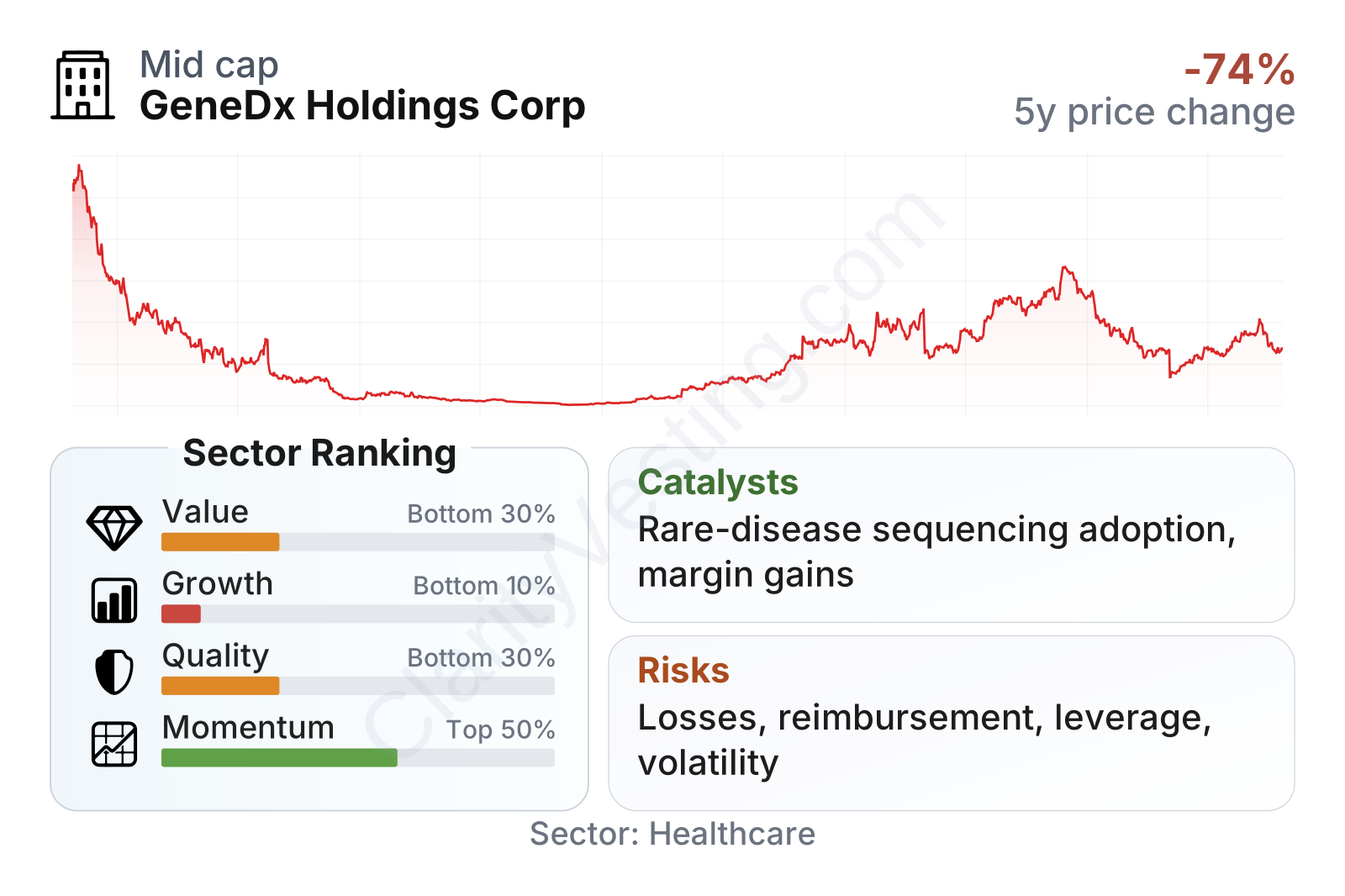
GeneDx is now a mid-cap healthcare company with a stock that has been extremely volatile. The share price collapsed between 2021 and early 2024, then rebounded dramatically as revenue growth accelerated and losses narrowed. In the factor table, valuation looks demanding versus the healthcare sector, quality metrics remain weak because returns and margins are still negative, and growth scores are pulled down by the company’s difficult earlier years even though more recent sales growth has been much stronger. Momentum is better than many peers over the longer window, but short-term trading has remained unstable.
Growth
GeneDx operates in a part of healthcare that still has room to expand. Genetic testing is becoming more useful as sequencing costs fall, clinical evidence improves, and physicians become more comfortable using genomic information in routine care. Rare disease diagnosis is a particularly important area because many patients spend years without a clear answer, and broad sequencing can shorten that process. This creates a real demand driver that is medical, not just cyclical.
The company’s strategy appears logical for that backdrop. GeneDx has focused on exome and genome testing, where interpretation quality and clinical databases matter a great deal. This is important because raw sequencing itself can become commoditized over time, but accurate interpretation, physician trust, and payer acceptance are harder to replicate. The company has repeatedly emphasized its data assets, clinical evidence generation, and tighter commercial execution, all of which support a more durable position if adoption keeps increasing.
The revenue pattern shows a major turnaround. After a choppy period in 2022 and 2023, year-over-year growth became very strong through 2024 and remained positive in 2025 and into 2026, although the pace has cooled from the earlier surge. That cooling matters: it suggests GeneDx is moving from rebound growth to a more normalized phase. Even so, growth around the low-teens remains better than the sector median and shows the business is still expanding rather than stalling.
Cash generation has also improved significantly from the deep outflows seen earlier. Free cash flow remains negative on a trailing basis, but the deficit is far smaller than it was during the restructuring period. That does not mean the financial model is fully proven yet, but it does indicate that scale and cost discipline are moving the company closer to self-sustaining operations.
A major catalyst is the broader use of first-line genome and exome testing in pediatric and rare disease settings. If clinical guidelines, hospital practices, and insurer policies continue shifting toward broader sequencing earlier in the diagnostic process, GeneDx could benefit from higher testing volumes and better reimbursement leverage. Another positive development is that the company has already shown it can translate volume growth into much better gross profit, which is one of the clearest signs that its current strategy is working better than the old model.
Risks
This article is for informational purposes only and does not constitute financial advice. Some content is AI-generated. See Disclaimer


