Stock Analysis · West Fraser Timber Co Ltd (WFG)
Overview
West Fraser Timber Co. Ltd. is one of the largest wood products manufacturers in North America. The company produces lumber, engineered wood products, OSB panels, plywood, pulp, paper, and wood chips. Its products are used mainly in residential construction, repair and remodeling, industrial applications, and packaging. In simple terms, West Fraser sells the structural materials that go into homes and other buildings, while also operating some pulp and paper assets.
The business is spread across Canada, the United States, the United Kingdom, and Europe, but North American housing remains the main economic driver. That means the company’s results are closely tied to building activity, renovation demand, and commodity wood-panel pricing.
Based on the company’s recent annual reporting structure, revenue is mainly generated from the following segments:
- Lumber: approximately 40% to 45% of revenue. This includes spruce, southern yellow pine, and other lumber products used in framing and general construction.
- OSB (oriented strand board): approximately 30% to 35% of revenue. OSB is a wood panel product widely used for walls, roofs, and subfloors.
- Engineered wood products and plywood: approximately 10% to 15% of revenue. This includes LVL, MDF, plywood, and related structural panel products.
- Pulp, paper, wood chips, and other products: approximately 10% to 15% of revenue. These operations are smaller than the building-products businesses but provide some diversification.
Over the last few years, the company’s earnings mix has been far more volatile than its sales mix. During periods of strong panel and lumber prices, profit can rise very quickly; when pricing weakens, margins can fall sharply even if volumes do not collapse. The long-term business model is therefore less about steady growth every year and more about owning a large, low-cost production base that can generate substantial cash across a full cycle.
The multi-year financial flow highlights how dramatically conditions changed after the exceptional 2021 and 2022 period. Revenue has fallen from peak levels, and profitability compressed much faster than sales, showing how sensitive the business is to product pricing. Even so, overhead remained relatively contained, which suggests the main pressure came from market conditions rather than a large expansion in administrative costs.
Key Figures
| Metric | Value | Sector ⓘ |
|---|---|---|
| Date | Oct 03, 2026 | |
| Context | ||
| Sector | Basic Materials | |
| Industry | Lumber & Wood Production | |
| Market Cap ⓘ | $5.54B | |
| Beta ⓘ | 1.12 | |
Value (Cheapness) | ||
| P/E Ratio ⓘ | N/A | 17.61 |
| P/B Ratio ⓘ | 0.98 | 1.77 |
| FCF Yield ⓘ | -8.90% | 5.87% |
| Dividend Yield ⓘ | 1.80% | 2.06% |
| EBIT / EV ⓘ | -20.84% | 6.43% |
| PEG ⓘ | N/A | |
Growth (Business expansion) | ||
| Revenue Growth ⓘ | -6.40% | 11.30% |
| RPS Growth (5Y CAGR) ⓘ | -7.49% | 4.46% |
| EPS Growth (5Y CAGR) ⓘ | N/A | -13.11% |
| BVPS Growth (5Y CAGR) ⓘ | -4.54% | 5.51% |
| Margin Growth (5Y Trend) ⓘ | -58.61% | -1.57% |
| FCF Growth (5Y CAGR) ⓘ | N/A | 0.55% |
| DPS Growth (5Y CAGR) ⓘ | 16.91% | 6.02% |
Quality (Business durability) | ||
| ROIC (Latest) ⓘ | -15.61% | 9.31% |
| ROA (Latest) ⓘ | -14.47% | 4.94% |
| ROIC (5Y Median) ⓘ | -0.11% | 7.91% |
| ROA (5Y Median) ⓘ | -0.06% | 3.93% |
| Net Debt / EBIT (Latest) ⓘ | N/A | 1.40 |
| Net Debt / EBIT (5Y Median) ⓘ | -0.34 | 1.70 |
| Net Debt / EBITDA (Latest) ⓘ | N/A | 0.91 |
| Net Debt / Assets ⓘ | 4.11% | 13.69% |
| EBITDA / Interest ⓘ | N/A | 11.93 |
| Operating Margin (Latest) ⓘ | -26.04% | 13.07% |
| Operating Margin (5Y Median) ⓘ | 1.04% | 11.86% |
| Debt to Equity (Latest) ⓘ | 6.83% | 40.43% |
| Profit Margin (Latest) ⓘ | -22.98% | 6.57% |
| Free Cash Flow (Latest) ⓘ | -$493.12M | |
Momentum (Price trend) | ||
| 3Y Return ⓘ | +0.64% | +65.06% |
| 12M Return (excl. last month) ⓘ | -4.66% | +36.05% |
| 6M Return ⓘ | +7.24% | +1.89% |
| Price vs. 200-Day MA ⓘ | +4.85% | +1.03% |
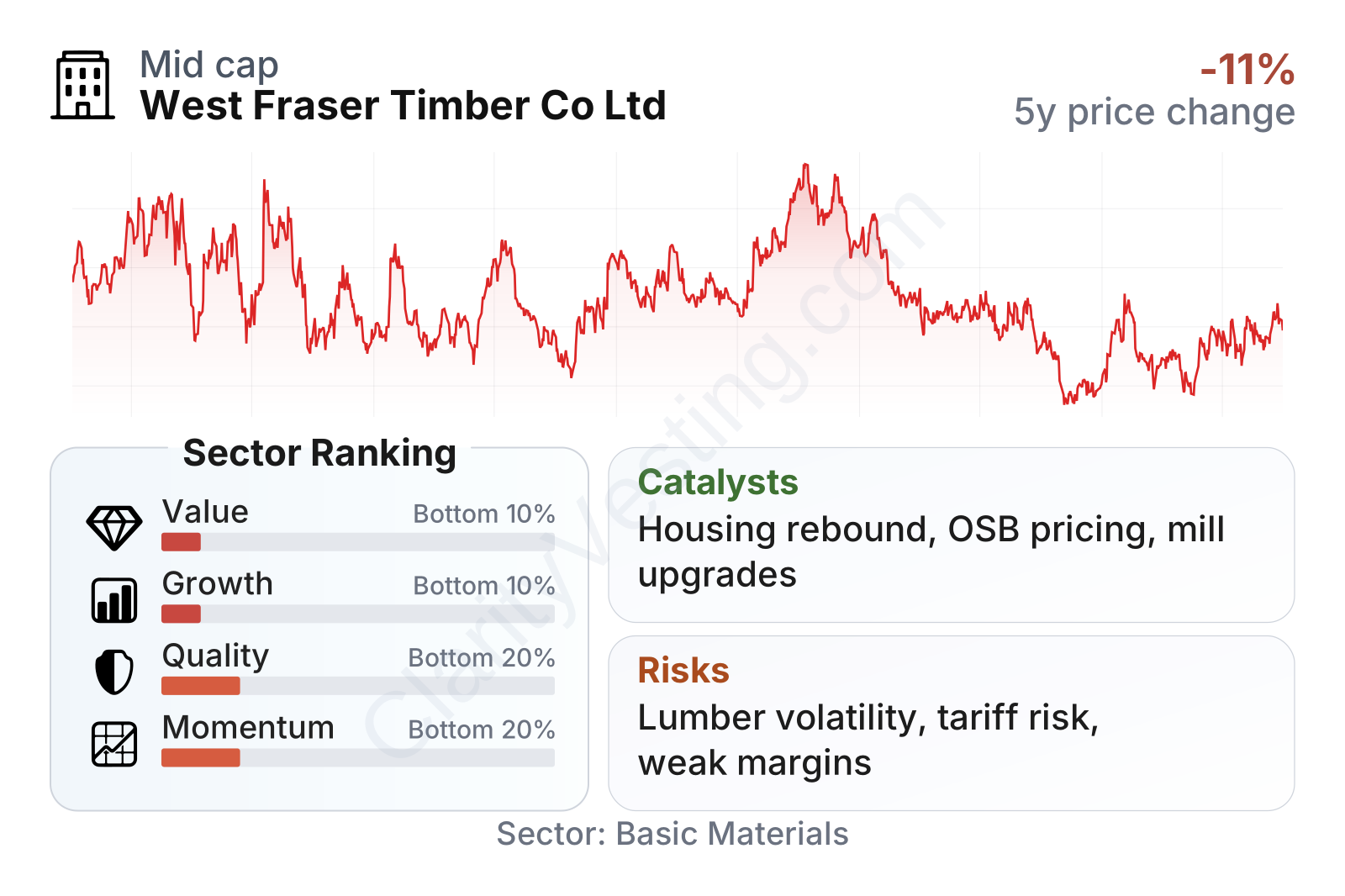
West Fraser is a mid-to-large player in its industry, with share-price behavior that is somewhat more volatile than the broad market but not unusually extreme for a cyclical materials company. The current factor profile is weak in value, growth, and quality relative to the sector, largely because recent earnings and cash flow have deteriorated sharply. Momentum is somewhat better than those fundamentals suggest, with the stock trading above its long-term average and a stronger six-month move than the sector median, but the longer three-year picture remains subdued.
Growth
West Fraser operates in a sector that has real long-term demand support, but it is not a straight-line growth industry. Wood products benefit from household formation, repair and remodeling activity, and the need for more housing supply in North America. Wood also has a role in lighter-carbon building materials, which supports the case for continued relevance over time. However, near-term performance depends heavily on housing starts, mortgage rates, and commodity panel prices.
The company’s strategy is sensible for this type of business. West Fraser has built scale across lumber, OSB, and engineered wood, which helps it serve different parts of the construction market instead of relying on a single product line. Management has also spent years expanding its U.S. manufacturing footprint, which reduces exposure to a single geography and gives it more access to major end markets. In cyclical industries, scale, mill quality, and cost position often matter more than rapid expansion.
Revenue growth has been under pressure for an extended period. After the extraordinary pricing environment of 2021 and part of 2022, year-over-year comparisons turned negative and have largely stayed there. That pattern indicates the business is still working through a difficult part of the cycle rather than showing a clean operating recovery.
Cash generation tells a similar story. Free cash flow moved from very strong levels a few years ago to negative territory more recently. For a commodity producer, this matters because long-term value creation depends on producing cash through the cycle, not just posting accounting profits during peak pricing periods. The positive angle is that West Fraser entered this weaker phase from a position of financial strength, giving it more room to absorb a downturn than a highly leveraged competitor.
Potential catalysts are mainly cyclical and operational. A recovery in U.S. housing starts, lower interest rates that improve affordability, and firmer OSB or lumber pricing could lift earnings materially because of the company’s operating leverage. There is also a structural angle: if building codes and developer preferences continue to support wood-intensive construction, West Fraser’s broad product offering could benefit. Recent company updates have also pointed to ongoing mill optimization, capital upgrades, and portfolio discipline, which can improve returns when demand normalizes.
Risks
This article is for informational purposes only and does not constitute financial advice. Some content is AI-generated. See Disclaimer