Stock Analysis · Woori Financial Group Inc (WF)
Overview
Woori Financial Group is one of South Korea’s major banking groups. It provides traditional banking services such as deposits, loans, cards, and corporate finance, while also operating in securities, asset management, capital markets, and insurance-related activities through subsidiaries. For most readers, the simplest way to think about Woori is as a large domestic financial group centered on Woori Bank, with additional businesses that broaden its customer reach and fee income.
The group’s revenue is still dominated by banking activity. Based on the company’s business structure and public reporting, the main sources of revenue can be summarized as follows:
- Banking: about 75% to 85% — interest income from loans to households and businesses, plus deposit-related spread income and basic banking fees.
- Credit card and consumer finance: about 5% to 10% — card fees, installment finance, and consumer lending.
- Capital markets, securities, and investment-related activities: about 5% to 10% — brokerage, trading, underwriting, wealth products, and market-related income.
- Asset management, leasing, savings bank, and other financial services: about 5% to 10% — trust services, leasing, savings bank operations, and other subsidiary businesses.
That mix matters because it shows both strength and concentration. Woori benefits from the scale and stability of a large commercial bank, but its earnings still depend heavily on the health of Korea’s credit cycle, interest-rate conditions, and loan demand. Over the last several years, revenue expanded materially, but the path of profitability has been less smooth as funding costs and credit conditions shifted.
The business has grown its top line strongly since 2021, but the flow from revenue to net income has been pressured at times by higher interest expense and operating costs. That suggests Woori is not just a simple volume-growth case; efficiency and asset quality remain central to how much of that revenue ultimately turns into shareholder earnings.
Key Figures
| Metric | Value | Sector ⓘ |
|---|---|---|
| Date | Nov 21, 2026 | |
| Context | ||
| Sector | Financial Services | |
| Industry | Banks - Regional | |
| Market Cap ⓘ | $17.26B | |
| Beta ⓘ | 0.56 | |
Value (Cheapness) | ||
| P/E Ratio ⓘ | 8.83 | 12.01 |
| P/B Ratio ⓘ | N/A | 1.48 |
| FCF Yield ⓘ | 3.00% | 8.77% |
| Dividend Yield ⓘ | 4.05% | 3.01% |
| EBIT / EV ⓘ | N/A | 8.31% |
| PEG ⓘ | 2.46 | |
Growth (Business expansion) | ||
| Revenue Growth ⓘ | 17.80% | 6.70% |
| RPS Growth (5Y CAGR) ⓘ | -1.45% | 12.35% |
| EPS Growth (5Y CAGR) ⓘ | -82.98% | -0.27% |
| BVPS Growth (5Y CAGR) ⓘ | 31.90% | 4.83% |
| Margin Growth (5Y Trend) ⓘ | 70.52% | -4.16% |
| FCF Growth (5Y CAGR) ⓘ | N/A | 4.69% |
| DPS Growth (5Y CAGR) ⓘ | 63.90% | 8.82% |
Quality (Business durability) | ||
| ROIC (Latest) ⓘ | N/A | 9.49% |
| ROE (Latest) ⓘ | 8.50% | 14.02% |
| ROA (Latest) ⓘ | 0.50% | 1.53% |
| ROIC (5Y Median) ⓘ | 2.86% | 7.80% |
| ROE (5Y Median) ⓘ | 9.41% | 12.09% |
| ROA (5Y Median) ⓘ | 0.60% | 1.28% |
| Net Debt / EBIT (Latest) ⓘ | N/A | 0.88 |
| Net Debt / EBIT (5Y Median) ⓘ | 13.39 | 0.73 |
| Net Debt / EBITDA (Latest) ⓘ | 14.25 | 0.71 |
| Operating Margin (Latest) ⓘ | N/A | 23.37% |
| Operating Margin (5Y Median) ⓘ | 26.16% | 24.29% |
| Debt to Equity (Latest) ⓘ | 256.62% | 59.34% |
| Profit Margin (Latest) ⓘ | 27.36% | 26.65% |
| Free Cash Flow (Latest) ⓘ | $517.41M | |
Momentum (Price trend) | ||
| 3Y Return ⓘ | +191.79% | +73.29% |
| 12M Return (excl. last month) ⓘ | +33.59% | +18.35% |
| 6M Return ⓘ | +12.10% | +3.24% |
| Price vs. 200-Day MA ⓘ | +0.99% | +2.17% |
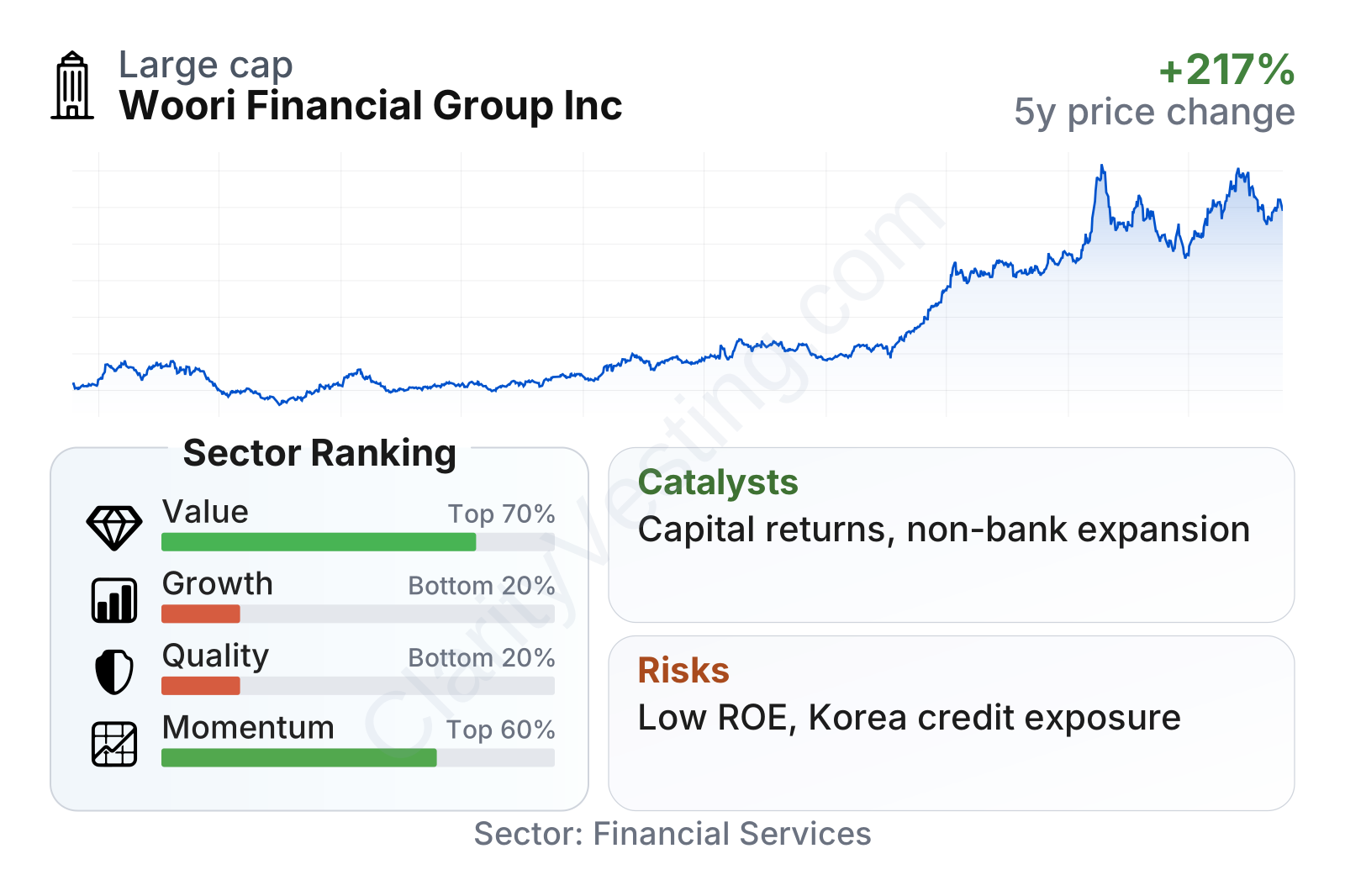
Woori stands out as a large regional bank with a relatively low share-price volatility profile, shown by a beta well below 1. On valuation, it screens cheaper than much of the sector, with a price-to-earnings ratio around the high-single digits and a dividend yield above the sector median. Momentum has also been strong, with multiyear and recent price performance ahead of many peers.
The weaker area is business quality and long-term growth consistency. Revenue growth over the last year has been broadly in line with the sector, but longer-term per-share growth has been less impressive, especially for earnings. Profitability remains mixed: profit margin is solid, yet returns on equity and assets sit below sector norms. In simple terms, the market appears to be recognizing Woori’s income generation and low valuation, while still discounting its lower efficiency and return profile relative to stronger banking peers.
Growth
Woori operates in a mature sector rather than a fast-growing one. Banking in South Korea is not a high-expansion industry in the way cloud software or semiconductors can be, but it can still produce meaningful long-term compounding when loan growth, fee income, capital returns, and disciplined risk management work together. That makes future growth less about disruption and more about improving profitability, expanding non-bank earnings, and keeping credit losses under control.
A sensible part of Woori’s strategy is diversification beyond plain-vanilla lending. Large Korean financial groups have been trying to build more balanced earnings through cards, securities, wealth management, and other fee-based services. For Woori, that matters because a broader revenue base can reduce dependence on pure interest spreads. If the company can keep expanding these businesses without taking excessive risk, it would support a more resilient earnings profile over time.
Earnings per share improved sharply from 2022 through 2025, which indicates the group was able to translate stronger business conditions into higher bottom-line results. However, the broader five-year growth record is not clean, and recent trailing figures look distorted compared with the prior full-year trend. For a long-term view, the key question is not whether one year looked strong, but whether Woori can sustain earnings through different rate and credit environments.
Book value per share has risen substantially over time despite some fluctuations. For banks, book value is an important anchor because it reflects the capital base supporting lending and financial activities. Woori’s growth here has been much stronger than the sector median over five years, which is a constructive sign for balance-sheet accumulation even if earnings growth has been uneven.
One notable catalyst is capital return. Woori has delivered strong dividend-per-share growth over the last five years, far above the sector median, and that can make the stock more visible when profitability is steady. Another catalyst is any continued progress in boosting non-bank profit contributions, because that would help narrow the gap with more diversified financial groups in Korea. If interest rates remain supportive for bank margins and credit costs stay manageable, that would also help the earnings outlook.
Risks
This article is for informational purposes only and does not constitute financial advice. Some content is AI-generated. See Disclaimer


