Stock Analysis · Werner Enterprises Inc (WERN)
Overview
Werner Enterprises is a large U.S. transportation and logistics company best known for moving freight by truck. Its core business is hauling goods for customers across North America, but it also operates logistics services that arrange transportation through a broader network of carriers. In simple terms, Werner earns money both by using its own trucks and drivers and by acting as a freight manager for shippers that need capacity, routing, and supply-chain coordination.
The business is organized mainly into two segments: Truckload Transportation Services and Werner Logistics. Truckload includes the company’s dedicated fleet operations, one-way truckload, expedited services, regional short-haul, cross-border freight, and temperature-controlled offerings. Werner Logistics includes freight brokerage, managed transportation, intermodal, and final-mile services.
Based on the latest annual reporting structure, revenue is split approximately as follows:
- Truckload Transportation Services: about 70% to 75% of revenue. This is the asset-heavy part of the business, using Werner’s tractors, trailers, drivers, and dedicated fleet arrangements.
- Werner Logistics: about 25% to 30% of revenue. This includes freight brokerage, transportation management, intermodal coordination, and other non-asset or lighter-asset logistics services.
Within Truckload, dedicated services have been an important focus because they usually involve longer customer relationships and more predictable freight flows than spot-market trucking. That matters in a cyclical industry where pricing can change quickly.
The multi-year operating picture shows a business that reached very strong profitability in 2021 and 2022, then saw a sharp margin reset as freight conditions weakened. Revenue stayed near the $3 billion range, but profit converted much less efficiently into operating income and, more recently, slipped into a small net loss on a trailing basis. That makes Werner look less like a straightforward volume growth case and more like a recovery-and-execution case.
Key Figures
| Metric | Value | Sector ⓘ |
|---|---|---|
| Date | Oct 17, 2026 | |
| Context | ||
| Sector | Industrials | |
| Industry | Trucking | |
| Market Cap ⓘ | $1.93B | |
| Beta ⓘ | 1.29 | |
Value (Cheapness) | ||
| P/E Ratio ⓘ | N/A | 22.10 |
| P/B Ratio ⓘ | 1.47 | 1.97 |
| FCF Yield ⓘ | 2.76% | 6.38% |
| Dividend Yield ⓘ | 1.71% | 1.94% |
| EBIT / EV ⓘ | -0.73% | 4.79% |
| PEG ⓘ | 3.83 | |
Growth (Business expansion) | ||
| Revenue Growth ⓘ | 24.00% | 9.30% |
| RPS Growth (5Y CAGR) ⓘ | 5.05% | 7.81% |
| EPS Growth (5Y CAGR) ⓘ | -51.87% | -13.06% |
| BVPS Growth (5Y CAGR) ⓘ | 3.00% | 6.14% |
| Margin Growth (5Y Trend) ⓘ | -12.20% | 0.88% |
| FCF Growth (5Y CAGR) ⓘ | N/A | 11.01% |
| DPS Growth (5Y CAGR) ⓘ | 7.02% | 9.48% |
Quality (Business durability) | ||
| ROIC (Latest) ⓘ | -0.83% | 10.84% |
| ROA (Latest) ⓘ | -1.51% | 5.41% |
| ROIC (5Y Median) ⓘ | 6.39% | 9.38% |
| ROA (5Y Median) ⓘ | 3.55% | 4.95% |
| Net Debt / EBIT (Latest) ⓘ | N/A | 2.08 |
| Net Debt / EBIT (5Y Median) ⓘ | 3.44 | 2.27 |
| Net Debt / EBITDA (Latest) ⓘ | 3.08 | 1.39 |
| Net Debt / Assets ⓘ | 28.04% | 19.28% |
| EBITDA / Interest ⓘ | 6.61 | 9.58 |
| Operating Margin (Latest) ⓘ | -0.66% | 10.50% |
| Operating Margin (5Y Median) ⓘ | 5.52% | 10.29% |
| Debt to Equity (Latest) ⓘ | 69.45% | 65.48% |
| Profit Margin (Latest) ⓘ | -1.42% | 6.67% |
| Free Cash Flow (Latest) ⓘ | $53.37M | |
Momentum (Price trend) | ||
| 3Y Return ⓘ | -11.64% | +61.68% |
| 12M Return (excl. last month) ⓘ | +36.51% | +12.58% |
| 6M Return ⓘ | +3.07% | 0.00% |
| Price vs. 200-Day MA ⓘ | -9.59% | +0.02% |
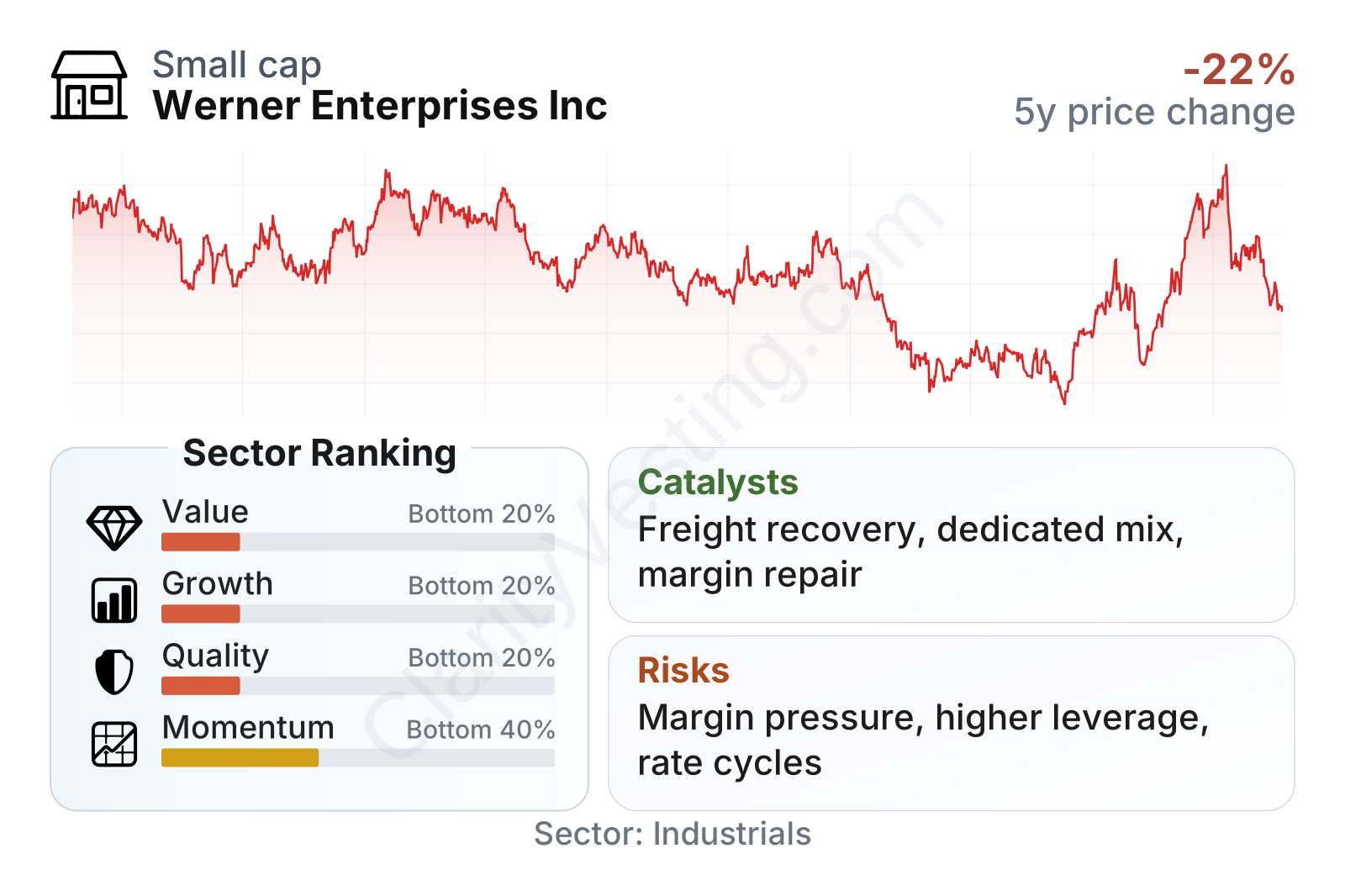
Werner is a mid-sized transportation company with a market value around $2 billion, so it is large enough to have national scale but still small compared with the biggest freight and parcel platforms. The factor profile is weak overall versus the broader industrial sector: value, growth, and quality all rank in the bottom 20%, while momentum is somewhat better but still below average. The main reason is simple: recent earnings and returns on capital have deteriorated faster than the sector median, while leverage has moved up and free cash flow remains modest relative to the company’s size.
The stock chart also highlights how cyclical the business is. The share price was far stronger earlier in the decade, then dropped materially during the freight downturn before rebounding sharply in 2026. That rebound suggests the market is starting to price in stabilization, but the operating profile still looks much weaker than it did a few years ago.
Growth
The trucking and logistics sector is structurally important because freight movement remains essential to retail, manufacturing, food, industrial supply chains, and e-commerce fulfillment. Over the long run, that gives the industry relevance. However, it is not a smooth growth market. Demand depends heavily on the economy, inventory cycles, industrial output, and freight capacity. For Werner, the long-term opportunity is less about the industry growing rapidly every year and more about gaining share, improving mix, and using its network more efficiently.
Werner’s strategy makes sense on paper. The company has emphasized dedicated fleet services, logistics, and cross-border capabilities rather than relying only on volatile one-way truckload exposure. Dedicated contracts can support steadier asset utilization, while logistics expands the service offering without requiring the same level of truck ownership. If management executes well, that mix can make earnings less volatile over time than a pure spot-market trucker.
Revenue growth shows why the current debate around Werner is complicated. After strong expansion in 2021 and 2022, the company moved through several quarters of contraction in 2023 and 2024 before returning to positive year-over-year growth in 2026, with recent growth running above the sector median. That improvement is encouraging because it suggests freight conditions or company-specific execution may be recovering. Still, one or two stronger periods do not erase the deeper profit pressure seen over the last few years.
Cash generation remains a point to watch closely. Free cash flow has been negative in several trailing periods, although the latest metric points back to positive territory at a modest level. For a trucking company, this matters because fleets require ongoing capital spending for tractors, trailers, maintenance, and technology. A recovery in free cash flow would be a more durable sign of progress than revenue growth alone.
Potential catalysts are tied mainly to freight-cycle normalization and mix improvement. If truckload pricing firms up, asset utilization improves, and dedicated and logistics operations contribute a larger share of profits, Werner could see a meaningful earnings recovery even without dramatic revenue expansion. Public company updates in 2026 also point to continued attention on fleet productivity, cost control, and network efficiency, all of which are central to margin repair.
Risks
This article is for informational purposes only and does not constitute financial advice. Some content is AI-generated. See Disclaimer


