Stock Analysis · Weimob Inc (WEMXF)
Overview
Weimob Inc is a China-based software company focused on digital tools for merchants. Its products help businesses build online stores, manage customers, run marketing campaigns, and operate sales across platforms such as WeChat and other major Chinese internet ecosystems. In simple terms, Weimob sells the software and related services that allow brands and retailers to run more of their business online.
The company’s business is usually described around two main engines: software subscriptions for merchants and merchant-related services that support transactions, marketing, and operations. Based on recent annual reporting, revenue is mainly split as follows:
- Digital commerce and merchant solutions: approximately 70% to 80% of revenue. This includes subscription software, store-building tools, customer management, marketing applications, and commerce operating systems used by brands and small-to-medium merchants.
- Merchant services and targeted marketing: approximately 20% to 30% of revenue. This includes value-added services tied to merchant operations, traffic acquisition, and transaction-related services.
Within that mix, software tends to be the more strategically important segment because it can create recurring relationships, while service revenue can be more sensitive to client activity and ad spending. The business model therefore combines a SaaS-like subscription layer with a service layer linked to merchant demand.
Profitability has been the central issue. Revenue has moved unevenly over the last several years, and the company has posted repeated losses. However, the cost structure improved materially in 2025: operating losses narrowed sharply, selling expenses came down, financing costs eased, and net losses became far smaller than in prior years. That suggests restructuring efforts are having an effect, even if the overall financial profile remains weak.
The long-term pattern shows a business that still generates solid gross profit relative to revenue, but has historically spent too much on operating expenses to convert that into earnings. The most encouraging recent change is not explosive top-line expansion, but a visible reduction in losses and a leaner expense base.
Key Figures
| Metric | Value | Sector ⓘ |
|---|---|---|
| Date | Oct 31, 2026 | |
| Context | ||
| Sector | Technology | |
| Industry | Software - Application | |
| Market Cap ⓘ | $825.29M | |
| Beta ⓘ | 1.06 | |
Value (Cheapness) | ||
| P/E Ratio ⓘ | N/A | 29.73 |
| FCF Yield ⓘ | -77.21% | 3.96% |
| Dividend Yield ⓘ | N/A | 1.30% |
| EBIT / EV ⓘ | N/A | 2.90% |
| PEG ⓘ | N/A | |
Growth (Business expansion) | ||
| Revenue Growth ⓘ | 12.10% | 15.80% |
| RPS Growth (5Y CAGR) ⓘ | -15.12% | 8.54% |
| EPS Growth (5Y CAGR) ⓘ | N/A | -10.19% |
| Margin Growth (5Y Trend) ⓘ | N/A | 0.45% |
| FCF Growth (5Y CAGR) ⓘ | -32.56% | 9.80% |
| DPS Growth (5Y CAGR) ⓘ | -50.30% | 7.67% |
Quality (Business durability) | ||
| ROIC (Latest) ⓘ | N/A | 9.74% |
| ROIC (5Y Median) ⓘ | -13.31% | 8.31% |
| Net Debt / EBIT (Latest) ⓘ | N/A | 0.53 |
| Net Debt / EBIT (5Y Median) ⓘ | N/A | 0.46 |
| Net Debt / EBITDA (Latest) ⓘ | N/A | 0.29 |
| Net Debt / Assets ⓘ | 5.34% | 3.45% |
| EBITDA / Interest ⓘ | N/A | 13.54 |
| Operating Margin (Latest) ⓘ | -8.80% | 10.12% |
| Operating Margin (5Y Median) ⓘ | -35.82% | 8.50% |
| Debt to Equity (Latest) ⓘ | 85.12% | 35.18% |
| Profit Margin (Latest) ⓘ | -20.50% | 7.13% |
| Free Cash Flow (Latest) ⓘ | -$637.23M | |
Momentum (Price trend) | ||
| 3Y Return ⓘ | -55.62% | +61.79% |
| 12M Return (excl. last month) ⓘ | -50.15% | +12.78% |
| 6M Return ⓘ | -31.56% | +7.85% |
| Price vs. 200-Day MA ⓘ | -16.74% | +5.43% |
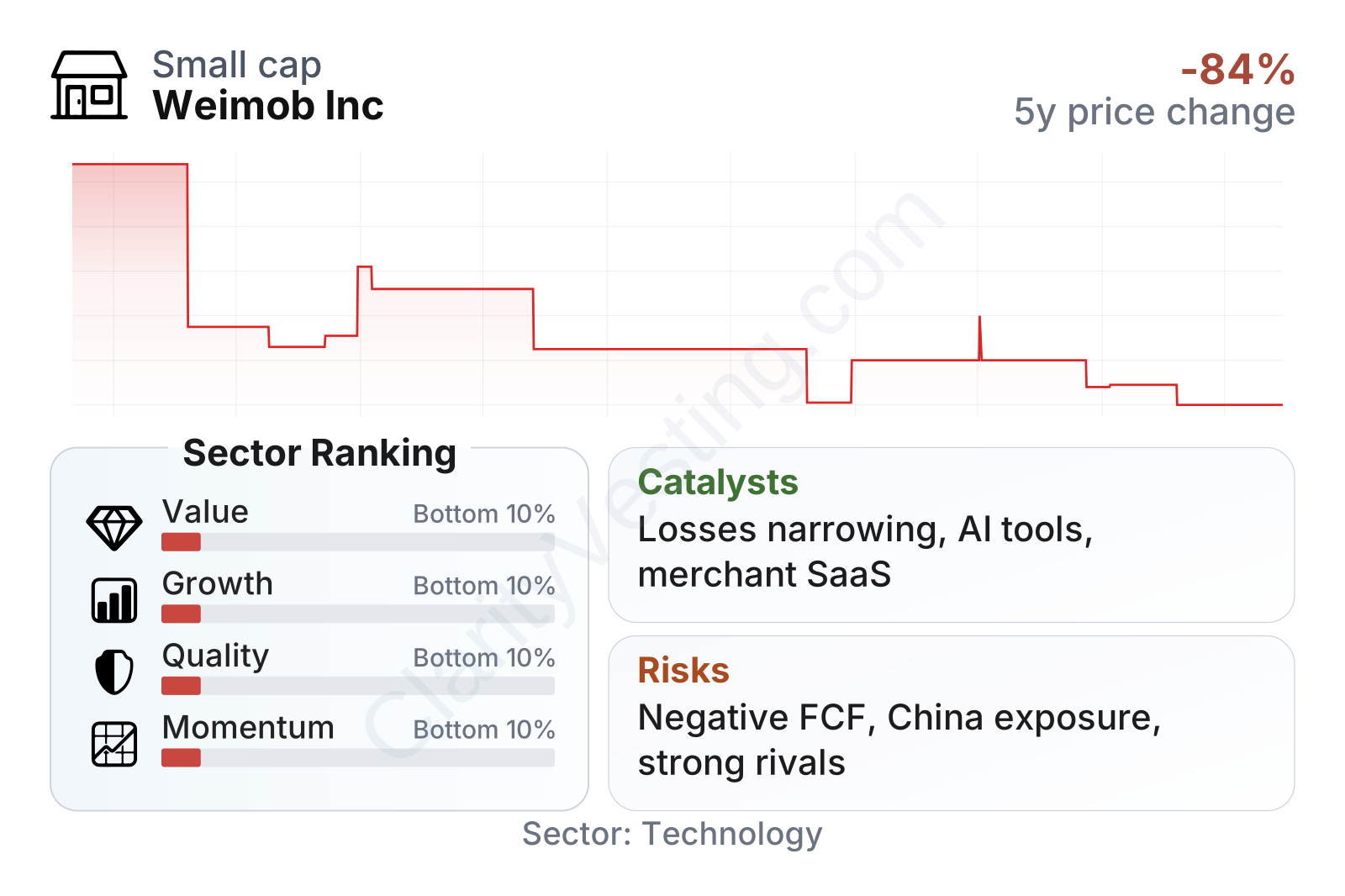
Weimob is a small-cap software company with share-price behavior that has broadly tracked market volatility, but the longer trend has been clearly negative. The stock has fallen substantially from 2021 levels and has remained under pressure more recently, reflecting weak profitability, inconsistent growth, and caution around Chinese technology names.
The metrics table points to a business that currently ranks near the bottom of its software peer group on value, quality, growth, and momentum. Revenue is still growing year over year at a low-double-digit pace, but that remains below the sector median. Profitability is also far weaker than peers, with negative operating and net margins, negative free cash flow, and leverage that is elevated for a company without stable earnings. In short, the company is showing signs of operational repair, but those improvements have not yet lifted it into a stronger financial category.
Growth
Weimob operates in a sector that still has structural growth behind it. Chinese merchants continue to digitize storefronts, customer engagement, and order management, while brands increasingly need tools that connect social media, private traffic, and online commerce. Those are durable themes, and they support demand for software that helps merchants manage data, marketing, and transactions in one place.
The company’s strategy is logically aligned with that trend. Weimob is positioned around commerce infrastructure for merchants rather than around direct consumer platforms, which can be attractive because it ties the business to digital transformation spending across many customers instead of relying on a single end market. Its focus on integrating commerce and marketing also matches how many Chinese brands now operate, especially through super-app ecosystems and social channels.
A meaningful catalyst is the company’s shift from aggressive spending toward efficiency. The sharp improvement in 2025 losses indicates management has been willing to cut costs and streamline operations. If that discipline continues while revenue stabilizes, the business could look materially different from the version the market priced during the heaviest loss-making years.
Another potential support is artificial intelligence. Like many application software providers, Weimob has been incorporating AI-related functions into merchant tools, especially in marketing, customer operations, and content workflows. That does not automatically create new revenue, but it can improve product relevance, reduce merchant workload, and potentially raise customer stickiness if execution is strong.
Recent corporate updates have also emphasized continued product development and merchant-service refinement. For a company at this stage, the biggest opportunity is less about one headline event and more about proving that normalized revenue, tighter costs, and product upgrades can coexist over several reporting periods.
Risks
This article is for informational purposes only and does not constitute financial advice. Some content is AI-generated. See Disclaimer