Stock Analysis · Welltower Inc (WELL)
Overview
Welltower Inc. is a large healthcare real estate investment trust, or REIT. In simple terms, it owns properties tied to healthcare and aging-related services and earns income mainly from rent and property-level operations. Its portfolio is concentrated in markets with higher incomes, dense populations, and strong healthcare demand, especially in the United States, Canada, and the United Kingdom. The company has built its business around housing, care, and outpatient settings that serve older adults and health systems.
The biggest revenue driver is its seniors housing business, especially communities operated under management arrangements where Welltower participates more directly in property-level results rather than collecting only fixed rent. A smaller but still important part comes from outpatient medical properties and long-term care facilities leased to operators.
Based on recent company reporting, Welltower’s revenue mix is approximately:
- Seniors Housing Operating: about 70% of total revenue. This includes senior living communities where revenue depends on occupancy, resident rates, and operating performance.
- Triple-net leased properties: about 17% of total revenue. These are properties leased to operators who typically pay rent, property taxes, insurance, and maintenance costs.
- Outpatient medical: about 12% of total revenue. This includes medical office and ambulatory care properties located near hospitals and health systems.
- Other: about 1%. This includes smaller items such as loans and miscellaneous real estate-related income.
That mix matters because it shows Welltower is no longer just a passive landlord. A much larger share of its business now benefits directly from improving senior housing fundamentals, which can lift revenue faster when occupancy and pricing rise, but can also make results more sensitive to operating conditions.
Over the last several years, revenue has climbed strongly and gross profit has expanded with it. The more notable change is that operating profit has been less smooth, reflecting the higher volatility that comes with a larger seniors housing operating platform and heavier overhead in the latest period.
Key Figures
| Metric | Value | Sector ⓘ |
|---|---|---|
| Date | Oct 24, 2026 | |
| Context | ||
| Sector | Real Estate | |
| Industry | REIT - Healthcare Facilities | |
| Market Cap ⓘ | $171.06B | |
| Beta ⓘ | 0.75 | |
Value (Cheapness) | ||
| P/E Ratio ⓘ | 106.46 | 17.85 |
| P/B Ratio ⓘ | 3.74 | 0.87 |
| FCF Yield ⓘ | 1.56% | 7.30% |
| Dividend Yield ⓘ | 1.31% | 4.83% |
| EBIT / EV ⓘ | 0.28% | 3.78% |
| PEG ⓘ | 3.62 | |
Growth (Business expansion) | ||
| Revenue Growth ⓘ | 39.10% | 5.35% |
| RPS Growth (5Y CAGR) ⓘ | 9.22% | 6.02% |
| EPS Growth (5Y CAGR) ⓘ | 63.57% | -10.65% |
| BVPS Growth (5Y CAGR) ⓘ | 11.52% | 0.43% |
| Margin Growth (5Y Trend) ⓘ | -12.42% | -0.69% |
| FCF Growth (5Y CAGR) ⓘ | 22.71% | 5.40% |
| DPS Growth (5Y CAGR) ⓘ | 3.30% | 5.07% |
Quality (Business durability) | ||
| ROIC (Latest) ⓘ | N/A | 5.69% |
| ROE (Latest) ⓘ | 3.18% | 7.37% |
| ROA (Latest) ⓘ | 2.08% | 2.85% |
| ROIC (5Y Median) ⓘ | 2.10% | 4.26% |
| ROE (5Y Median) ⓘ | 2.04% | 6.04% |
| ROA (5Y Median) ⓘ | 1.00% | 2.45% |
| Net Debt / EBIT (Latest) ⓘ | 34.40 | 7.55 |
| Net Debt / EBIT (5Y Median) ⓘ | 20.40 | 8.26 |
| Net Debt / EBITDA (Latest) ⓘ | 5.89 | 5.26 |
| Net Debt / Assets ⓘ | 25.41% | 37.45% |
| EBITDA / Interest ⓘ | 4.07 | 4.11 |
| Operating Margin (Latest) ⓘ | 4.09% | 33.86% |
| Operating Margin (5Y Median) ⓘ | 13.99% | 37.49% |
| Debt to Equity (Latest) ⓘ | 42.49% | 88.76% |
| Profit Margin (Latest) ⓘ | 12.15% | 18.94% |
| Free Cash Flow (Latest) ⓘ | $2.66B | |
Momentum (Price trend) | ||
| 3Y Return ⓘ | +203.34% | +36.33% |
| 12M Return (excl. last month) ⓘ | +39.64% | +4.32% |
| 6M Return ⓘ | +19.73% | -1.74% |
| Price vs. 200-Day MA ⓘ | +9.86% | -1.42% |
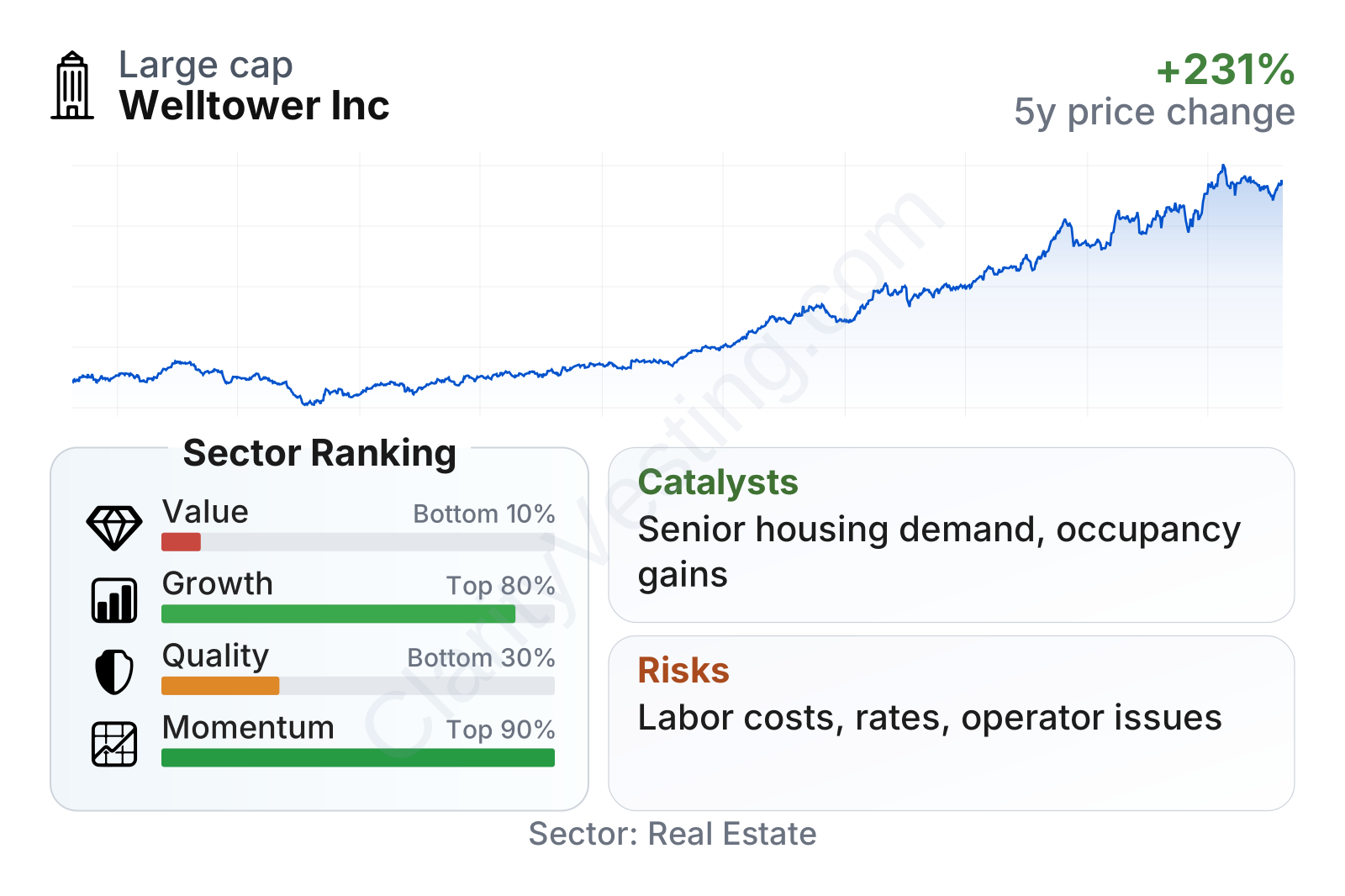
Welltower is one of the largest companies in its industry and its share price momentum has been much stronger than the broader real estate sector. Growth metrics are also above sector norms, especially on revenue and cash flow expansion. The weaker areas are valuation and profitability: the stock trades at a steep premium to most real estate peers, while return measures and margins remain less impressive than the sector median.
The stock’s long-term price climb has been dramatic since late 2022, which helps explain why the dividend yield now looks low by REIT standards. A beta below 1 also suggests the stock has historically moved less violently than the broader equity market, even though operational performance remains tied to economic and interest-rate conditions.
Growth
Welltower operates in a part of real estate with favorable long-term demand. Aging populations in the U.S., Canada, and the U.K. are increasing the need for senior housing, memory care, and healthcare-related facilities. In senior housing, a particularly important dynamic is that the population aged 80 and older is growing faster than new supply in many markets. That can create a better environment for occupancy gains and rent increases over time.
The company’s strategy is built around this trend. It has been shifting capital toward senior housing communities in markets where barriers to new development are higher and demand is more durable. It has also emphasized data, operating partnerships, and local market selection rather than simply owning a very broad set of healthcare properties. For long-term readers, the key point is that Welltower is trying to place itself where demographics are strongest and new competition is harder to add quickly.
Revenue per share has shown a solid upward trend over the past five years, with a particularly strong step-up in the latest year. That suggests growth has not come only from issuing more shares or buying more assets, but also from improving the earning power attached to each share.
Dividend per share has also moved upward, although at a much slower pace than revenue. That gap indicates management has kept more financial flexibility inside the business while it continues to invest in expansion and portfolio repositioning. At the same time, because the stock price has risen much faster than the dividend, the current yield sits well below the REIT sector median.
A major catalyst is the recovery and continued normalization of senior housing operations. If occupancy keeps improving and resident rates remain firm, Welltower can benefit more directly than a landlord that relies mostly on fixed leases. Another growth support is capital recycling: selling lower-priority assets and redeploying funds into properties and markets with better demand and operating potential.
Recent company updates have also pointed to continued investment activity, including acquisitions and development funding tied to senior housing and healthcare infrastructure. Those moves are significant because they show management is still finding places to deploy capital within its core thesis rather than relying only on broad market appreciation.
Risks
This article is for informational purposes only and does not constitute financial advice. Some content is AI-generated. See Disclaimer


