Stock Analysis · The Weir Group PLC (WEIGF)
Overview
The Weir Group PLC is a U.K.-based industrial engineering company that designs and services equipment used in harsh operating environments. Its core focus is mining, where its pumps, valves, crushers, screens, and wear parts help customers move, process, and reduce rock and slurry. The group also has a smaller exposure to infrastructure markets through specialty valves and control products.
For a long-term reader, the easiest way to think about Weir is as a picks-and-shovels business for mining. Rather than taking direct commodity price risk like a miner, it sells essential equipment and replacement parts to mine operators. A large share of its activity comes after the original equipment sale, because installed machines need ongoing maintenance, spare parts, and upgrades.
Based on the company’s recent annual reporting, revenue is mainly split across two divisions, with mining overwhelmingly dominant.
- Minerals: about 90%+ of group revenue. This includes slurry pumps, mill circuit products, crushing and screening equipment, hydrocyclones, wear parts, digital tools, and a large aftermarket service business for mining customers.
- ESCO: about 8% to 10% of group revenue. This business mainly supplies ground engaging tools, buckets, attachments, and wear solutions used in surface mining and infrastructure applications.
That mix matters because Minerals is the company’s largest earnings engine and also the most exposed to long-cycle mining spending, while ESCO adds wear-part and replacement demand tied to fleet usage in mines and construction sites. Geographically, Weir is broad-based, serving customers across the Americas, Asia-Pacific, Europe, the Middle East, and Africa, which reduces dependence on any single country.
The economics of the business are attractive when the installed base grows: original equipment can be cyclical, but aftermarket demand tends to be steadier and usually carries stronger margins. Over the last several years, Weir has also become more focused, exiting oil and gas exposure and concentrating capital on mining technology and service-heavy product lines.
The broad financial flow shows a useful pattern: revenue has risen materially since 2021, while operating income has improved faster than sales. That suggests a healthier mix, pricing discipline, and operating leverage, even though net income has been more uneven because of interest and tax effects.
Key Figures
| Metric | Value | Sector ⓘ |
|---|---|---|
| Date | Oct 24, 2026 | |
| Context | ||
| Sector | Industrials | |
| Industry | Specialty Industrial Machinery | |
| Market Cap ⓘ | $9.35B | |
| Beta ⓘ | 1.09 | |
Value (Cheapness) | ||
| P/E Ratio ⓘ | 26.10 | 22.29 |
| P/B Ratio ⓘ | 4.62 | 1.98 |
| FCF Yield ⓘ | 6.26% | 6.26% |
| Dividend Yield ⓘ | 1.19% | 1.92% |
| EBIT / EV ⓘ | N/A | 4.83% |
| PEG ⓘ | 1.28 | |
Growth (Business expansion) | ||
| Revenue Growth ⓘ | 6.20% | 9.30% |
| RPS Growth (5Y CAGR) ⓘ | 7.44% | 7.76% |
| EPS Growth (5Y CAGR) ⓘ | -40.99% | -13.17% |
| BVPS Growth (5Y CAGR) ⓘ | 7.18% | 6.13% |
| Margin Growth (5Y Trend) ⓘ | 5.97% | 0.74% |
| FCF Growth (5Y CAGR) ⓘ | 26.34% | 10.79% |
| DPS Growth (5Y CAGR) ⓘ | 38.01% | 9.41% |
Quality (Business durability) | ||
| ROIC (Latest) ⓘ | 21.13% | 10.75% |
| ROA (Latest) ⓘ | 13.53% | 5.41% |
| ROIC (5Y Median) ⓘ | 11.62% | 9.37% |
| ROA (5Y Median) ⓘ | 5.93% | 4.95% |
| Net Debt / EBIT (Latest) ⓘ | 1.64 | 2.04 |
| Net Debt / EBIT (5Y Median) ⓘ | 2.63 | 2.27 |
| Net Debt / EBITDA (Latest) ⓘ | 1.31 | 1.39 |
| Net Debt / Assets ⓘ | 31.28% | 19.27% |
| EBITDA / Interest ⓘ | 8.45 | 9.58 |
| Operating Margin (Latest) ⓘ | 17.29% | 10.49% |
| Operating Margin (5Y Median) ⓘ | 14.43% | 10.30% |
| Debt to Equity (Latest) ⓘ | 91.54% | 64.82% |
| Profit Margin (Latest) ⓘ | 10.01% | 6.67% |
| Free Cash Flow (Latest) ⓘ | $585.54M | |
Momentum (Price trend) | ||
| 3Y Return ⓘ | +74.59% | +67.77% |
| 12M Return (excl. last month) ⓘ | +2.25% | +12.05% |
| 6M Return ⓘ | -12.76% | 0.00% |
| Price vs. 200-Day MA ⓘ | +17.88% | +0.67% |
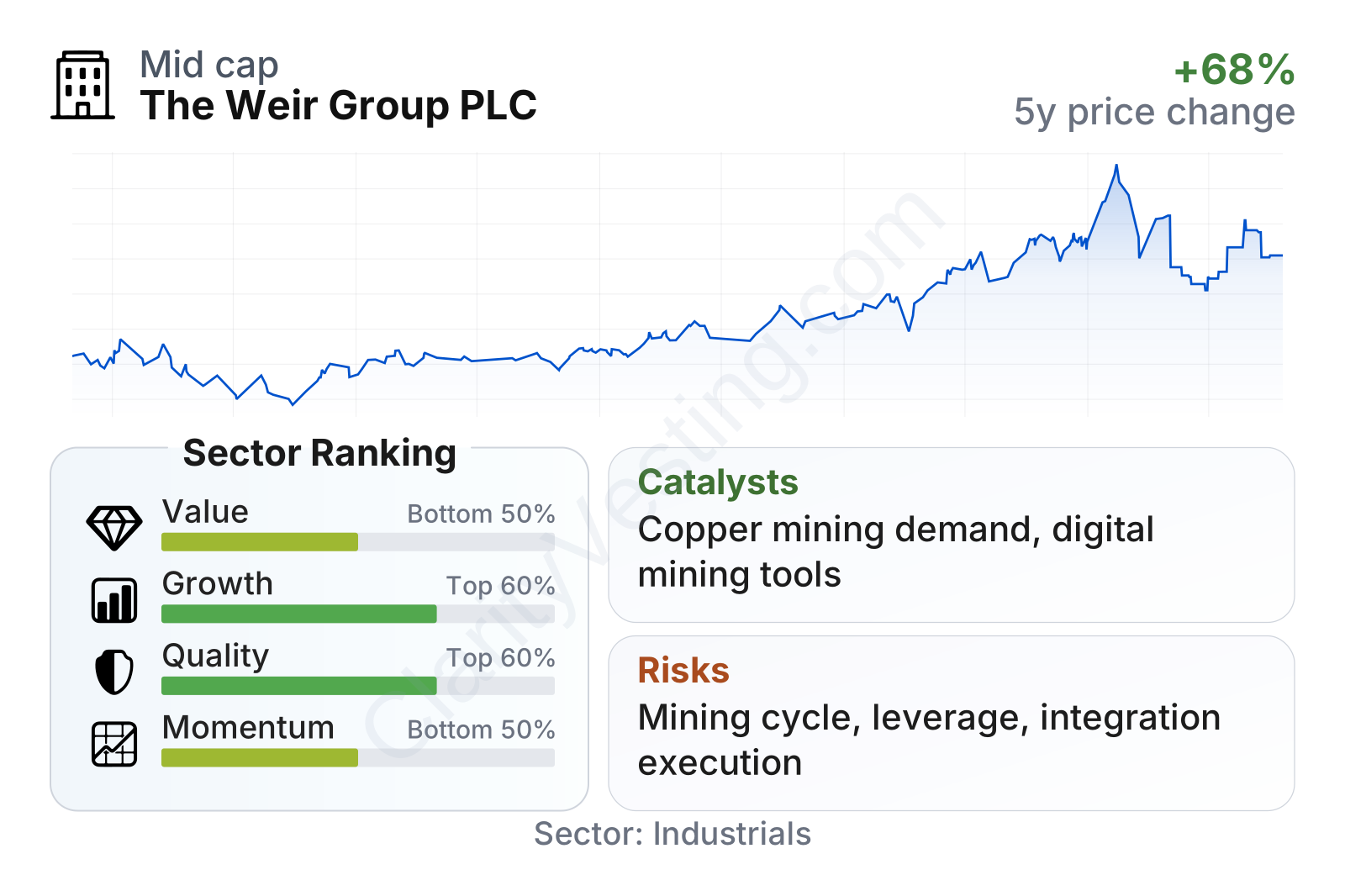
Weir stands in the large-cap range within industrial machinery, with share-price volatility close to the market average. The overall picture from the latest metrics is mixed in a constructive way: quality and cash generation look solid, growth is respectable rather than outstanding, momentum has cooled recently, and valuation multiples sit above sector medians on earnings and book value. Returns on capital and operating margins are notably stronger than many industry peers, which helps explain why the shares do not screen as cheap on simple multiples.
Growth
Weir operates in a sector with credible long-term support. Mining remains essential for copper, iron ore, gold, and other materials, while the energy transition adds demand for metals used in electrification, grid expansion, batteries, and renewable infrastructure. That does not mean mining demand moves in a straight line, but it does create a durable need for productivity tools, replacement parts, and plant-efficiency upgrades.
The company’s strategy is aligned with that backdrop. Management has been concentrating on higher-margin mining technologies, digital optimization tools, and products that help customers improve throughput, reduce water usage, and lower energy intensity. Those are practical selling points for mine operators because they connect directly to operating costs and asset performance, not just expansion budgets.
Another important feature is the aftermarket model. Once Weir equipment is installed in a mine, replacement parts and service often continue for years. That can turn a one-time equipment sale into a recurring revenue stream. It also creates switching friction, since mine operators are reluctant to risk downtime by changing critical process equipment without a strong reason.
Growth has not been explosive, but it has been consistent enough to matter. Recent year-over-year revenue expansion is below the sector median, yet the longer-term pattern still shows a business that has been compounding sales per share and, even more importantly, improving margins and free cash flow at a faster pace. That is often a healthier profile than chasing top-line growth alone.
A notable catalyst in recent years has been the integration and scaling of mining technology platforms such as MOTION METRICS and NEXT Intelligent Solutions, which add data, monitoring, and automation capabilities to traditional equipment lines. This pushes Weir further from pure hardware and deeper into workflow optimization. The acquisition of Micromine also strengthens its exposure to upstream mining software, extending the company’s reach into planning and orebody knowledge. If these tools are adopted more broadly across the installed base, they could support both stickier customer relationships and higher-value revenue over time.
Recent company updates have also highlighted healthy aftermarket demand and a solid mining project pipeline, especially in copper-related markets. That is important because copper is one of the clearest long-term themes in global mining, tied to power networks, electric vehicles, and industrial electrification.
Risks
This article is for informational purposes only and does not constitute financial advice. Some content is AI-generated. See Disclaimer


