Stock Analysis · Weibo Corporation (WEIBF)
Overview
Weibo Corporation operates one of China’s best-known social media platforms. Its service is often compared with a mix of a public newsfeed, microblogging platform, celebrity fan hub, and online discussion network. Users follow public figures, media outlets, brands, and trending topics, while advertisers and merchants use the platform to reach large audiences and turn attention into sales.
The business is still primarily monetized through advertising and marketing services, with a smaller contribution from value-added services. Based on the company’s recent annual disclosures, revenue sources can be summarized as follows:
- Advertising and marketing: about 87% of revenue. This includes brand advertising, promoted content, campaign services, and performance-oriented marketing sold to advertisers across consumer, internet, automotive, e-commerce, and other sectors.
- Value-added services: about 13% of revenue. This includes membership features, social commerce-related services, online games, live or interactive features, and other paid products built on top of the user platform.
That mix matters because it shows Weibo is still heavily tied to ad spending. The upside is that advertising can be very profitable when engagement is stable. The downside is that revenue can be sensitive to weak economic conditions, changes in advertiser budgets, or competition for user attention.
Looking at the broader financial flow over the last several years, revenue has declined from the 2021 peak and then largely stabilized around the mid-$1.7 billion range in 2023 through 2025. At the same time, operating discipline improved: research and development spending came down, selling costs stayed controlled, and operating income recovered strongly by 2025. In other words, Weibo today looks less like a rapid-growth platform and more like a mature digital media business focused on defending profitability and cash generation.
Key Figures
| Metric | Value | Sector ⓘ |
|---|---|---|
| Date | Oct 31, 2026 | |
| Context | ||
| Sector | Communication Services | |
| Industry | Internet Content & Information | |
| Market Cap ⓘ | $3.54B | |
| Beta ⓘ | 0.14 | |
Value (Cheapness) | ||
| P/E Ratio ⓘ | 8.47 | 18.47 |
| FCF Yield ⓘ | N/A | 14.23% |
| Dividend Yield ⓘ | N/A | 2.78% |
| EBIT / EV ⓘ | 78.52% | 4.73% |
| PEG ⓘ | N/A | |
Growth (Business expansion) | ||
| Revenue Growth ⓘ | 2.00% | 6.10% |
| RPS Growth (5Y CAGR) ⓘ | -6.94% | 4.57% |
| EPS Growth (5Y CAGR) ⓘ | -29.63% | -17.96% |
| Margin Growth (5Y Trend) ⓘ | 28.28% | 1.32% |
| FCF Growth (5Y CAGR) ⓘ | -7.31% | 5.75% |
| DPS Growth (5Y CAGR) ⓘ | N/A | 5.19% |
Quality (Business durability) | ||
| ROIC (Latest) ⓘ | 8.17% | 9.19% |
| ROIC (5Y Median) ⓘ | N/A | 8.24% |
| Net Debt / EBIT (Latest) ⓘ | 0.38 | 1.92 |
| Net Debt / EBIT (5Y Median) ⓘ | N/A | 2.88 |
| Net Debt / EBITDA (Latest) ⓘ | 0.38 | 1.22 |
| Net Debt / Assets ⓘ | 3.19% | 18.63% |
| EBITDA / Interest ⓘ | N/A | 8.36 |
| Operating Margin (Latest) ⓘ | 33.74% | 15.68% |
| Operating Margin (5Y Median) ⓘ | 32.69% | 13.39% |
| Debt to Equity (Latest) ⓘ | N/A | 59.65% |
| Profit Margin (Latest) ⓘ | 17.78% | 8.74% |
| Free Cash Flow (Latest) ⓘ | N/A | |
Momentum (Price trend) | ||
| 3Y Return ⓘ | N/A | +46.16% |
| 12M Return (excl. last month) ⓘ | +50.37% | +1.26% |
| 6M Return ⓘ | 0.00% | 0.00% |
| Price vs. 200-Day MA ⓘ | +1.42% | +0.87% |
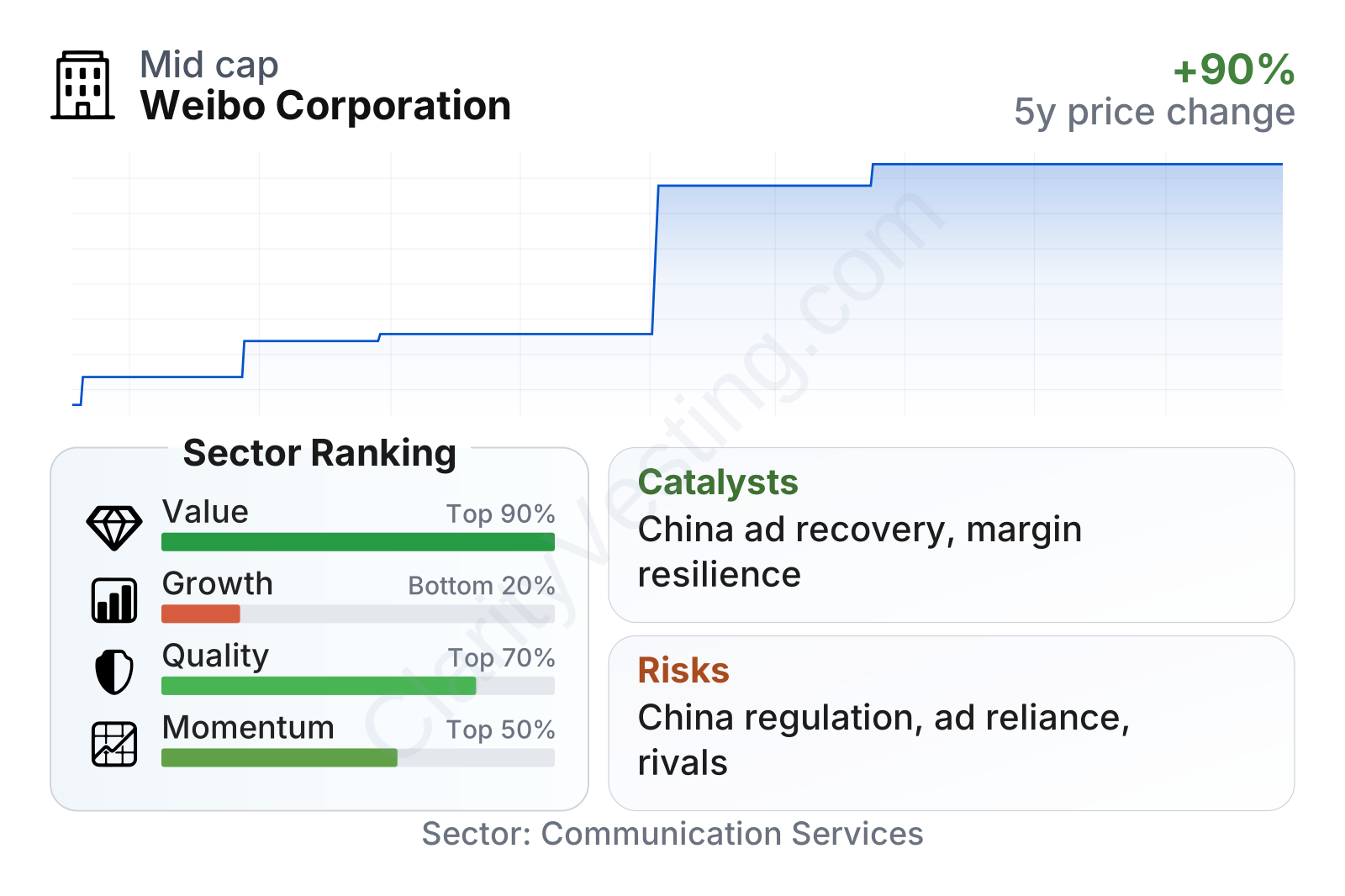
Weibo is a mid-sized communication services company with an unusually low share price volatility for an internet platform, as shown by its very low beta. The most striking part of the metrics table is the contrast between strong value and decent quality versus weak growth. Profitability remains solid, leverage is modest, and margins are well above the sector median, but revenue and earnings growth over longer periods have been under pressure. Recent share price performance has improved noticeably, which suggests the market has been reacting positively to better earnings efficiency and a still-low valuation base.
Growth
Weibo operates in a sector that should still benefit from long-term digital trends: online advertising, creator-led media, social engagement, and commercial activity tied to content. In that sense, the company is not in a shrinking corner of the economy. The challenge is that the fastest-growing parts of Chinese internet traffic have shifted toward short video, algorithm-driven discovery, and integrated commerce ecosystems, where competition is much more intense than it was during Weibo’s earlier expansion years.
Management’s strategy has increasingly centered on improving monetization quality rather than chasing raw scale at any cost. Recent company updates have emphasized refining advertising products, strengthening content ecosystems around hot topics and vertical interests, and improving operating efficiency. That approach makes sense for a mature platform: if user attention can be retained and advertiser tools become more effective, earnings can improve even without strong top-line growth.
A meaningful catalyst is Weibo’s role as a public-interest and trend-driven platform in China. It remains relevant for celebrity culture, news discussion, entertainment promotion, and major social events. That creates recurring demand from brands that want broad visibility. Another possible tailwind is any recovery in China’s advertising market, especially in industries that rely heavily on mass awareness campaigns. Since the business is already highly profitable at the operating level, even modest revenue acceleration could have an outsized effect on earnings.
Recent results also point to a more favorable setup than the longer-term growth profile suggests. Annual revenue has been mostly flat lately rather than falling sharply, while operating income and net income improved materially in the latest full year. That combination can be important: it suggests the business may be moving from contraction toward stabilization, with profitability doing more of the heavy lifting.
Risks
This article is for informational purposes only and does not constitute financial advice. Some content is AI-generated. See Disclaimer


