Stock Analysis · Weir Group PLC (WEGRY)
Overview
Weir Group PLC is a specialized industrial equipment company focused mainly on mining. Its products help customers move, crush, pump, classify, and process abrasive materials such as ore, tailings, and slurry. In simpler terms, Weir sells the heavy-duty machines and replacement parts that mines need to keep operating, especially in demanding environments where equipment wears out quickly.
The business is attractive because a large share of its activity comes after the original equipment sale. Once a mine installs Weir equipment, it typically needs recurring aftermarket parts and maintenance support. That creates a steadier revenue base than a pure one-time equipment model.
Based on recent annual reporting, revenue is centered on two main divisions, with mining clearly dominant.
- Minerals: approximately 88% of revenue. This division supplies pumps, hydrocyclones, valves, crushers, screening equipment, wear parts, and digital tools used in mine processing and comminution.
- ESCO: approximately 12% of revenue. This unit provides ground engaging tools, buckets, lip systems, and wear solutions used mainly in mining and infrastructure earthmoving applications.
Another important way to understand Weir is by revenue mix within those divisions. The group has consistently emphasized aftermarket sales as its economic engine, and these have represented roughly 70% of group revenue in recent years, with original equipment making up roughly 30%. That matters because aftermarket demand is usually more resilient and tends to carry better margins.
Geographically, Weir is globally diversified, serving miners across the Americas, Asia-Pacific, Europe, the Middle East, and Africa. The end-market exposure is especially tied to commodities needed for long-term electrification trends, including copper and iron ore.
The broader income profile has improved over the last few years. Revenue climbed from about £1.9 billion-equivalent levels in 2021 to about £2.5 billion in 2024 and remained around that level in 2025, while operating income expanded meaningfully. Gross profit also improved, showing that the company has not only grown but also become more efficient in turning sales into operating earnings.
The multi-year pattern points to a stronger earnings mix: sales are much higher than in 2021, operating profit has grown materially, and costs of revenue have become better controlled relative to sales. That supports the idea that Weir is benefiting from a richer aftermarket mix and improved execution.
Key Figures
| Metric | Value | Sector ⓘ |
|---|---|---|
| Date | Oct 03, 2026 | |
| Context | ||
| Sector | Industrials | |
| Industry | Specialty Industrial Machinery | |
| Market Cap ⓘ | $9.47B | |
| Beta ⓘ | 1.08 | |
Value (Cheapness) | ||
| P/E Ratio ⓘ | 27.22 | 22.45 |
| P/B Ratio ⓘ | 4.71 | 1.98 |
| FCF Yield ⓘ | 6.19% | 6.31% |
| Dividend Yield ⓘ | 1.54% | 1.96% |
| EBIT / EV ⓘ | N/A | 4.81% |
| PEG ⓘ | 1.31 | |
Growth (Business expansion) | ||
| Revenue Growth ⓘ | 6.20% | 9.10% |
| RPS Growth (5Y CAGR) ⓘ | 6.86% | 7.75% |
| EPS Growth (5Y CAGR) ⓘ | 4.69% | -13.59% |
| BVPS Growth (5Y CAGR) ⓘ | 7.13% | 6.22% |
| Margin Growth (5Y Trend) ⓘ | 5.97% | 0.72% |
| FCF Growth (5Y CAGR) ⓘ | 25.64% | 10.98% |
| DPS Growth (5Y CAGR) ⓘ | 37.26% | 9.48% |
Quality (Business durability) | ||
| ROIC (Latest) ⓘ | 21.17% | 10.92% |
| ROA (Latest) ⓘ | 13.55% | 5.41% |
| ROIC (5Y Median) ⓘ | 11.50% | 9.21% |
| ROA (5Y Median) ⓘ | 5.81% | 4.94% |
| Net Debt / EBIT (Latest) ⓘ | 1.63 | 2.07 |
| Net Debt / EBIT (5Y Median) ⓘ | 2.65 | 2.28 |
| Net Debt / EBITDA (Latest) ⓘ | 1.30 | 1.43 |
| Net Debt / Assets ⓘ | 31.22% | 19.27% |
| EBITDA / Interest ⓘ | 8.50 | 9.53 |
| Operating Margin (Latest) ⓘ | 17.29% | 10.50% |
| Operating Margin (5Y Median) ⓘ | 14.43% | 10.27% |
| Debt to Equity (Latest) ⓘ | 91.54% | 65.48% |
| Profit Margin (Latest) ⓘ | 10.01% | 6.62% |
| Free Cash Flow (Latest) ⓘ | $585.92M | |
Momentum (Price trend) | ||
| 3Y Return ⓘ | +64.85% | +58.56% |
| 12M Return (excl. last month) ⓘ | +16.84% | +15.63% |
| 6M Return ⓘ | -0.97% | +4.19% |
| Price vs. 200-Day MA ⓘ | -4.05% | +0.93% |
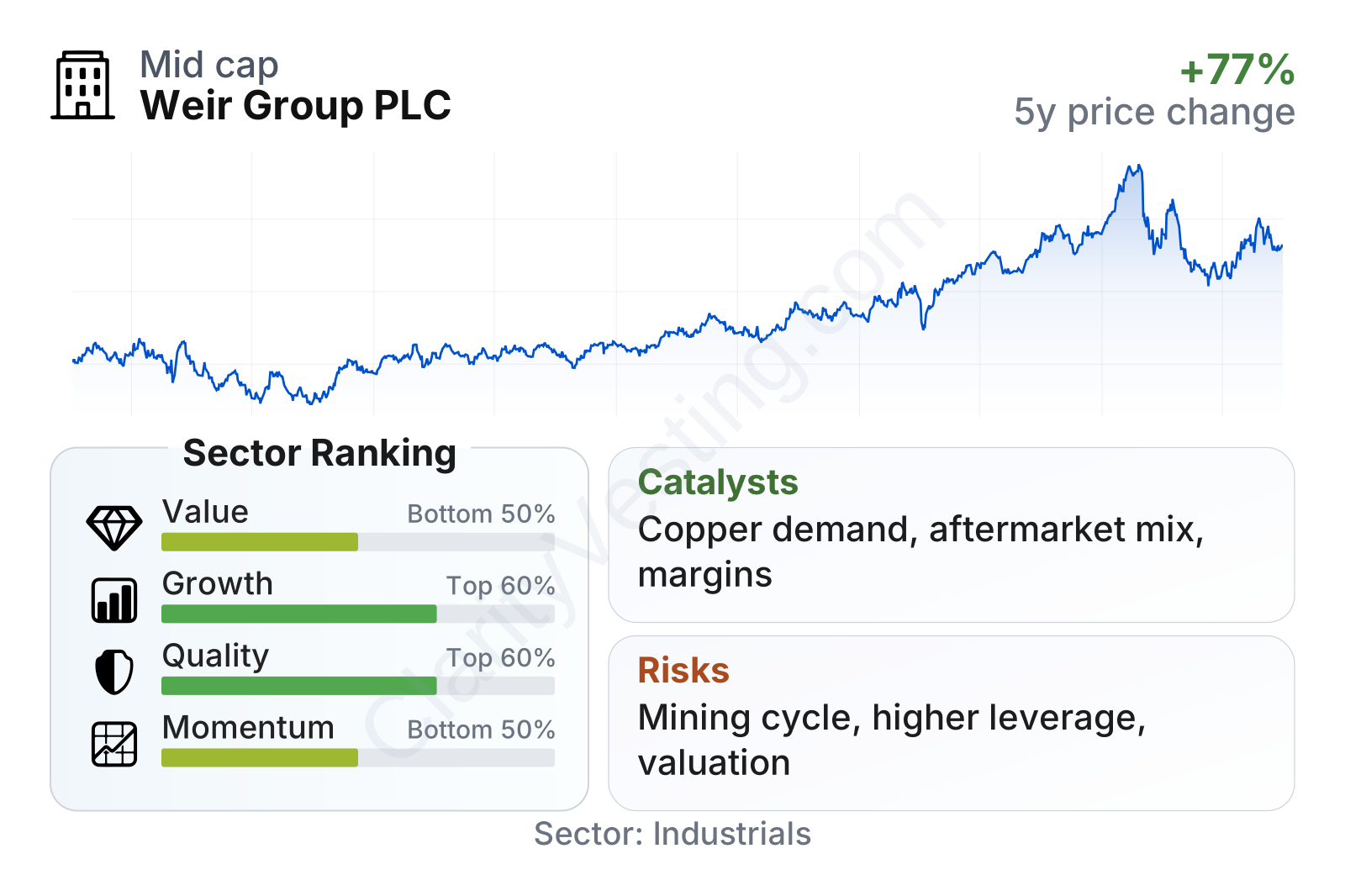
Weir is a large industrial company with a market value around $9 billion, placing it well above many niche machinery peers. The table suggests a business with solid quality and decent growth characteristics, but not an obviously cheap valuation. Returns on capital and assets are clearly above typical sector levels, and operating margins are also stronger than the industry median. Growth is respectable rather than exceptional, while recent share-price momentum has softened compared with the broader industrial group.
Growth
Weir operates in a sector with credible long-term support. Mining equipment is not usually viewed as a high-growth industry in the same way as software or biotech, but its demand can be durable when tied to structural commodity needs. Copper, iron ore, and other mined materials remain critical for electrification, grid investment, renewables, and infrastructure. That creates a favorable backdrop for suppliers that are deeply embedded in mine operations.
Weir’s strategy also makes industrial sense. The company has been focusing on higher-margin, technology-led mining applications and on consumable wear parts that must be replaced regularly. This is a practical model for long-duration growth because it is based less on winning one-off mega-projects and more on staying essential to existing mine sites. Its digital optimization tools and efforts to improve energy and water efficiency in mineral processing could also strengthen its relevance as miners work on productivity and sustainability.
Recent top-line growth appears positive but not especially fast. Year-over-year revenue growth is in the mid-single digits, which trails the sector median, yet the longer record shows more than simple volume growth. Over five years, revenue per share has advanced at a healthy pace, earnings per share have compounded positively while many peers struggled, and margin trends have improved more strongly than the sector norm. That points to a business that is becoming better, not just bigger.
Cash generation is another important part of the growth picture. Free cash flow has remained solid and moved higher into 2025, while the five-year growth rate in free cash flow stands out as particularly strong versus the sector. This matters because recurring cash supports internal investment, acquisitions, and dividends without relying too heavily on outside financing.
A notable catalyst is Weir’s positioning in copper and comminution. Miners are investing to raise output from existing operations and develop new supply where ore grades are often lower and processing is more demanding. That can increase the need for efficient crushing, grinding, pumping, and wear-management systems, all core areas for Weir. The company has also continued to highlight demand linked to technology that improves throughput and reduces energy intensity, a combination that fits current mining priorities well.
Risks
This article is for informational purposes only and does not constitute financial advice. Some content is AI-generated. See Disclaimer