Stock Analysis · Westpac Banking Corporation (WEBNF)
Overview
Westpac Banking Corporation is one of Australia’s largest banking groups. It provides everyday banking, home loans, business lending, institutional banking, wealth-related products, and payment services. Its core markets are Australia and New Zealand, with the business centered on taking deposits, making loans, and earning the spread between funding costs and lending income, alongside fees and service charges.
Westpac reports through several major divisions. Based on recent annual reporting, the main revenue and earnings sources are broadly concentrated in consumer and business banking in Australia, followed by institutional banking and New Zealand operations. Because banks often present income as net interest income plus non-interest income rather than product-by-product sales, exact percentages can move from year to year, but the business mix is reasonably clear:
- Consumer banking in Australia: approximately 35% to 40% of group earnings. This includes home loans, credit cards, deposits, and day-to-day banking under the Westpac and St.George family of brands.
- Business and wealth-related banking in Australia: approximately 25% to 30%. This includes lending and transaction services for small and medium-sized businesses, commercial customers, and related financial products.
- Institutional banking: approximately 15% to 20%. This covers larger corporate, government, and institutional clients, including transaction banking, markets, and specialized lending.
- Westpac New Zealand: approximately 10% to 15%. This includes retail and business banking operations in New Zealand.
- Other and group items: the remainder. This typically includes treasury, corporate functions, technology spending, and accounting adjustments.
For a long-term reader, the important point is that Westpac is not a niche lender. It is a large, diversified regional bank with a strong deposit base, a leading home-lending franchise, and a business model tied closely to the health of the Australian and New Zealand economies.
The revenue flow over the last few years shows a business that benefited from higher interest rates lifting total revenue, while profit has been steadier than revenue. That matters because it suggests better top-line support from margins, but also pressure from funding costs, compliance, and operating expenses.
Key Figures
| Metric | Value | Sector ⓘ |
|---|---|---|
| Date | Oct 10, 2026 | |
| Context | ||
| Sector | Financial Services | |
| Industry | Banks - Diversified | |
| Market Cap ⓘ | $83.67B | |
| Beta ⓘ | 0.72 | |
Value (Cheapness) | ||
| P/E Ratio ⓘ | 18.28 | 12.38 |
| P/B Ratio ⓘ | 1.19 | 1.23 |
| FCF Yield ⓘ | -38.91% | 10.23% |
| Dividend Yield ⓘ | 6.29% | 3.01% |
| EBIT / EV ⓘ | 1.20% | 8.08% |
| PEG ⓘ | 1.25 | |
Growth (Business expansion) | ||
| Revenue Growth ⓘ | 1.50% | 9.50% |
| RPS Growth (5Y CAGR) ⓘ | 45.50% | 12.21% |
| EPS Growth (5Y CAGR) ⓘ | -9.88% | -9.62% |
| BVPS Growth (5Y CAGR) ⓘ | 14.30% | 4.98% |
| Margin Growth (5Y Trend) ⓘ | -21.63% | -4.07% |
| FCF Growth (5Y CAGR) ⓘ | -27.64% | 4.76% |
| DPS Growth (5Y CAGR) ⓘ | 32.62% | 8.79% |
Quality (Business durability) | ||
| ROIC (Latest) ⓘ | N/A | 9.35% |
| ROE (Latest) ⓘ | 19.65% | 13.91% |
| ROA (Latest) ⓘ | 1.24% | 1.53% |
| ROIC (5Y Median) ⓘ | 2.42% | 7.86% |
| ROE (5Y Median) ⓘ | 9.59% | 12.22% |
| ROA (5Y Median) ⓘ | 0.63% | 1.29% |
| Net Debt / EBIT (Latest) ⓘ | N/A | 0.99 |
| Net Debt / EBIT (5Y Median) ⓘ | 12.02 | 0.73 |
| Net Debt / EBITDA (Latest) ⓘ | N/A | 0.93 |
| Operating Margin (Latest) ⓘ | 4.16% | 22.19% |
| Operating Margin (5Y Median) ⓘ | 38.97% | 24.30% |
| Debt to Equity (Latest) ⓘ | 318.97% | 60.24% |
| Profit Margin (Latest) ⓘ | 31.50% | 26.49% |
| Free Cash Flow (Latest) ⓘ | -$32.56B | |
Momentum (Price trend) | ||
| 3Y Return ⓘ | +132.11% | +88.52% |
| 12M Return (excl. last month) ⓘ | +0.91% | +19.65% |
| 6M Return ⓘ | -11.92% | +6.00% |
| Price vs. 200-Day MA ⓘ | -1.82% | +3.61% |
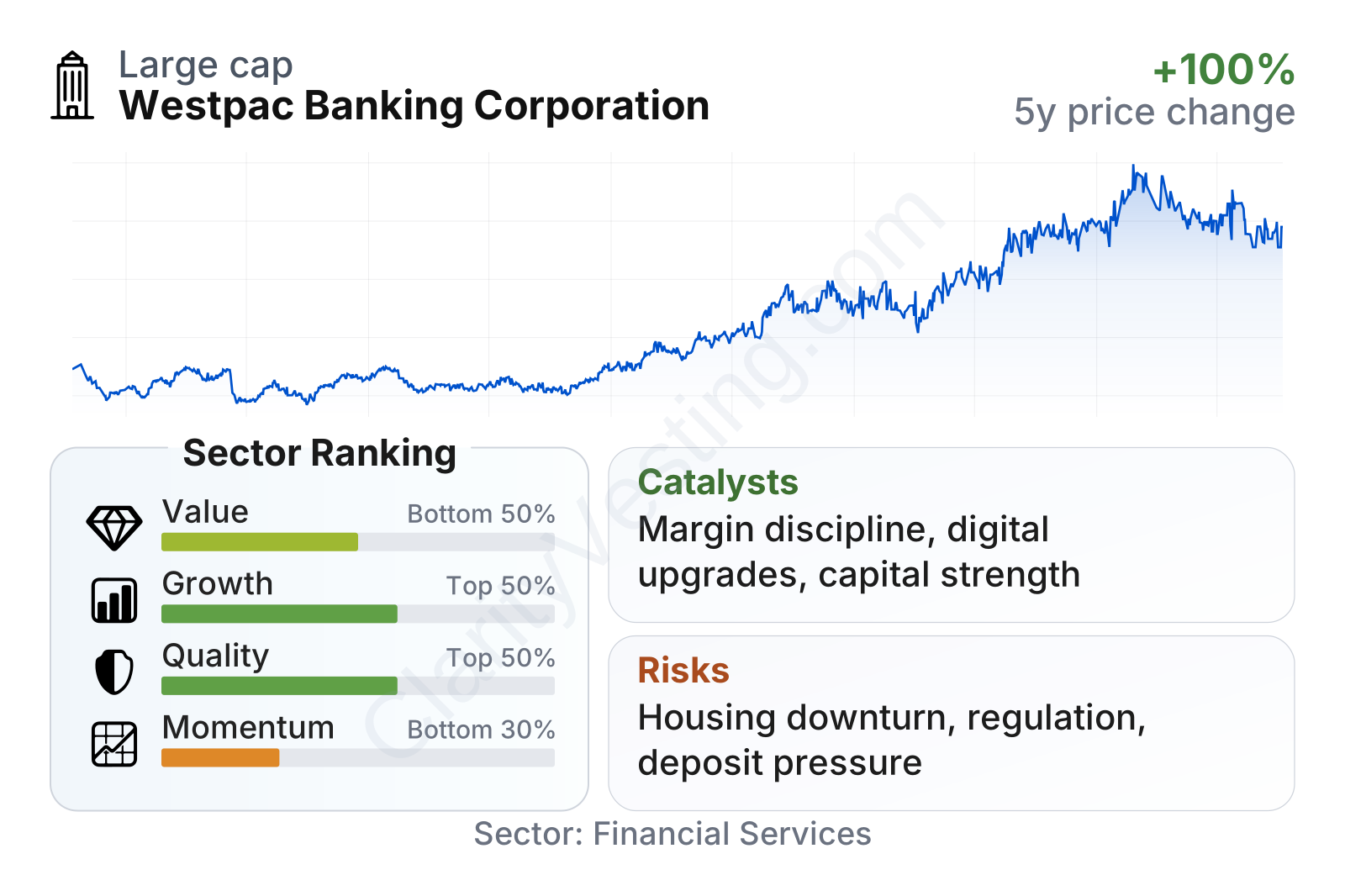
Westpac is a very large bank with lower share-price volatility than the broader market, as reflected in its beta below 1. On valuation, it screens as mixed: the price-to-earnings ratio sits above the sector median, while the price-to-book ratio is close to the sector norm. Income stands out more favorably, with a trailing dividend yield around 6%, well above the sector median.
Quality metrics are also mixed but generally respectable for a mature bank. Recent return on equity is strong at roughly 20%, above the sector median, and profit margin is healthy at about 32%. On the other hand, leverage is naturally high, as is common for banks, and some broad cross-sector debt comparisons can look extreme for financial firms. Growth indicators show modest recent revenue expansion, but stronger longer-term growth in revenue per share and book value per share than many peers. Momentum has softened recently after a strong multiyear stock run.
Growth
Banking is not a high-growth sector in the same way as software or semiconductors, but it remains essential and tends to grow alongside population, housing credit, business formation, payments activity, and inflation. In Australia, those drivers are still present. Population growth, continued housing demand, and the central role of a handful of major banks create a relatively supportive structure for large incumbents such as Westpac.
Westpac’s strategy in recent years has focused less on expansion into new geographies and more on improving execution in its core markets. Management has emphasized simplifying the group, strengthening capital, investing in digital platforms, tightening risk controls, and improving customer service. For a mature bank, that is a sensible path: stronger technology and cleaner operations can support market share retention, lower costs over time, and better regulatory outcomes.
A key operating catalyst is margin discipline. If deposit pricing remains manageable and loan growth stays positive, earnings can remain resilient even without rapid balance-sheet expansion. Another catalyst is productivity. Large banks can create meaningful value from cost reduction, branch optimization, and automation because even small efficiency gains apply across huge revenue and asset bases.
The earnings trend deserves a balanced reading. Recent profitability is solid, but longer-term earnings growth has not been especially strong, and five-year EPS compounding remains negative. That suggests the business has recovered well from earlier disruptions, yet still needs stronger consistency before it can be described as a sustained earnings grower.
Book value per share has improved meaningfully over time, including a sharp step-up in the latest reported period shown here. For banks, book value is important because it reflects the capital base supporting future lending and returns. A rising book value can give the company more flexibility for balance-sheet growth, dividends, and loss absorption.
Recent company updates have also pointed to ongoing technology investment, capital discipline, and focus on core banking franchises. None of these is a dramatic single event, but together they support a practical long-term growth case based on steadier execution rather than aggressive expansion.
Risks
This article is for informational purposes only and does not constitute financial advice. Some content is AI-generated. See Disclaimer


