Stock Analysis · WD-40 Company (WDFC)
Overview
WD-40 Company is a specialty chemicals business best known for its blue-and-yellow WD-40 can, but the company is broader than a single household product. It develops and sells maintenance products used to lubricate, protect against rust and corrosion, remove moisture, clean, and loosen stuck parts. Its portfolio also includes hand-cleaning products and homecare or cleaning items in certain markets. The business is global, selling through hardware stores, home improvement chains, industrial distributors, automotive channels, farm supply outlets, and e-commerce.
The company’s revenue mix is highly concentrated in maintenance products, with a much smaller contribution from homecare and cleaning brands. Based on the latest annual reporting, the approximate breakdown is as follows:
- Maintenance products: about 89% of revenue. This includes the core WD-40 Multi-Use Product and other maintenance lines such as specialist lubricants, penetrants, greases, bike products, and products for industrial and trade users.
- Homecare and cleaning products: about 11% of revenue. This smaller group includes brands such as GT85, 1001, Carpet Fresh, and Lava, depending on geography and channel.
Geographically, WD-40 is also diversified, though still strongest outside its home market. In recent filings, sales were split approximately across Americas at 44%, EMEA at 39%, and Asia-Pacific at 17%. That matters because the company’s expansion plan depends heavily on international distribution, brand building, and premium maintenance categories rather than on rapid product reinvention.
The business model is attractive in its simplicity: a relatively small product family, sold under well-known brands, with repeat demand driven by maintenance needs rather than by fashion or fast technology cycles. Recent years also show revenue climbing faster than costs, which has supported improving profitability.
The operating picture has improved over the last few fiscal years: revenue has moved up from a little above $500 million to roughly $620 million, while net income has risen more sharply. Gross profit has expanded faster than cost of goods sold, showing that pricing, mix, and brand strength have helped offset input pressures, even though selling and administrative expenses have also increased.
Key Figures
| Metric | Value | Sector ⓘ |
|---|---|---|
| Date | Oct 17, 2026 | |
| Context | ||
| Sector | Basic Materials | |
| Industry | Specialty Chemicals | |
| Market Cap ⓘ | $2.74B | |
| Beta ⓘ | 0.26 | |
Value (Cheapness) | ||
| P/E Ratio ⓘ | 31.07 | 16.90 |
| P/B Ratio ⓘ | 9.88 | 1.65 |
| FCF Yield ⓘ | 2.90% | 5.76% |
| Dividend Yield ⓘ | 1.97% | 2.13% |
| EBIT / EV ⓘ | 4.32% | 6.30% |
| PEG ⓘ | 3.76 | |
Growth (Business expansion) | ||
| Revenue Growth ⓘ | 24.30% | 11.10% |
| RPS Growth (5Y CAGR) ⓘ | 6.48% | 4.49% |
| EPS Growth (5Y CAGR) ⓘ | 1.05% | -13.47% |
| BVPS Growth (5Y CAGR) ⓘ | 7.88% | 5.51% |
| Margin Growth (5Y Trend) ⓘ | -1.27% | -1.54% |
| FCF Growth (5Y CAGR) ⓘ | 4.60% | 0.37% |
| DPS Growth (5Y CAGR) ⓘ | 7.41% | 6.08% |
Quality (Business durability) | ||
| ROIC (Latest) ⓘ | 24.99% | 9.26% |
| ROA (Latest) ⓘ | 18.29% | 4.91% |
| ROIC (5Y Median) ⓘ | 22.23% | 7.70% |
| ROA (5Y Median) ⓘ | 15.70% | 3.86% |
| Net Debt / EBIT (Latest) ⓘ | 0.47 | 1.40 |
| Net Debt / EBIT (5Y Median) ⓘ | 0.59 | 1.70 |
| Net Debt / EBITDA (Latest) ⓘ | 0.43 | 0.95 |
| Net Debt / Assets ⓘ | 11.06% | 13.69% |
| EBITDA / Interest ⓘ | 31.51 | 12.34 |
| Operating Margin (Latest) ⓘ | 17.50% | 13.20% |
| Operating Margin (5Y Median) ⓘ | 16.90% | 11.80% |
| Debt to Equity (Latest) ⓘ | 41.05% | 40.56% |
| Profit Margin (Latest) ⓘ | 13.23% | 6.43% |
| Free Cash Flow (Latest) ⓘ | $79.50M | |
Momentum (Price trend) | ||
| 3Y Return ⓘ | +6.68% | +68.89% |
| 12M Return (excl. last month) ⓘ | -7.41% | +30.21% |
| 6M Return ⓘ | +0.62% | -4.16% |
| Price vs. 200-Day MA ⓘ | -6.18% | -1.27% |
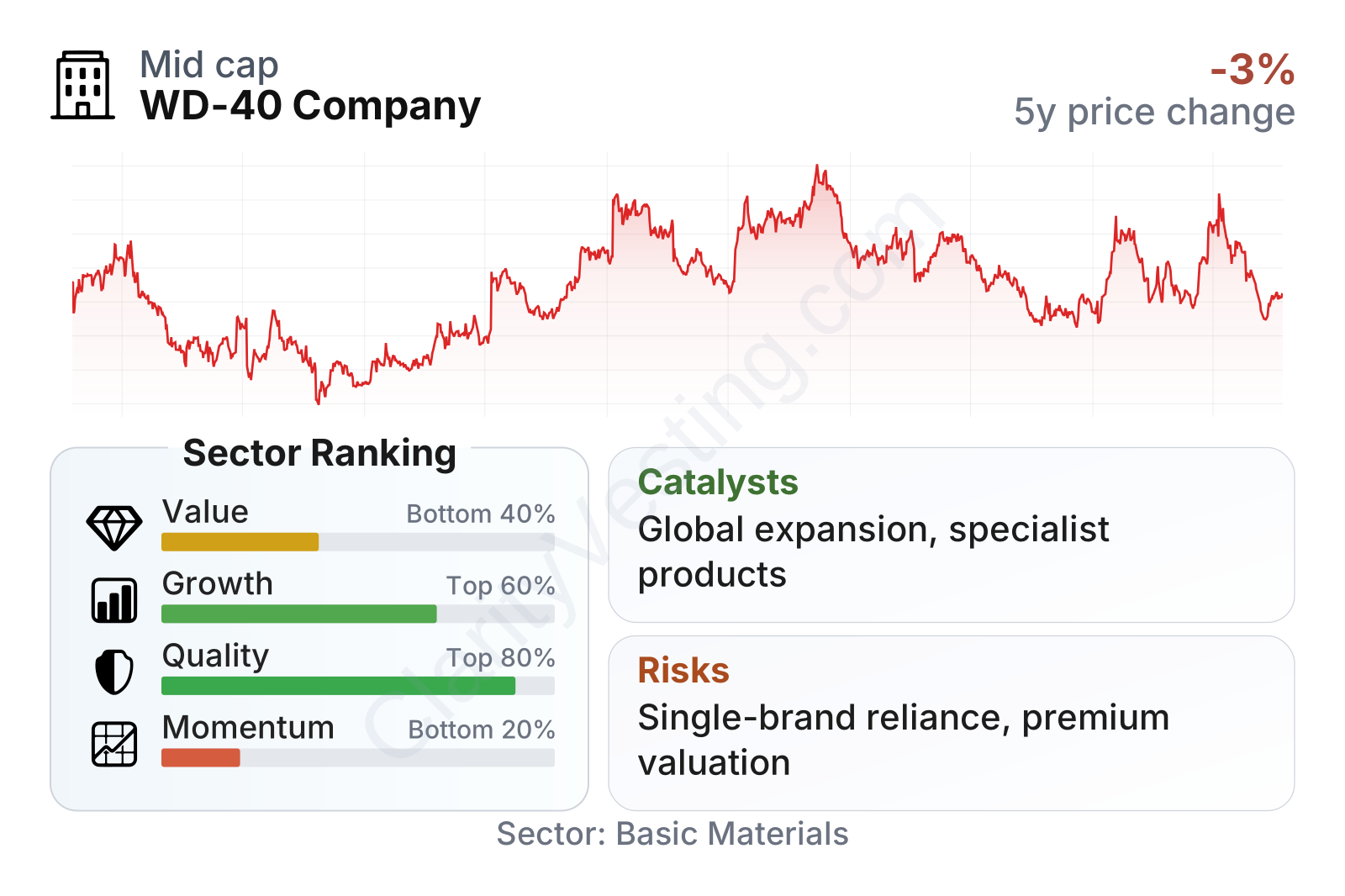
WD-40 is a mid-sized company with an unusually defensive trading profile, reflected in a very low beta. Financial quality stands out: returns on capital and assets are well above most companies in its sector, margins are stronger than the industry median, and leverage remains controlled. Growth metrics are generally above sector medians as well, especially on revenue and free cash flow over a multi-year period. The weak spot is valuation: earnings, book value, and cash-flow-based multiples are richer than the sector, while recent share price momentum has lagged.
Growth
WD-40 operates in a steady, not explosive, part of the chemicals market. Maintenance products are tied to ongoing equipment upkeep, automotive care, DIY work, industrial repair, and general household use. That makes the category relatively resilient because tools, machines, and metal parts still need lubrication and protection in most economic environments. This is not a fast-changing technology market, but it is a durable one.
The company’s strategy is centered on expanding the core maintenance franchise rather than trying to become a broad chemical conglomerate. Management has repeatedly focused on growing the WD-40 brand globally, extending specialist maintenance products, increasing distribution, and improving execution by region. For a company of this size, that strategy is logical: it builds around a product with strong recognition instead of spreading capital across unrelated businesses.
Recent revenue trends have been encouraging. Growth has not been perfectly smooth from quarter to quarter, but the overall direction has been positive, and the latest year-over-year readings show a clear acceleration. Over a five-year view, sales per share have also risen faster than the sector median, suggesting that expansion has not relied mainly on share issuance or financial engineering.
Cash generation has also recovered after a weak period. Free cash flow was notably soft in early 2023, then rebounded strongly and has remained at healthier levels since. That matters for a business like WD-40 because cash funds dividends, debt reduction, marketing support, and selective investment in brand expansion. A company with a simple product line and strong cash conversion often has more flexibility than its modest size would suggest.
A practical growth catalyst is international penetration. WD-40 still has room to deepen sales in industrial, maintenance, and specialist channels outside the United States, especially where branded maintenance products can gain share from local or private-label alternatives. Another catalyst is premiumization: specialist products for bikes, workshops, tradespeople, and industrial users can lift average selling prices and broaden usage without requiring a dramatic shift in manufacturing complexity.
Recent company updates have also pointed to continuing progress in sales growth and margin improvement, helped by volume recovery in several regions and a more favorable gross margin profile. That does not transform WD-40 into a high-growth company, but it reinforces the case for steady compounding if execution remains disciplined.
Risks
This article is for informational purposes only and does not constitute financial advice. Some content is AI-generated. See Disclaimer


