Stock Analysis · WESCO International Inc (WCC)
Overview
WESCO International is a large industrial distributor that supplies electrical, communications, networking, security, utility, and industrial products, along with related services. In simple terms, it sits between manufacturers and end customers, helping businesses, contractors, data center builders, utilities, and institutions get the equipment they need while also providing logistics, technical support, project services, and supply chain management.
The business is organized into three main segments, and this is the clearest way to understand where revenue comes from.
- Electrical & Electronic Solutions: approximately 43% of revenue in 2025. This segment distributes electrical equipment, automation products, industrial controls, wires and cables, and other items used in factories, commercial buildings, and maintenance work.
- Communications & Security Solutions: approximately 30% of revenue in 2025. This includes data communications, broadband products, networking equipment, security systems, and related infrastructure used in data centers, enterprise networks, and connected buildings.
- Utility & Broadband Solutions: approximately 27% of revenue in 2025. This segment serves electric and gas utilities as well as broadband network projects, supplying products used in grid upgrades, transmission and distribution work, and outside-plant communications infrastructure.
That mix matters because WESCO is not tied to a single end market. It has exposure to construction and industrial spending, but also to longer-cycle themes such as grid modernization, broadband deployment, automation, and digital infrastructure.
Over the last several years, revenue expanded from roughly $18 billion in 2021 to more than $23 billion in 2025. Gross profit also increased over that span. However, earnings did not rise in a straight line: operating income and net income peaked earlier and later softened, showing that scale alone does not fully protect the company from margin pressure and interest costs.
The business has become larger and more diversified since the Anixter acquisition, but its cost structure still reflects the reality of distribution: gross margins are moderate, operating expenses are meaningful, and financing costs can materially affect final profit.
Key Figures
| Metric | Value | Sector ⓘ |
|---|---|---|
| Date | Oct 24, 2026 | |
| Context | ||
| Sector | Industrials | |
| Industry | Industrial Distribution | |
| Market Cap ⓘ | $16.65B | |
| Beta ⓘ | 1.55 | |
Value (Cheapness) | ||
| P/E Ratio ⓘ | 23.64 | 22.29 |
| P/B Ratio ⓘ | 3.30 | 1.98 |
| FCF Yield ⓘ | 0.93% | 6.26% |
| Dividend Yield ⓘ | 0.56% | 1.92% |
| EBIT / EV ⓘ | 5.73% | 4.83% |
| PEG ⓘ | 1.56 | |
Growth (Business expansion) | ||
| Revenue Growth ⓘ | 13.00% | 9.30% |
| RPS Growth (5Y CAGR) ⓘ | 7.92% | 7.76% |
| EPS Growth (5Y CAGR) ⓘ | -17.65% | -13.17% |
| BVPS Growth (5Y CAGR) ⓘ | 8.72% | 6.13% |
| Margin Growth (5Y Trend) ⓘ | 0.62% | 0.74% |
| FCF Growth (5Y CAGR) ⓘ | 19.42% | 10.79% |
| DPS Growth (5Y CAGR) ⓘ | 20.64% | 9.41% |
Quality (Business durability) | ||
| ROIC (Latest) ⓘ | 9.55% | 10.75% |
| ROA (Latest) ⓘ | 4.13% | 5.41% |
| ROIC (5Y Median) ⓘ | 9.76% | 9.37% |
| ROA (5Y Median) ⓘ | 4.76% | 4.95% |
| Net Debt / EBIT (Latest) ⓘ | 4.34 | 2.04 |
| Net Debt / EBIT (5Y Median) ⓘ | 3.94 | 2.27 |
| Net Debt / EBITDA (Latest) ⓘ | 3.71 | 1.39 |
| Net Debt / Assets ⓘ | 33.12% | 19.27% |
| EBITDA / Interest ⓘ | 3.84 | 9.58 |
| Operating Margin (Latest) ⓘ | 5.43% | 10.49% |
| Operating Margin (5Y Median) ⓘ | 6.03% | 10.30% |
| Debt to Equity (Latest) ⓘ | 128.47% | 64.82% |
| Profit Margin (Latest) ⓘ | 2.84% | 6.67% |
| Free Cash Flow (Latest) ⓘ | $155.10M | |
Momentum (Price trend) | ||
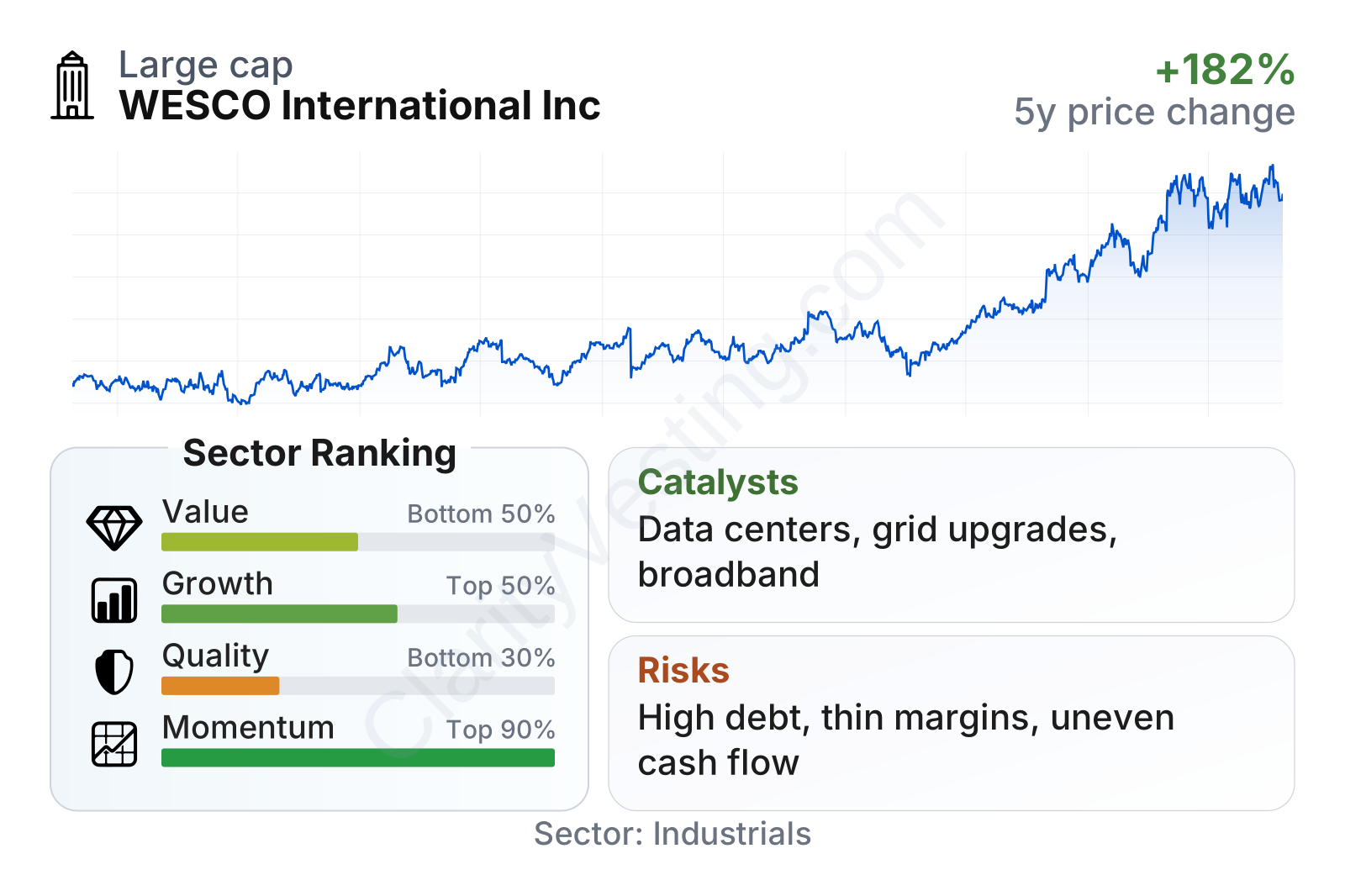
| 3Y Return ⓘ | +185.16% | +67.77% |
| 12M Return (excl. last month) ⓘ | +71.30% | +12.05% |
| 6M Return ⓘ | +7.81% | 0.00% |
| Price vs. 200-Day MA ⓘ | +7.48% | +0.67% |
WESCO is now a large-cap industrial distributor with a stock that has shown strong price momentum over the last one, three, and six years. Growth metrics are generally better than the sector median, especially on revenue and free cash flow growth over longer periods. The weaker area is quality: leverage is clearly above sector norms, profitability is below sector averages, and current free cash flow yield looks thin. Valuation is not extreme on earnings alone, but it no longer looks obviously discounted relative to its own operating risks.
Growth
WESCO operates in markets that are supported by several durable trends. Electricity demand is rising as data centers, industrial automation, electrification, and grid upgrades require more equipment. Communications infrastructure also remains a structural need, especially in data centers, fiber, security systems, and enterprise connectivity. These are not short-lived themes, and they align well with WESCO’s broad catalog and project-driven distribution model.
The company’s strategy also makes sense for long-term expansion. Management has built a larger platform that can serve customers across electrical, communications, utility, and supply chain needs. That breadth can help WESCO win larger contracts, cross-sell products, and participate in complex projects where customers prefer fewer vendors. Scale also matters in distribution because purchasing power, logistics efficiency, and customer relationships can improve as volume rises.
Recent revenue growth shows that the business went through a slowdown in 2024 before reaccelerating. By the first half of 2026, year-over-year growth was back in the low-teens range, which is stronger than the broader sector median. That suggests demand has improved in at least some of the company’s end markets, especially those tied to infrastructure and digital connectivity.
Cash generation is more mixed. Free cash flow has been positive but uneven, with a very strong spike in one period followed by much lower levels afterward. For a distributor, this often reflects swings in working capital such as inventory and receivables rather than a simple collapse in the core business. Even so, steadier cash conversion would make the growth profile more convincing.
One of the clearest catalysts is WESCO’s positioning in data center and AI-related infrastructure. Building and expanding data centers requires power distribution, cables, networking gear, cooling-related electrical systems, and security infrastructure, all areas where the company already participates. Utility grid modernization is another important tailwind, since rising power demand requires upgrades across transmission and distribution networks. Broadband deployment and building digitization add further support.
Recent company communications have also emphasized backlog, project activity, and exposure to strategic verticals such as data centers, utilities, and broadband. Those categories can create larger, more specialized orders than standard maintenance distribution and may support growth even if more traditional industrial demand remains uneven.
Risks
This article is for informational purposes only and does not constitute financial advice. Some content is AI-generated. See Disclaimer