Stock Analysis · Wilson Bank Holding Company (WBHC)
Overview
Wilson Bank Holding Company is the parent company of Wilson Bank & Trust, a regional bank based in Tennessee. Its business is straightforward: it gathers deposits from individuals and businesses, makes loans, earns interest on those loans and on its securities portfolio, and provides everyday banking services such as treasury management, debit and credit cards, mortgages, and wealth-related services. Like many community and regional banks, its strength comes from local relationships rather than a national footprint.
The company’s revenue is primarily generated by interest-based banking activities. Based on the structure described in its public filings and the economics of regional banking, the main sources of revenue are approximately:
- Net interest income: about 75% to 85% of total revenue. This is the spread between what the bank earns on loans and securities and what it pays on deposits and borrowings.
- Service charges and deposit account fees: about 5% to 10%. This includes account fees, card-related fees, and cash-management services.
- Mortgage banking and other loan-related fees: about 3% to 8%. This can include origination fees, secondary market sales activity, and related servicing income where applicable.
- Wealth management, trust, and other noninterest income: about 3% to 7%. This generally includes fiduciary services, investment-related fees, and miscellaneous banking income.
Over the last several years, the business appears to have expanded meaningfully, with total revenue rising from roughly $163 million in 2021 to about $357 million in 2025. At the same time, funding costs also increased sharply as interest rates moved higher, which is normal for banks in this cycle. Even so, net income improved from about $49 million in 2021 to about $76 million in 2025, showing that asset growth and pricing helped offset much of that pressure.
The revenue mix still points to a classic regional bank model: relationship lending remains the core engine, while fee income plays a useful but secondary role. That usually makes results heavily tied to loan growth, deposit stability, credit quality, and interest-rate conditions.
Key Figures
| Metric | Value | Sector ⓘ |
|---|---|---|
| Date | Oct 24, 2026 | |
| Context | ||
| Sector | Financial Services | |
| Industry | Banks - Regional | |
| Market Cap ⓘ | $6.83B | |
| Beta ⓘ | 3.12 | |
Value (Cheapness) | ||
| P/E Ratio ⓘ | 82.09 | 12.46 |
| P/B Ratio ⓘ | 11.07 | 1.25 |
| FCF Yield ⓘ | 1.26% | 9.82% |
| Dividend Yield ⓘ | 0.25% | 2.94% |
| EBIT / EV ⓘ | 2.40% | 8.11% |
| PEG ⓘ | N/A | |
Growth (Business expansion) | ||
| Revenue Growth ⓘ | 12.70% | 9.10% |
| RPS Growth (5Y CAGR) ⓘ | 19.22% | 12.31% |
| EPS Growth (5Y CAGR) ⓘ | -7.82% | -6.97% |
| BVPS Growth (5Y CAGR) ⓘ | 6.64% | 5.02% |
| Margin Growth (5Y Trend) ⓘ | -12.27% | -4.00% |
| FCF Growth (5Y CAGR) ⓘ | 13.20% | 4.71% |
| DPS Growth (5Y CAGR) ⓘ | -15.34% | 8.92% |
Quality (Business durability) | ||
| ROIC (Latest) ⓘ | N/A | 9.18% |
| ROE (Latest) ⓘ | 14.27% | 13.93% |
| ROA (Latest) ⓘ | 1.41% | 1.57% |
| ROIC (5Y Median) ⓘ | N/A | 7.80% |
| ROE (5Y Median) ⓘ | 12.45% | 12.15% |
| ROA (5Y Median) ⓘ | 1.28% | 1.28% |
| Net Debt / EBIT (Latest) ⓘ | -0.28 | 1.02 |
| Net Debt / EBIT (5Y Median) ⓘ | -3.68 | 0.72 |
| Net Debt / EBITDA (Latest) ⓘ | -0.27 | 0.88 |
| Operating Margin (Latest) ⓘ | 28.76% | 22.30% |
| Operating Margin (5Y Median) ⓘ | 27.16% | 24.50% |
| Debt to Equity (Latest) ⓘ | N/A | 59.34% |
| Profit Margin (Latest) ⓘ | 35.16% | 26.42% |
| Free Cash Flow (Latest) ⓘ | $86.17M | |
Momentum (Price trend) | ||
| 3Y Return ⓘ | +1536.98% | +95.73% |
| 12M Return (excl. last month) ⓘ | +216.73% | +17.30% |
| 6M Return ⓘ | 0.00% | +6.07% |
| Price vs. 200-Day MA ⓘ | +9.32% | +5.36% |
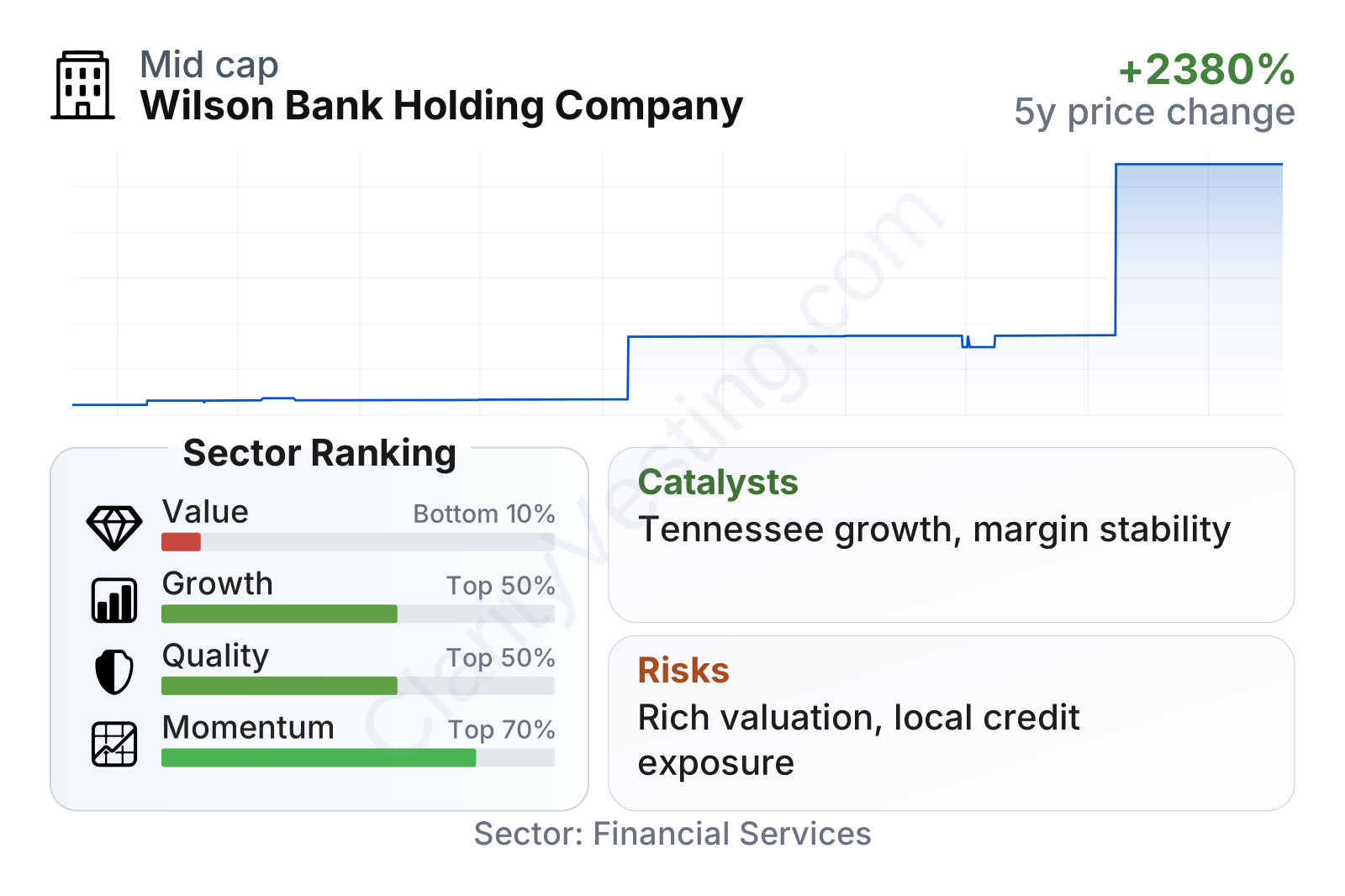
Recent market behavior has been unusually strong compared with most regional banks, but the valuation measures now stand far above sector norms. On quality, profitability is respectable, with return on equity slightly above the industry median and profit margins also ahead of peers. Growth metrics are mixed in a useful way: revenue and book value per share have grown at a solid pace, while earnings growth over a longer period has been less consistent. Momentum remains very strong, which helps explain why valuation ratios have moved so far above the typical regional bank range.
Growth
Regional banking is not a high-growth industry in the same way as software or semiconductors, but it can still produce durable expansion when a bank operates in attractive local markets and keeps credit discipline. Wilson Bank Holding Company is tied closely to Middle Tennessee, an area that has benefited from population growth, business formation, and continued economic development over the last several years. For a locally focused lender, that backdrop matters because it can support loan demand in commercial real estate, residential housing, small business lending, and consumer banking.
The company’s strategy appears sensible for long-term expansion: grow customer relationships in existing markets, deepen low-cost deposit funding, and add loans without stretching too far outside its home territory. For a bank of this type, focused execution can be more valuable than rapid geographic expansion. A strong local franchise can protect customer loyalty and support better underwriting because management often knows its markets well.
Earnings per share show that profitability has not moved in a straight line, but the broader direction improved into 2025. That matters because banks are often judged not just by raw asset growth, but by whether they can convert that growth into steadily higher earnings after absorbing funding costs, staffing, technology, and credit provisions.
Book value per share has advanced over time, including a noticeable rebound after the 2022 decline. For banks, book value is especially important because it reflects the capital base supporting future lending and loss absorption. A rising book value usually signals that the institution is retaining earnings and compounding capital, which can support future growth if credit quality remains sound.
A meaningful catalyst is the operating environment itself. If deposit costs stabilize and loan yields remain favorable, regional banks can see margin support even without dramatic balance-sheet growth. Another possible catalyst is continued economic and population growth in Tennessee, which could help the bank win more household and commercial relationships. The company’s revenue growth of roughly 13% year over year and stronger five-year revenue-per-share growth than the sector median suggest that franchise expansion has been real, not just inflation-driven.
At the same time, no obvious single transformational event stands out from the public record in the way it might for a biotech approval or a major industrial acquisition. The opportunity here is more gradual: local market expansion, disciplined lending, and compounding book value rather than a one-time step change.
Risks
This article is for informational purposes only and does not constitute financial advice. Some content is AI-generated. See Disclaimer


