Stock Analysis · Waystar Holding Corp (WAY)
Overview
Waystar Holding Corp is a healthcare payments and software company. Its platform helps hospitals, physician groups, and other healthcare providers manage the financial side of care: checking insurance coverage, estimating patient responsibility, submitting claims, detecting billing errors, managing denials, and collecting payments. In simple terms, it sits between healthcare providers, insurers, and patients to make reimbursement faster and more accurate.
The business is part of the healthcare information services industry, a segment that benefits from the U.S. healthcare system’s complexity. Providers face constant pressure to reduce claim denials, speed up cash collection, and automate administrative work. That gives companies like Waystar a practical role in day-to-day operations rather than a discretionary one.
Public filings describe revenue largely as subscription and transaction-based fees tied to software usage and payment-related activity. Exact 2026 revenue splits are not fully broken out in the materials available, but the company’s main economic drivers can be summarized as follows:
- Revenue cycle management software and network transactions — the largest source of revenue, incorporating eligibility checks, prior authorizations, claims management, denials management, and payment workflows for providers.
- Patient payment and financial clearance solutions — tools for price transparency, payment estimation, and payment collection from patients.
- Analytics and productivity tools — software that helps providers improve workflow efficiency, reduce errors, and increase reimbursement success.
Over the last several years, the business has shown a clear pattern: revenue has expanded steadily, gross profit has risen meaningfully, and operating income has improved much faster than sales. Interest expense had previously weighed heavily on net income, but that pressure eased sharply in 2025, helping the company move into positive profitability.
The financial flow also highlights an attractive feature of the model: gross profit has remained large relative to revenue, while operating leverage has become more visible as the company scales. The biggest improvement recently has been below operating income, where lower interest burden allowed much more of the operating gains to reach net income.
Key Figures
| Metric | Value | Sector ⓘ |
|---|---|---|
| Date | Oct 24, 2026 | |
| Context | ||
| Sector | Healthcare | |
| Industry | Health Information Services | |
| Market Cap ⓘ | $5.53B | |
| Beta ⓘ | 0.18 | |
Value (Cheapness) | ||
| P/E Ratio ⓘ | 41.20 | 25.42 |
| P/B Ratio ⓘ | 1.41 | 3.08 |
| FCF Yield ⓘ | 4.45% | 3.12% |
| Dividend Yield ⓘ | N/A | 1.85% |
| EBIT / EV ⓘ | 4.57% | 0.56% |
| PEG ⓘ | N/A | |
Growth (Business expansion) | ||
| Revenue Growth ⓘ | 18.10% | 7.50% |
| RPS Growth (5Y CAGR) ⓘ | 14.41% | 8.60% |
| EPS Growth (5Y CAGR) ⓘ | 41.65% | -17.73% |
| BVPS Growth (5Y CAGR) ⓘ | 13.32% | 3.72% |
| Margin Growth (5Y Trend) ⓘ | 12.25% | -0.57% |
| FCF Growth (5Y CAGR) ⓘ | 32.51% | 0.96% |
| DPS Growth (5Y CAGR) ⓘ | N/A | 6.69% |
Quality (Business durability) | ||
| ROIC (Latest) ⓘ | 3.66% | 3.17% |
| ROA (Latest) ⓘ | 2.54% | 2.98% |
| ROIC (5Y Median) ⓘ | 2.58% | 4.56% |
| ROA (5Y Median) ⓘ | -0.75% | 1.87% |
| Net Debt / EBIT (Latest) ⓘ | 5.33 | 1.34 |
| Net Debt / EBIT (5Y Median) ⓘ | 15.58 | 1.86 |
| Net Debt / EBITDA (Latest) ⓘ | 3.40 | 1.00 |
| Net Debt / Assets ⓘ | 25.03% | 5.06% |
| EBITDA / Interest ⓘ | 5.36 | 9.55 |
| Operating Margin (Latest) ⓘ | 22.87% | 9.25% |
| Operating Margin (5Y Median) ⓘ | 13.11% | 7.33% |
| Debt to Equity (Latest) ⓘ | 37.17% | 26.68% |
| Profit Margin (Latest) ⓘ | 11.18% | 3.34% |
| Free Cash Flow (Latest) ⓘ | $246.26M | |
Momentum (Price trend) | ||
| 3Y Return ⓘ | N/A | +51.61% |
| 12M Return (excl. last month) ⓘ | -32.02% | +19.90% |
| 6M Return ⓘ | +14.27% | +10.10% |
| Price vs. 200-Day MA ⓘ | +20.74% | +6.44% |
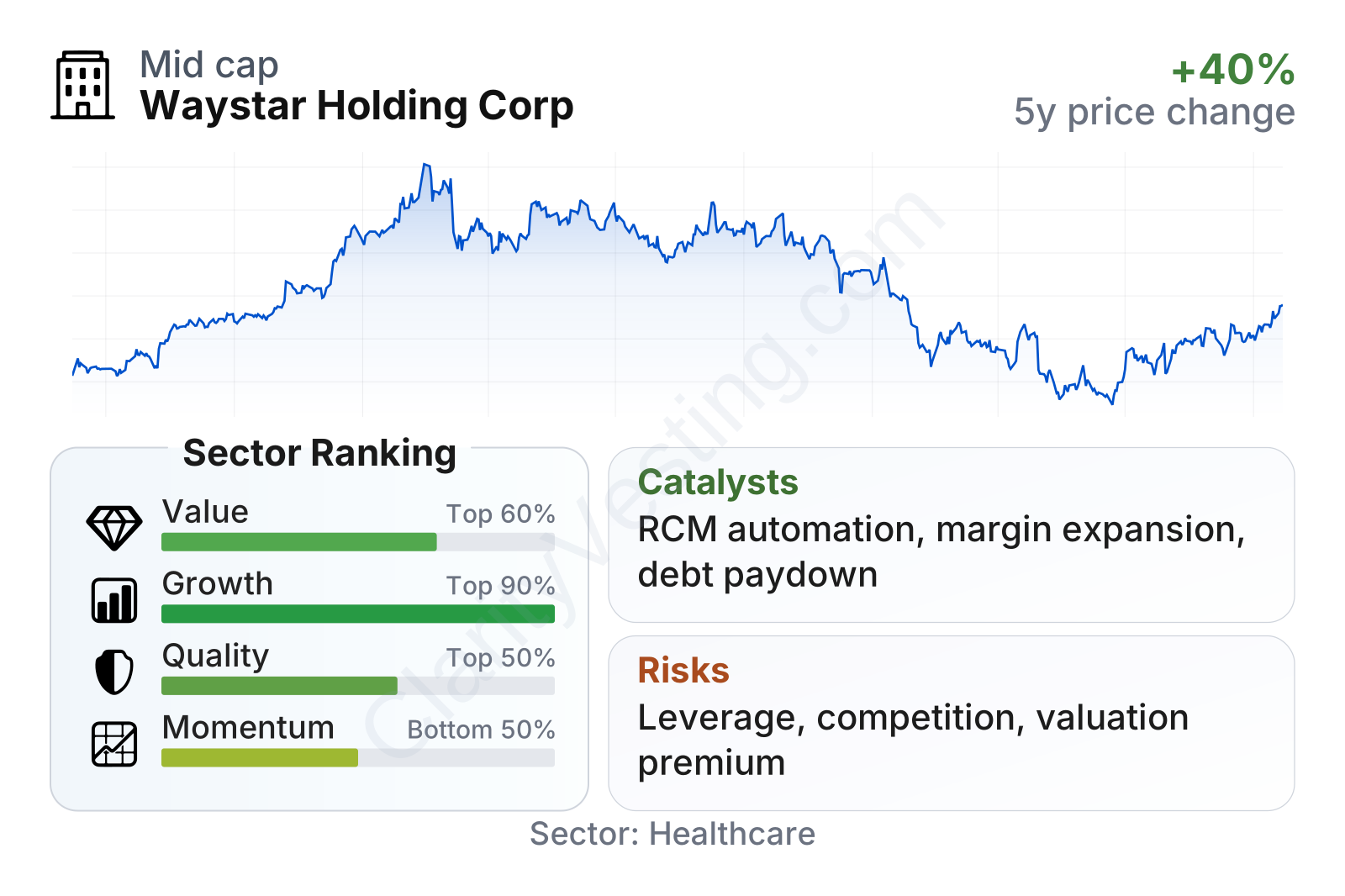
Waystar is a mid-sized healthcare technology company with unusually strong growth metrics for its sector. The table suggests a mixed but interesting profile: growth ranks near the top of the healthcare group, profitability is clearly better than the sector median, and cash generation is solid. Value metrics are not straightforward because the earnings multiple is above the sector median, while cash flow yield and enterprise-value-based profitability look stronger than many peers. Momentum, however, has been weak, reflecting a major stock-price pullback after the post-IPO run-up.
The share-price history shows that the market initially assigned a much richer valuation after listing, then reset expectations sharply through 2026 before a partial rebound. That kind of move usually means sentiment has cooled faster than the underlying business has deteriorated, which makes the fundamental trend more important than the chart alone.
Growth
Waystar operates in a sector with favorable long-term demand. U.S. healthcare administration remains expensive, fragmented, and full of manual processes. Providers increasingly need software that can automate claims, reduce denials, improve collections, and handle patient payment complexity. That backdrop supports steady demand even when healthcare providers are under budget pressure, because administrative efficiency tools can protect revenue rather than simply add cost.
The company’s strategy also makes sense for future growth. It is focused on core revenue-cycle workflows that are deeply embedded in provider operations. Once these tools are integrated into billing and reimbursement processes, switching can be disruptive. That creates the potential for recurring revenue, expansion through additional modules, and cross-selling across the customer base.
Recent growth has been strong by sector standards. Year-over-year revenue growth has been running in the mid-to-high teens, with some quarters rising above 20%. That is well ahead of the healthcare sector median in the metrics table and suggests demand remains healthy across the platform.
Cash generation has improved alongside revenue. Free cash flow has moved up materially over the last reported periods, which matters because it shows growth is not only accounting-based. The company appears to be converting a larger share of its expanding revenue base into cash that can be used for debt reduction, product investment, or balance-sheet flexibility.
A notable recent catalyst is the company’s transition from years of reported net losses to sustained positive margins and earnings. That shift can change how the market evaluates the business, especially for a software-like healthcare platform where scale tends to improve economics over time. Another important growth driver is the continued digitization of provider workflows, especially around prior authorization, payment accuracy, and denial prevention, where automation can directly improve customer returns.
Risks
This article is for informational purposes only and does not constitute financial advice. Some content is AI-generated. See Disclaimer


