Stock Analysis · Western Alliance Bancorporation (WAL)
Overview
Western Alliance Bancorporation is a regional bank headquartered in Phoenix, Arizona. Through its main banking subsidiary, Western Alliance Bank, the company provides commercial banking services, treasury management, mortgage warehouse lending, specialized real estate financing, and selected consumer-related banking products. Its model is not built around a large national branch network. Instead, it focuses on businesses, professionals, and niche lending categories where it believes it can earn better spreads and build deeper client relationships.
For a bank, revenue mainly comes from the spread between what it earns on loans and securities and what it pays on deposits and other funding, plus fees from banking services. Based on recent company filings, Western Alliance’s revenue mix is still dominated by net interest income, with non-interest income playing a smaller but useful supporting role.
- Net interest income: approximately 85% to 90% of total revenue. This is the core engine of the business and includes interest earned on commercial loans, real estate lending, mortgage warehouse finance, and securities, minus interest paid on deposits and borrowings.
- Non-interest income: approximately 10% to 15% of total revenue. This includes service charges and fees, income tied to treasury and payment services, mortgage banking-related fees, and other banking-related revenue streams.
Within lending, the bank is especially known for specialized commercial categories such as mortgage warehouse lending, owner-occupied and investor commercial real estate, construction and land, and commercial and industrial loans. On the funding side, deposits from business customers are a critical source of low-cost financing, so the stability and composition of deposits matter as much as loan growth.
The recent business pattern shows a bank that has recovered revenue after the 2023 regional banking shock, but with a cost structure that remains heavily influenced by higher funding costs. Revenue has expanded meaningfully over the last two years, while profitability has improved more gradually.
The overall picture is of a bank whose top line has rebounded strongly, but where the path from revenue to net income is still shaped by elevated interest expense and normalizing margins rather than purely by loan growth.
Key Figures
| Metric | Value | Sector ⓘ |
|---|---|---|
| Date | Oct 24, 2026 | |
| Context | ||
| Sector | Financial Services | |
| Industry | Banks - Regional | |
| Market Cap ⓘ | $8.36B | |
| Beta ⓘ | 1.42 | |
Value (Cheapness) | ||
| P/E Ratio ⓘ | 8.38 | 12.46 |
| P/B Ratio ⓘ | 1.08 | 1.25 |
| FCF Yield ⓘ | -19.73% | 9.82% |
| Dividend Yield ⓘ | N/A | 2.94% |
| EBIT / EV ⓘ | 13.08% | 8.11% |
| PEG ⓘ | 1.47 | |
Growth (Business expansion) | ||
| Revenue Growth ⓘ | 13.60% | 9.10% |
| RPS Growth (5Y CAGR) ⓘ | 28.18% | 12.31% |
| EPS Growth (5Y CAGR) ⓘ | -12.37% | -6.97% |
| BVPS Growth (5Y CAGR) ⓘ | 10.43% | 5.02% |
| Margin Growth (5Y Trend) ⓘ | -37.36% | -4.00% |
| FCF Growth (5Y CAGR) ⓘ | N/A | 4.71% |
| DPS Growth (5Y CAGR) ⓘ | 8.11% | 8.92% |
Quality (Business durability) | ||
| ROIC (Latest) ⓘ | 7.47% | 9.18% |
| ROE (Latest) ⓘ | 13.37% | 13.93% |
| ROA (Latest) ⓘ | 1.06% | 1.57% |
| ROIC (5Y Median) ⓘ | 7.46% | 7.80% |
| ROE (5Y Median) ⓘ | 13.59% | 12.15% |
| ROA (5Y Median) ⓘ | 1.12% | 1.28% |
| Net Debt / EBIT (Latest) ⓘ | 1.23 | 1.02 |
| Net Debt / EBIT (5Y Median) ⓘ | 2.56 | 0.72 |
| Net Debt / EBITDA (Latest) ⓘ | 1.09 | 0.88 |
| Operating Margin (Latest) ⓘ | 24.01% | 22.30% |
| Operating Margin (5Y Median) ⓘ | 43.91% | 24.50% |
| Debt to Equity (Latest) ⓘ | 88.93% | 59.34% |
| Profit Margin (Latest) ⓘ | 28.20% | 26.42% |
| Free Cash Flow (Latest) ⓘ | -$1.65B | |
Momentum (Price trend) | ||
| 3Y Return ⓘ | +95.66% | +95.73% |
| 12M Return (excl. last month) ⓘ | -11.33% | +17.30% |
| 6M Return ⓘ | -1.12% | +6.07% |
| Price vs. 200-Day MA ⓘ | -3.80% | +5.36% |
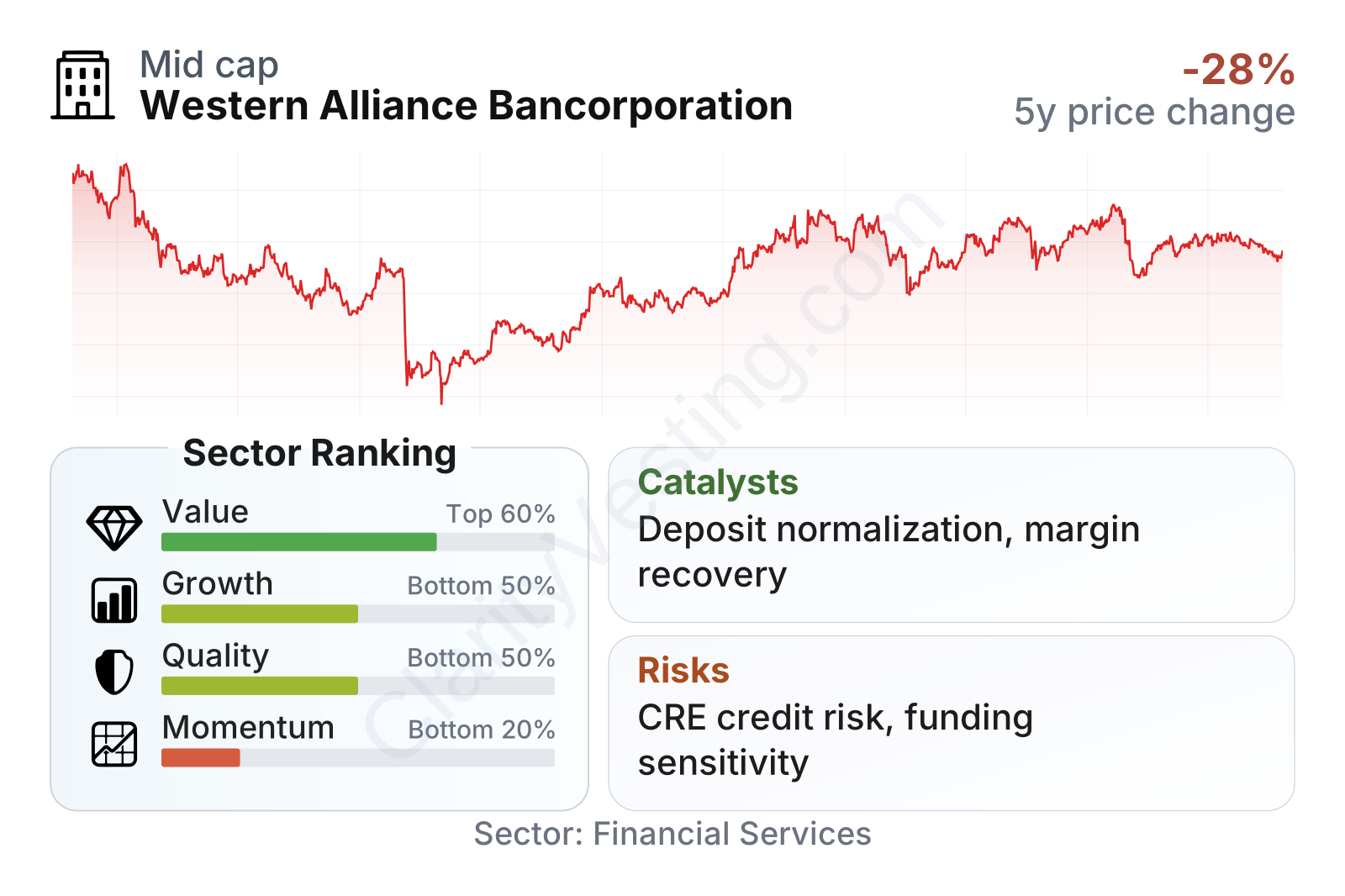
Western Alliance is a mid-sized regional bank with a stock that has been notably volatile over the last several years. The valuation profile looks inexpensive compared with much of the regional bank universe, with both earnings and book-based multiples below sector medians. At the same time, the broader quality and momentum picture is less strong. Profitability remains acceptable rather than exceptional, balance-sheet leverage is on the high side for the peer group, and recent share performance has lagged the sector. Growth metrics are mixed: revenue growth has been solid, book value per share has compounded well, but earnings growth over a five-year span has been weaker because 2023 and 2024 interrupted the earlier profit trajectory.
Growth
Western Alliance operates in a sector that can grow over time, but not in the same way as a fast-scaling technology company. Long-term growth for regional banks usually comes from gathering deposits, expanding loans prudently, gaining share in attractive niches, and increasing fee income. In that context, Western Alliance has a sensible strategy. It has built expertise in specialized lending areas that are harder to replicate than standard retail banking, and that can support stronger client retention and pricing discipline when markets are stable.
One important positive is that the bank has continued to grow book value per share over time, which is a key indicator for banks because it reflects the value of the net assets backing the business. That trend suggests the franchise has continued to build capital internally despite a difficult operating period for regional banks.
Earnings have been less smooth. Profit per share rose strongly in 2021 and 2022, then fell during the industry stress period before recovering. That pattern matters because long-term compounding for banks depends not just on asset growth, but on turning that growth into stable earnings without taking excessive funding or credit risk.
A meaningful catalyst is the ongoing normalization of deposit costs and funding mix. When a bank can hold on to deposits without paying unusually high rates, net interest margin can improve and earnings can recover faster than balance-sheet growth alone would suggest. Western Alliance has also emphasized relationship-based commercial banking, treasury management, and specialized lending verticals, which can deepen ties with clients and reduce dependence on any single product line.
Another favorable point is that the bank emerged from the 2023 regional banking panic without the type of permanent franchise damage that some market participants feared at the time. More recent filings and company updates indicate continued deposit stability, ongoing loan production, and capital generation. In practical terms, that means the market’s attention can gradually shift from emergency liquidity concerns back toward normalized profitability and franchise value.
Risks
This article is for informational purposes only and does not constitute financial advice. Some content is AI-generated. See Disclaimer


