Stock Analysis · Westamerica Bancorporation (WABC)
Overview
Westamerica Bancorporation is a regional bank headquartered in California. Through its banking subsidiary, it provides traditional banking services to individuals, businesses, and local communities, with a strong emphasis on deposit gathering, business and consumer lending, and treasury-related income. Its business model is relatively straightforward compared with larger diversified banks: collect deposits, invest part of that funding in loans and securities, and earn a spread between what it receives and what it pays out, while also collecting fees from banking services.
The company’s revenue is mainly tied to banking spread income, which tends to be the dominant source for regional banks like Westamerica. Based on its recent annual mix and business description, the main sources of revenue can be summarized as follows:
- Net interest income: approximately 85% to 90% — income from loans, investment securities, and interest-earning deposits, minus interest paid on deposits and borrowings.
- Service charges on deposit accounts and other fees: approximately 7% to 10% — fees linked to checking accounts, treasury services, and other customer banking activity.
- Other income: approximately 2% to 5% — this can include card-related income, safe deposit fees, and miscellaneous banking revenue.
What stands out is how concentrated the company is in classic community and commercial banking rather than in volatile investment banking or capital markets activities. That simplicity makes the business easier to understand, but it also means results are closely tied to interest rates, deposit trends, loan demand, and credit quality.
Over the last several years, revenue and profit expanded meaningfully through 2023, then moderated in 2024 and 2025 as funding costs rose and earnings normalized from unusually favorable rate conditions. Even so, the expense base remained controlled, which helped preserve unusually strong profitability for a bank of this size.
The long-term pattern shows a bank that converted a large share of revenue into operating profit, even after earnings pulled back from the 2023 peak. Costs stayed comparatively contained, but the revenue line softened after the exceptionally strong period created by higher interest rates.
Key Figures
| Metric | Value | Sector ⓘ |
|---|---|---|
| Date | Oct 19, 2026 | |
| Context | ||
| Sector | Financial Services | |
| Industry | Banks - Regional | |
| Market Cap ⓘ | $1.42B | |
| Beta ⓘ | 0.56 | |
Value (Cheapness) | ||
| P/E Ratio ⓘ | 13.59 | 12.26 |
| P/B Ratio ⓘ | 1.79 | 1.23 |
| FCF Yield ⓘ | 7.63% | 10.40% |
| Dividend Yield ⓘ | 3.05% | 3.02% |
| EBIT / EV ⓘ | 12.33% | 8.14% |
| PEG ⓘ | 4.62 | |
Growth (Business expansion) | ||
| Revenue Growth ⓘ | 0.50% | 9.25% |
| RPS Growth (5Y CAGR) ⓘ | 7.91% | 12.19% |
| EPS Growth (5Y CAGR) ⓘ | -6.34% | -9.36% |
| BVPS Growth (5Y CAGR) ⓘ | 5.11% | 4.99% |
| Margin Growth (5Y Trend) ⓘ | 3.66% | -3.86% |
| FCF Growth (5Y CAGR) ⓘ | 8.15% | 4.81% |
| DPS Growth (5Y CAGR) ⓘ | 3.46% | 8.79% |
Quality (Business durability) | ||
| ROIC (Latest) ⓘ | N/A | 9.49% |
| ROE (Latest) ⓘ | 12.85% | 13.87% |
| ROA (Latest) ⓘ | 1.88% | 1.54% |
| ROIC (5Y Median) ⓘ | 14.94% | 7.86% |
| ROE (5Y Median) ⓘ | 16.67% | 12.17% |
| ROA (5Y Median) ⓘ | 1.93% | 1.30% |
| Net Debt / EBIT (Latest) ⓘ | -0.99 | 0.99 |
| Net Debt / EBIT (5Y Median) ⓘ | -2.45 | 0.73 |
| Net Debt / EBITDA (Latest) ⓘ | -1.21 | 0.91 |
| Operating Margin (Latest) ⓘ | 56.07% | 22.30% |
| Operating Margin (5Y Median) ⓘ | 60.76% | 24.63% |
| Debt to Equity (Latest) ⓘ | 17.61% | 58.04% |
| Profit Margin (Latest) ⓘ | 43.84% | 26.57% |
| Free Cash Flow (Latest) ⓘ | $108.12M | |
Momentum (Price trend) | ||
| 3Y Return ⓘ | +48.56% | +88.26% |
| 12M Return (excl. last month) ⓘ | +28.65% | +19.24% |
| 6M Return ⓘ | +16.02% | +4.70% |
| Price vs. 200-Day MA ⓘ | +11.66% | +3.66% |
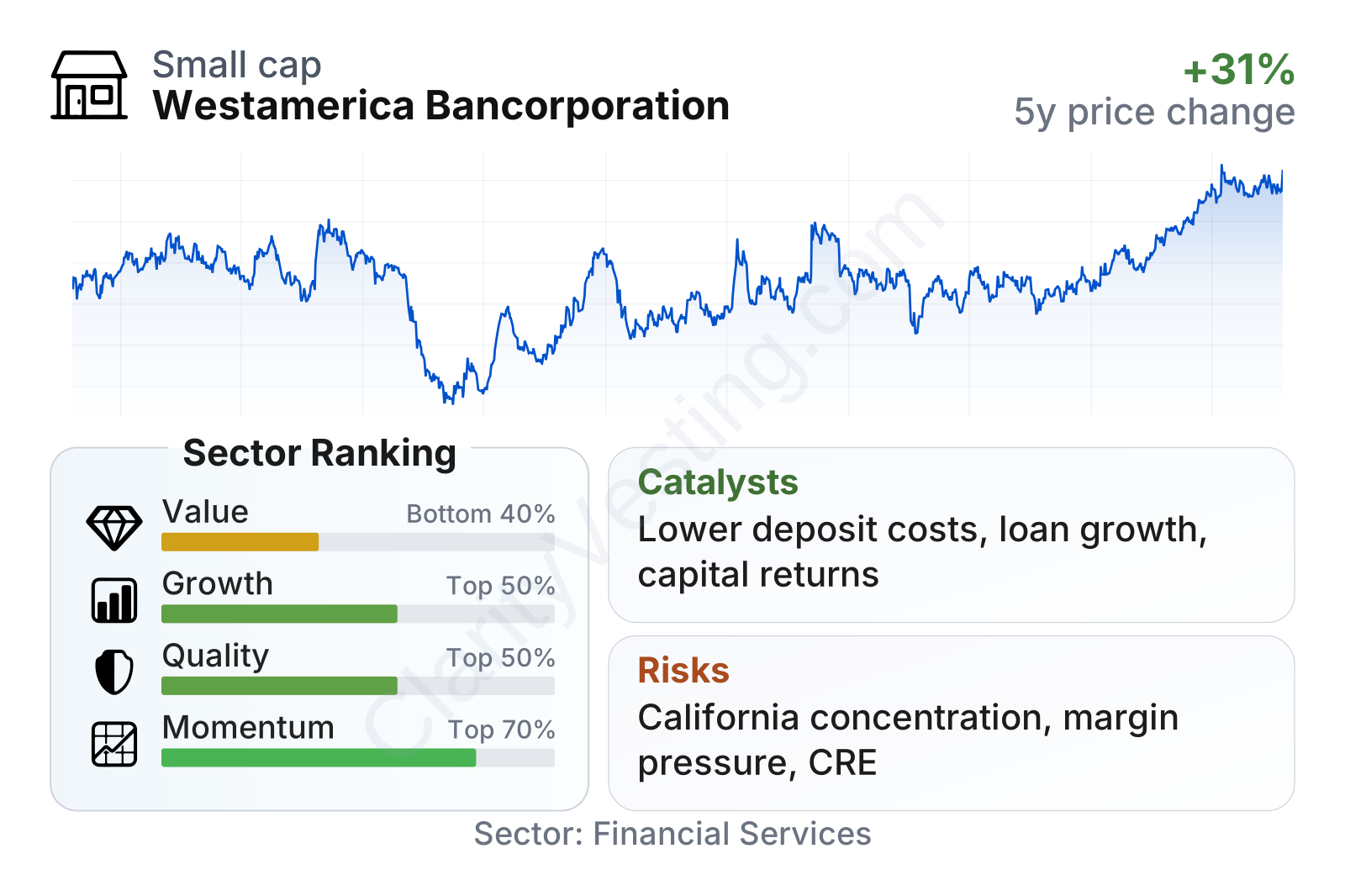
Westamerica is a small regional bank by market value, and its share price has been relatively resilient since the 2023 regional banking shock, with a clear recovery into 2026. The metrics table paints a mixed but understandable picture: profitability and balance-sheet quality look stronger than much of the regional bank universe, while valuation is not especially cheap and revenue growth remains modest. The stock’s beta is low, which fits a bank often viewed as more conservative than peers.
Growth
Westamerica operates in a mature sector rather than a high-growth one. Regional banking can still grow over time, but usually through branch expansion, deposit gathering, market share gains in local business banking, disciplined lending, and occasional acquisitions. That means the company’s long-term potential depends less on rapid industry expansion and more on execution, pricing discipline, and efficient use of capital.
Its strategy appears centered on conservatism: maintain a strong balance sheet, keep credit standards tight, preserve margin where possible, and avoid stretching for risky growth. For long-term analysis, that approach can be attractive when compared with banks that chase loan growth too aggressively. The trade-off is that growth may look slower in normal periods.
Earnings per share climbed sharply from 2021 through 2023, then moved lower in 2024 and 2025 as the rate environment became less favorable and the sector normalized. That pattern suggests Westamerica benefited strongly from rising rates, but it also shows that peak earnings were not a stable baseline. The more important point is that earnings remained solid rather than collapsing, which supports the view of a relatively durable franchise.
Book value per share has trended upward over the past several years despite earlier volatility. That matters for a bank because book value is a rough indicator of the capital base supporting future lending and earnings. The company’s five-year growth in book value per share is slightly better than the sector median, which points to steady internal value creation even without rapid top-line growth.
Potential catalysts are specific rather than transformative. If deposit costs stabilize or fall, net interest margin could improve. If loan demand in its California markets remains healthy, balance-sheet growth could reaccelerate. In addition, a bank with a strong capital position can support shareholder returns or selective expansion when weaker competitors pull back. Recent market performance also suggests that the market has recognized improving conditions after the stress that hit regional banks in 2023.
Risks
This article is for informational purposes only and does not constitute financial advice. Some content is AI-generated. See Disclaimer


