Stock Analysis · Ventas Inc (VTR)
Overview
Ventas is a healthcare real estate investment trust, or REIT. In simple terms, it owns properties tied to healthcare and aging-related services and earns money mainly from rent and property operations. Its portfolio spans senior housing communities, medical office buildings, life science and innovation properties, hospitals, and skilled nursing or long-term care facilities. The company’s long-term thesis is closely linked to aging demographics, because more older adults generally means more demand for housing, outpatient care, and healthcare facilities.
Its revenue mix is diversified, but senior housing and outpatient-oriented properties are the main engines. Based on recent company reporting, the business can be approximated as follows:
- Senior Housing Operating Portfolio: about 45% to 50% of revenue. These are senior living communities where Ventas participates more directly in property-level operating results through third-party managers.
- Outpatient Medical and Research: about 30% to 35%. This includes medical office buildings and research or life science properties, often located near health systems and universities.
- Triple-Net Leased Properties: about 15% to 20%. These are mainly senior housing, skilled nursing, hospital, and other healthcare facilities leased to operators that pay rent under long-term contracts.
- Other income and smaller segments: a low-single-digit share, including loans, ancillary items, and residual categories that vary over time.
This mix matters because it gives Ventas exposure to both property rent and healthcare service demand. It also means results are influenced by several drivers at once: occupancy in senior housing, rent collection and operator strength in net lease assets, and leasing demand in medical office and research properties.
Over the last several years, total revenue has moved upward and operating income has improved, while interest expense has remained a meaningful cost. Net income has been more uneven than revenue because real estate companies are affected by depreciation, asset sales, financing costs, and periodic valuation or restructuring effects.
Key Figures
| Metric | Value | Sector ⓘ |
|---|---|---|
| Date | Oct 24, 2026 | |
| Context | ||
| Sector | Real Estate | |
| Industry | REIT - Healthcare Facilities | |
| Market Cap ⓘ | $43.80B | |
| Beta ⓘ | 0.74 | |
Value (Cheapness) | ||
| P/E Ratio ⓘ | 161.09 | 17.85 |
| P/B Ratio ⓘ | 2.93 | 0.87 |
| FCF Yield ⓘ | 3.67% | 7.30% |
| Dividend Yield ⓘ | 2.31% | 4.83% |
| EBIT / EV ⓘ | 1.77% | 3.78% |
| PEG ⓘ | 4.94 | |
Growth (Business expansion) | ||
| Revenue Growth ⓘ | 21.70% | 5.35% |
| RPS Growth (5Y CAGR) ⓘ | 6.21% | 6.02% |
| EPS Growth (5Y CAGR) ⓘ | N/A | -10.65% |
| BVPS Growth (5Y CAGR) ⓘ | -1.04% | 0.43% |
| Margin Growth (5Y Trend) ⓘ | 1.63% | -0.69% |
| FCF Growth (5Y CAGR) ⓘ | 22.06% | 5.40% |
| DPS Growth (5Y CAGR) ⓘ | 1.12% | 5.07% |
Quality (Business durability) | ||
| ROIC (Latest) ⓘ | 4.93% | 5.69% |
| ROE (Latest) ⓘ | 1.98% | 7.37% |
| ROA (Latest) ⓘ | 0.94% | 2.85% |
| ROIC (5Y Median) ⓘ | 2.06% | 4.26% |
| ROE (5Y Median) ⓘ | 0.47% | 6.04% |
| ROA (5Y Median) ⓘ | 0.20% | 2.45% |
| Net Debt / EBIT (Latest) ⓘ | 13.31 | 7.55 |
| Net Debt / EBIT (5Y Median) ⓘ | 24.08 | 8.26 |
| Net Debt / EBITDA (Latest) ⓘ | 5.43 | 5.26 |
| Net Debt / Assets ⓘ | 45.36% | 37.45% |
| EBITDA / Interest ⓘ | 3.22 | 4.11 |
| Operating Margin (Latest) ⓘ | 15.69% | 33.86% |
| Operating Margin (5Y Median) ⓘ | 13.10% | 37.49% |
| Debt to Equity (Latest) ⓘ | 93.18% | 88.76% |
| Profit Margin (Latest) ⓘ | 4.09% | 18.94% |
| Free Cash Flow (Latest) ⓘ | $1.61B | |
Momentum (Price trend) | ||
| 3Y Return ⓘ | +129.41% | +36.33% |
| 12M Return (excl. last month) ⓘ | +32.71% | +4.32% |
| 6M Return ⓘ | +9.90% | -1.74% |
| Price vs. 200-Day MA ⓘ | +1.90% | -1.42% |
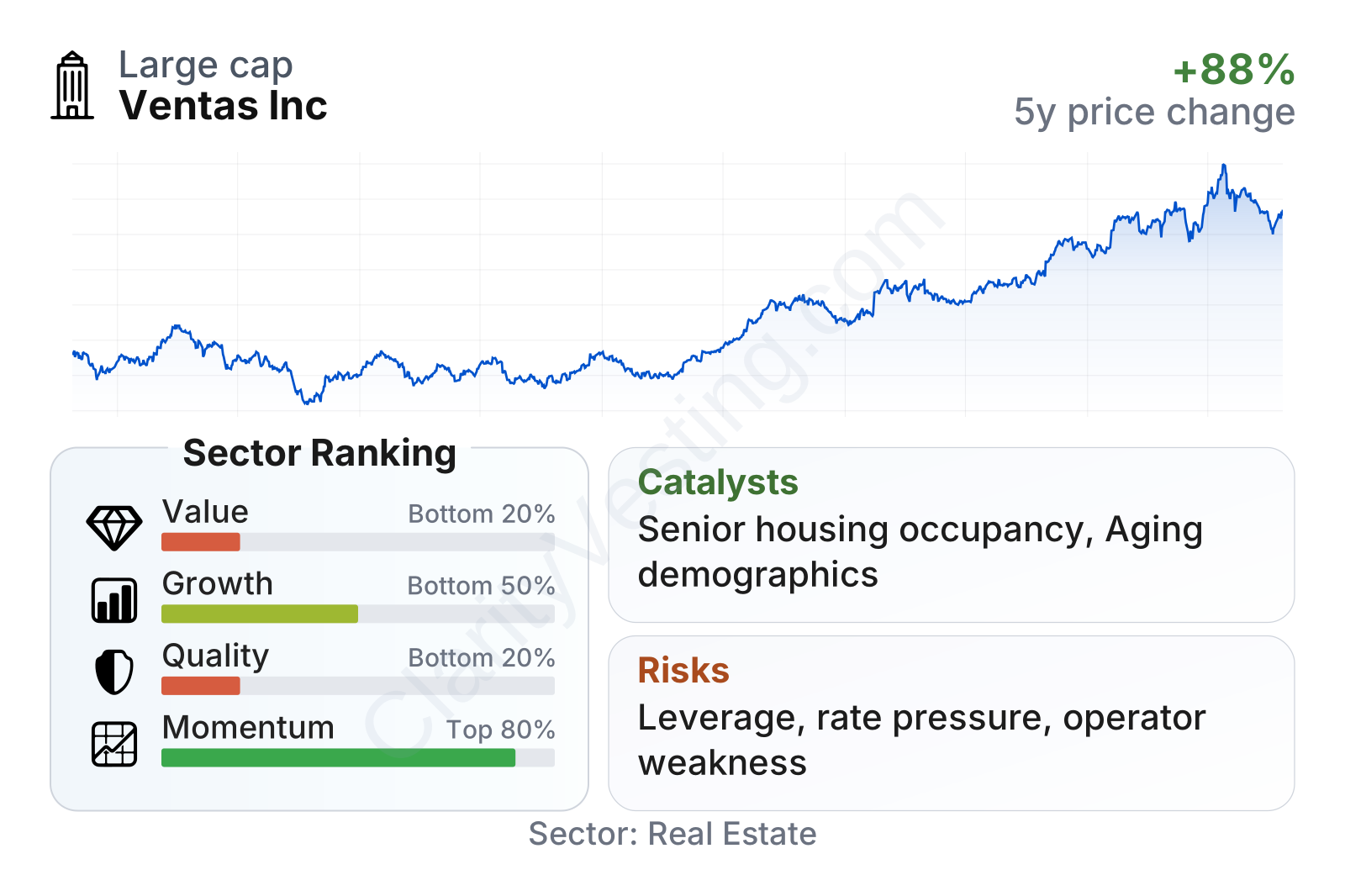
Ventas is a very large healthcare REIT with a stock that has shown strong price momentum over the last three years and relatively low share-price volatility for an equity, with a beta below 1. The broad picture from the metrics table is less flattering on fundamentals than on market performance. Growth has improved, especially in revenue and free cash flow, but profitability and returns on capital still sit below many peers in the real estate sector. The valuation section of the table also points to a premium setup: the stock trades at clearly higher earnings and book multiples than sector medians, while its dividend yield is lower than the typical REIT peer.
Growth
Ventas operates in a part of real estate that has a clear long-term tailwind: population aging. In the United States and several developed markets, the number of older adults continues to rise, which supports demand for senior housing, medical office space, and other care-related facilities. That does not automatically guarantee smooth results, but it gives the company a favorable demand backdrop that many other property types do not have.
A key part of Ventas’s strategy has been to lean into senior housing operating assets and outpatient-focused real estate. That makes strategic sense. Senior housing can benefit directly from occupancy gains and pricing increases when demand tightens. Medical office buildings tend to be more stable because they are tied to recurring care needs and physician or hospital systems. Life science and research properties add a different growth angle, although that segment can be more cyclical and sensitive to leasing conditions.
Revenue per share has trended upward over the past five years, which is an encouraging sign because it suggests growth has not come only from issuing more shares. Recent year-over-year revenue growth has been notably stronger than the sector median, and free cash flow growth over five years has also been well ahead of many peers. Margin trends have improved as well, even if absolute margins remain below sector norms.
The dividend per share has been relatively stable with only modest long-term growth. That fits the current phase of the company: management appears to be balancing shareholder distributions with debt management, capital investment, and portfolio positioning. For a REIT, a slower-growing dividend is not ideal, but it can be understandable when the business is still rebuilding profitability and optimizing leverage.
Recent company updates have emphasized senior housing occupancy gains, rate growth, and continued portfolio shaping. Those are meaningful catalysts because even small changes in occupancy can have a noticeable effect on earnings in operating senior housing communities. If the supply of new senior housing remains limited while demand rises, Ventas could continue to benefit from stronger pricing power and improved property-level cash flow.
Risks
This article is for informational purposes only and does not constitute financial advice. Some content is AI-generated. See Disclaimer


