Stock Analysis · Bristow Group Inc (VTOL)
Overview
Bristow Group Inc is a provider of vertical flight services. In simple terms, it operates helicopters and other aircraft for missions that are difficult, time-sensitive, or take place far from normal transportation networks. The company is best known for transporting workers to and from offshore energy platforms, but it also flies search and rescue missions, supports government and public-service contracts, and provides aircraft support and maintenance services.
Bristow’s business is global, with operations spanning offshore energy regions and government service markets in the Americas, Europe, Africa, Australia, and other selected areas. Its fleet mix and long operating history matter because many of its jobs require high safety standards, specialized aircraft, trained crews, and regulatory approvals that are not easy to replicate.
Based on the company’s recent annual reporting structure, revenue is mainly generated from the following sources:
- Offshore energy transportation: approximately 70% to 80% of revenue. This is the core business and includes transporting personnel and equipment to offshore oil and gas platforms.
- Government and public services: approximately 15% to 25% of revenue. This includes search and rescue, public-sector aviation support, and other mission-critical contracts.
- Other services: approximately 5% to 10% of revenue. This generally includes fixed-wing services, aircraft management, maintenance, training, and other aviation support activities.
The broader financial picture shows a company that has lifted revenue and operating income meaningfully over the last several years. Sales moved from roughly $1.2 billion in 2021 to about $1.5 billion in 2025, while operating income improved far more sharply. That suggests better utilization, firmer contract economics, or both. At the same time, the business still carries meaningful operating costs, which is normal in aircraft-heavy services but important when judging resilience.
Key Figures
| Metric | Value | Sector ⓘ |
|---|---|---|
| Date | Oct 17, 2026 | |
| Context | ||
| Sector | Energy | |
| Industry | Oil & Gas Equipment & Services | |
| Market Cap ⓘ | $1.22B | |
| Beta ⓘ | 1.24 | |
Value (Cheapness) | ||
| P/E Ratio ⓘ | 11.90 | 15.44 |
| P/B Ratio ⓘ | 1.08 | 1.73 |
| FCF Yield ⓘ | -2.82% | 8.20% |
| Dividend Yield ⓘ | 0.61% | 3.59% |
| EBIT / EV ⓘ | 8.20% | 7.46% |
| PEG ⓘ | N/A | |
Growth (Business expansion) | ||
| Revenue Growth ⓘ | 9.40% | 26.90% |
| RPS Growth (5Y CAGR) ⓘ | 4.61% | 6.90% |
| EPS Growth (5Y CAGR) ⓘ | -8.02% | -15.73% |
| BVPS Growth (5Y CAGR) ⓘ | 4.81% | 6.07% |
| Margin Growth (5Y Trend) ⓘ | 9.69% | 0.58% |
| FCF Growth (5Y CAGR) ⓘ | -11.80% | 1.86% |
| DPS Growth (5Y CAGR) ⓘ | -20.50% | 16.79% |
Quality (Business durability) | ||
| ROIC (Latest) ⓘ | 9.11% | 11.40% |
| ROA (Latest) ⓘ | 4.48% | 6.06% |
| ROIC (5Y Median) ⓘ | 1.95% | 10.30% |
| ROA (5Y Median) ⓘ | 0.51% | 5.42% |
| Net Debt / EBIT (Latest) ⓘ | 4.15 | 1.64 |
| Net Debt / EBIT (5Y Median) ⓘ | 9.32 | 1.83 |
| Net Debt / EBITDA (Latest) ⓘ | 2.55 | 1.08 |
| Net Debt / Assets ⓘ | 27.49% | 17.29% |
| EBITDA / Interest ⓘ | 5.53 | 9.64 |
| Operating Margin (Latest) ⓘ | 10.09% | 16.27% |
| Operating Margin (5Y Median) ⓘ | 5.44% | 20.39% |
| Debt to Equity (Latest) ⓘ | 89.03% | 54.76% |
| Profit Margin (Latest) ⓘ | 6.66% | 8.82% |
| Free Cash Flow (Latest) ⓘ | -$34.46M | |
Momentum (Price trend) | ||
| 3Y Return ⓘ | +45.39% | +67.38% |
| 12M Return (excl. last month) ⓘ | +12.11% | +49.19% |
| 6M Return ⓘ | -20.04% | +7.07% |
| Price vs. 200-Day MA ⓘ | -10.17% | +9.56% |
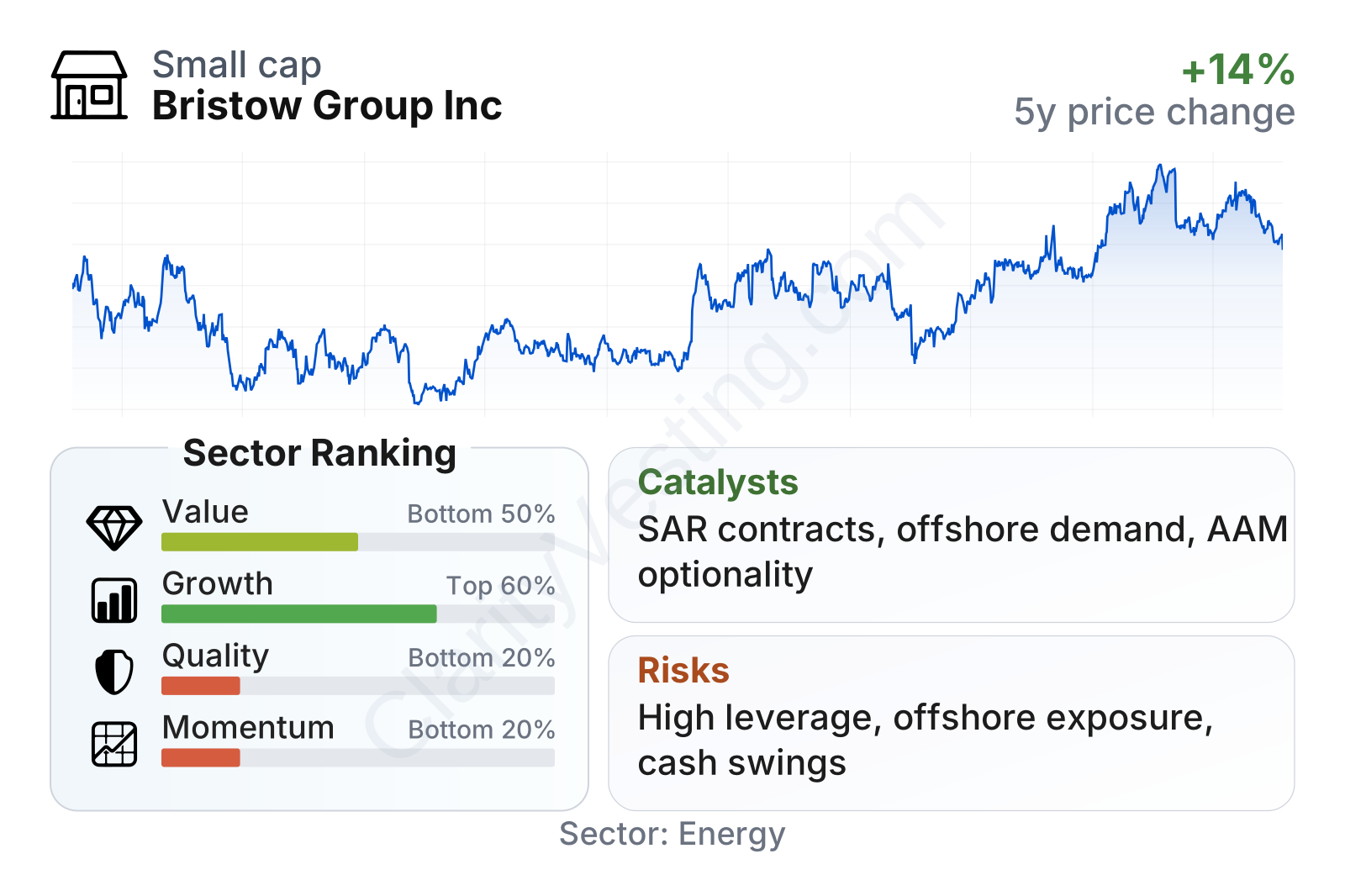
Bristow is a small-cap company with a market value around $1.2 billion, so it is large enough to matter in its niche but still small compared with major energy-service names. The table points to a mixed profile. On valuation, the shares look moderate on earnings and book value, while the EBIT-to-enterprise-value measure is slightly better than the sector median. Growth indicators are uneven but not weak overall: revenue is still expanding, and margin trends have improved over time. The weakest area is quality, where returns on capital, leverage, and cash generation remain less favorable than much of the sector. Momentum is also soft, meaning the stock’s recent trading pattern has lagged many peers even after a stronger multi-year climb.
Growth
Bristow operates in a sector that is more durable than it may first appear. Offshore energy is cyclical, but offshore production assets need ongoing crew transport and logistical support over long periods. That gives Bristow exposure not just to new drilling activity, but also to the day-to-day servicing of existing offshore infrastructure. In addition, search and rescue and government aviation contracts can add steadier demand than pure oilfield exposure.
The company’s strategy appears sensible for long-term growth because it is built around specialized services where reliability and certification matter more than simple price competition. Bristow has also been positioning itself in adjacent areas such as government services and newer advanced air mobility partnerships, which could broaden the business over time if those markets become commercially meaningful.
Revenue growth has improved noticeably from the contraction seen earlier in the period. Growth accelerated strongly through 2023 and 2024, then moderated, but the recent pace still points to ongoing expansion rather than stagnation. That matters because Bristow is not being judged only on near-term profits; the market is also watching whether demand for its aircraft and mission base continues to widen.
Cash generation has been less smooth than revenue growth. Free cash flow was negative for several periods before turning positive again in early 2026. For a fleet-intensive aviation company, that pattern often reflects maintenance cycles, aircraft investments, and working-capital swings rather than a simple deterioration in demand. Still, the return to positive free cash flow is an encouraging operational sign if it can be sustained.
One of the clearest catalysts is contract visibility. Bristow’s business tends to run on multi-year agreements, especially in search and rescue and offshore transportation, which can support revenue stability and fleet planning. Another catalyst is offshore market tightening in key basins, where stronger utilization can improve aircraft pricing. A further opportunity comes from its role in emerging electric vertical takeoff and landing infrastructure partnerships, although that remains more of a long-range option than a current earnings driver.
Recent company communications have also continued to emphasize contract awards, fleet optimization, and the contribution from government and public-service work. For a business like Bristow, these are important signals because long-duration contracts and higher aircraft utilization often matter more than headline revenue alone.
Risks
This article is for informational purposes only and does not constitute financial advice. Some content is AI-generated. See Disclaimer


