Stock Analysis · Corporación Inmobiliaria Vesta S.A.B de C.V (VTMX)
Overview
Corporación Inmobiliaria Vesta is a Mexican real estate company focused on industrial properties. In simple terms, it develops, owns, leases, and manages warehouses, distribution facilities, and manufacturing buildings. Its customers are typically companies involved in logistics, e-commerce, light manufacturing, automotive, aerospace, and export-oriented supply chains. Vesta’s portfolio is concentrated in key industrial corridors in Mexico, especially markets that benefit from trade with the United States and the relocation of production closer to North America.
The business model is relatively straightforward: Vesta invests in land, develops industrial buildings, signs lease contracts with tenants, and then collects recurring rental income. It can also generate value by stabilizing newly developed assets and by increasing rents over time as occupancy and demand improve. For a long-term reader, the important point is that this is mainly a landlord for industrial real estate, not a homebuilder and not a shopping mall operator.
Based on company reporting, revenue comes overwhelmingly from rental and related real estate operations, with additional support from property management and other tenant-related services. A practical breakdown is:
- Industrial rental income: about 90% to 95% — recurring lease payments from warehouses and manufacturing facilities.
- Reimbursements, maintenance, and other property-related income: about 5% to 10% — charges tied to property operations and tenant services.
- Property disposals or other non-recurring items: variable — not a dependable core source of annual revenue.
Over the last several years, revenue has moved higher while direct property costs remained relatively contained, which is consistent with a portfolio benefiting from scale and rising rents. The business also converts a large share of revenue into operating profit, although real estate accounting can make margins look unusually high because property revaluations and other non-cash items may affect results.
The overall picture is of a specialized industrial landlord with recurring income, a development pipeline, and clear exposure to Mexico’s manufacturing and logistics expansion.
Key Figures
| Metric | Value | Sector ⓘ |
|---|---|---|
| Date | Oct 17, 2026 | |
| Context | ||
| Sector | Real Estate | |
| Industry | Real Estate - Diversified | |
| Market Cap ⓘ | $3.18B | |
| Beta ⓘ | 0.26 | |
Value (Cheapness) | ||
| P/E Ratio ⓘ | 7.50 | 17.38 |
| P/B Ratio ⓘ | 1.03 | 0.85 |
| FCF Yield ⓘ | 4.26% | 7.38% |
| Dividend Yield ⓘ | 2.41% | 4.85% |
| EBIT / EV ⓘ | 9.12% | 3.78% |
| PEG ⓘ | N/A | |
Growth (Business expansion) | ||
| Revenue Growth ⓘ | 16.80% | 5.30% |
| RPS Growth (5Y CAGR) ⓘ | 9.85% | 6.02% |
| EPS Growth (5Y CAGR) ⓘ | -10.65% | -11.37% |
| BVPS Growth (5Y CAGR) ⓘ | 11.06% | 0.45% |
| Margin Growth (5Y Trend) ⓘ | -86.96% | -0.22% |
| FCF Growth (5Y CAGR) ⓘ | 10.58% | 5.40% |
| DPS Growth (5Y CAGR) ⓘ | -0.09% | 5.02% |
Quality (Business durability) | ||
| ROIC (Latest) ⓘ | N/A | 5.69% |
| ROE (Latest) ⓘ | 14.06% | 7.56% |
| ROA (Latest) ⓘ | 8.52% | 2.85% |
| ROIC (5Y Median) ⓘ | N/A | 4.22% |
| ROE (5Y Median) ⓘ | 13.58% | 6.03% |
| ROA (5Y Median) ⓘ | 6.94% | 2.44% |
| Net Debt / EBIT (Latest) ⓘ | 2.22 | 7.59 |
| Net Debt / EBIT (5Y Median) ⓘ | 1.60 | 8.40 |
| Net Debt / EBITDA (Latest) ⓘ | 2.21 | 5.27 |
| Net Debt / Assets ⓘ | 15.99% | 37.76% |
| EBITDA / Interest ⓘ | 4.96 | 4.10 |
| Operating Margin (Latest) ⓘ | 110.86% | 35.29% |
| Operating Margin (5Y Median) ⓘ | 187.02% | 37.31% |
| Debt to Equity (Latest) ⓘ | 37.43% | 88.87% |
| Profit Margin (Latest) ⓘ | 132.16% | 19.61% |
| Free Cash Flow (Latest) ⓘ | $135.41M | |
Momentum (Price trend) | ||
| 3Y Return ⓘ | +17.59% | +30.75% |
| 12M Return (excl. last month) ⓘ | +24.49% | +4.36% |
| 6M Return ⓘ | -2.89% | -2.52% |
| Price vs. 200-Day MA ⓘ | +3.77% | -2.34% |
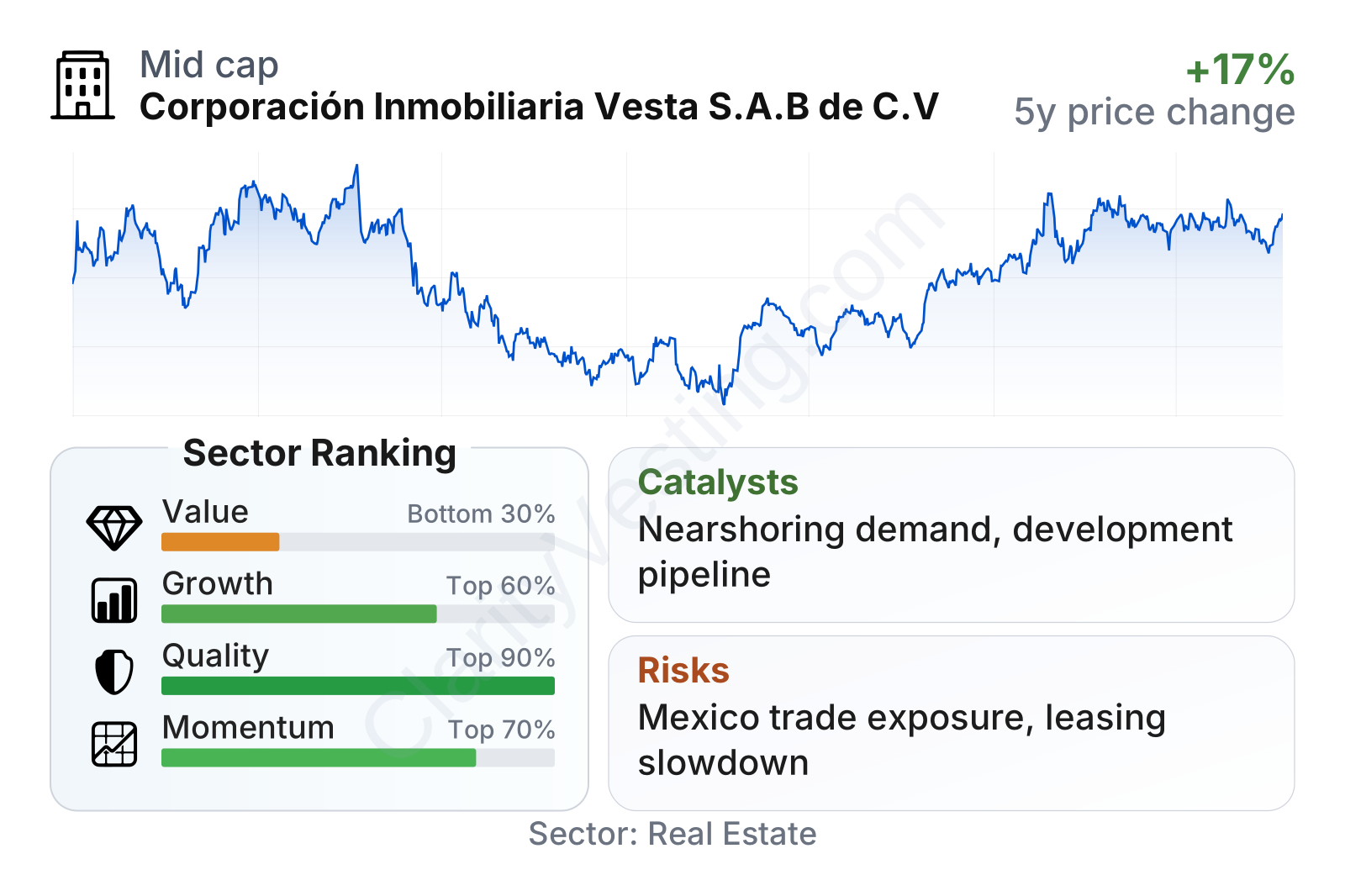
Vesta is a mid-sized real estate company with a relatively low share-price volatility profile, as shown by its beta well below 1. On valuation, the stock screens mixed: earnings-based measures look inexpensive versus the sector, while book value is closer to sector norms. On operating quality, the company stands out much more clearly. Returns on equity and assets are comfortably above the sector median, and leverage is lower than many peers. Growth metrics are also constructive, especially for revenue and book value per share, even though earnings trends can be distorted by real estate valuation effects and margin normalization. Momentum has improved over the last year, but the longer multi-year stock performance still looks less impressive than the broader real estate group.
Growth
Vesta operates in one of the more attractive corners of real estate: industrial properties tied to manufacturing and logistics. This segment has benefited from several structural forces, including nearshoring, supply-chain diversification, e-commerce infrastructure needs, and continued trade integration across North America. Mexico has been a meaningful beneficiary of these trends because it offers manufacturing scale, geographic proximity to the United States, and established export corridors.
The company’s strategy fits that backdrop well. Rather than relying only on buying finished assets, Vesta develops many of its own buildings. That matters because development can create higher long-term returns when demand is strong and leasing conditions are favorable. It also gives the company more control over location, tenant mix, and future expansion. In recent company communications, management has continued to emphasize development, portfolio growth, and disciplined capital allocation, which is consistent with a business trying to capture sustained industrial demand rather than short-lived cycles.
Revenue per share has shown a steady upward path over the last five years, which is an encouraging sign because it means growth was not purely driven by issuing more shares. The pace has been stronger than the sector median over that period, suggesting Vesta has been expanding its cash-generating asset base at a healthy rate.
The dividend per share has been less consistent. It dipped for a period and then recovered, which suggests management has prioritized growth and balance-sheet flexibility over delivering a steadily rising payout. For a company in expansion mode, that is not necessarily negative, but it does mean the long-term case depends more on portfolio growth and rental income than on income distribution alone.
A notable catalyst is the broader push by global manufacturers to locate production closer to end markets. Vesta’s exposure to industrial hubs in Mexico makes it well positioned if tenants continue to expand distribution and manufacturing capacity. Another important support is that the company has already built a recognized platform in a niche where scale, land access, and execution matter. Recent operating updates and investor materials have continued to point to leasing activity, development deliveries, and portfolio expansion as major drivers for future growth.
Risks
This article is for informational purposes only and does not constitute financial advice. Some content is AI-generated. See Disclaimer


