Stock Analysis · Victoria's Secret & Co (VSXY)
Overview
Victoria’s Secret & Co. is a specialty retailer focused on women’s intimate apparel, sleepwear, beauty products, and adjacent lifestyle categories. Its main brands are Victoria’s Secret and PINK, sold through company-operated stores, digital channels, and international partner-operated locations. The business is built around a globally recognized brand name, a large store base, and direct relationships with customers through both e-commerce and physical retail.
The company’s revenue mix is still dominated by its core lingerie-led assortment, with beauty and international activities providing additional diversification. Based on recent annual filings, the revenue base can be summarized approximately as follows:
- North America stores and digital sales: about 85% to 90% — this includes bras, panties, sleepwear, loungewear, sportswear, and beauty products sold directly through Victoria’s Secret and PINK stores and websites.
- International business: about 10% to 15% — this comes mainly from franchise, partner, wholesale, and certain direct international activities using the Victoria’s Secret and PINK brands outside the U.S. and Canada.
- Beauty and personal care: a meaningful but smaller product category within brand sales — fragrances, body care, and related items remain important because they can bring repeat purchases and attractive gross margins, but the company does not consistently break them out as a separate top-line segment in public filings.
What stands out is that Victoria’s Secret remains a focused brand company rather than a diversified apparel group. That concentration can be powerful when brand relevance improves, but it also means performance depends heavily on product acceptance, merchandising, and brand perception.
Over the last four fiscal years, revenue has been relatively stable in a band a little above $6 billion, while profitability has been more volatile. Gross profit has held up reasonably well, but selling and administrative expenses have risen, keeping pressure on operating income. The business still generates meaningful cash, yet the path from sales to net income is less efficient than it was several years ago.
The operating picture shows a company with resilient sales and solid gross margins, but one that has had difficulty converting that into consistently strong earnings because overhead remains heavy. That makes execution on costs and merchandising especially important.
Key Figures
| Metric | Value | Sector ⓘ |
|---|---|---|
| Date | Nov 14, 2026 | |
| Context | ||
| Sector | Consumer Cyclical | |
| Industry | Apparel Retail | |
| Market Cap ⓘ | $9.05B | |
| Beta ⓘ | 2.13 | |
Value (Cheapness) | ||
| P/E Ratio ⓘ | 25.34 | 17.68 |
| P/B Ratio ⓘ | 10.03 | 2.77 |
| FCF Yield ⓘ | 6.12% | 7.36% |
| Dividend Yield ⓘ | N/A | 2.55% |
| EBIT / EV ⓘ | 5.02% | 7.05% |
| PEG ⓘ | N/A | |
Growth (Business expansion) | ||
| Revenue Growth ⓘ | 10.40% | 5.20% |
| RPS Growth (5Y CAGR) ⓘ | 1.52% | 8.97% |
| EPS Growth (5Y CAGR) ⓘ | -9.47% | -12.17% |
| BVPS Growth (5Y CAGR) ⓘ | 30.55% | 5.63% |
| Margin Growth (5Y Trend) ⓘ | -3.28% | -0.17% |
| FCF Growth (5Y CAGR) ⓘ | 4.55% | 5.89% |
| DPS Growth (5Y CAGR) ⓘ | N/A | 10.17% |
Quality (Business durability) | ||
| ROIC (Latest) ⓘ | 24.72% | 11.44% |
| ROA (Latest) ⓘ | 7.34% | 5.57% |
| ROIC (5Y Median) ⓘ | N/A | 10.52% |
| ROA (5Y Median) ⓘ | 3.37% | 5.37% |
| Net Debt / EBIT (Latest) ⓘ | 4.30 | 2.06 |
| Net Debt / EBIT (5Y Median) ⓘ | 8.21 | 2.24 |
| Net Debt / EBITDA (Latest) ⓘ | 3.09 | 1.45 |
| Net Debt / Assets ⓘ | 46.11% | 21.26% |
| EBITDA / Interest ⓘ | 11.92 | 9.63 |
| Operating Margin (Latest) ⓘ | 7.99% | 9.14% |
| Operating Margin (5Y Median) ⓘ | 4.59% | 9.64% |
| Debt to Equity (Latest) ⓘ | 292.83% | 73.06% |
| Profit Margin (Latest) ⓘ | 5.47% | 5.35% |
| Free Cash Flow (Latest) ⓘ | $554.00M | |
Momentum (Price trend) | ||
| 3Y Return ⓘ | +105.24% | +20.92% |
| 12M Return (excl. last month) ⓘ | N/A | 0.00% |
| 6M Return ⓘ | +126.96% | +1.89% |
| Price vs. 200-Day MA ⓘ | N/A | +1.11% |
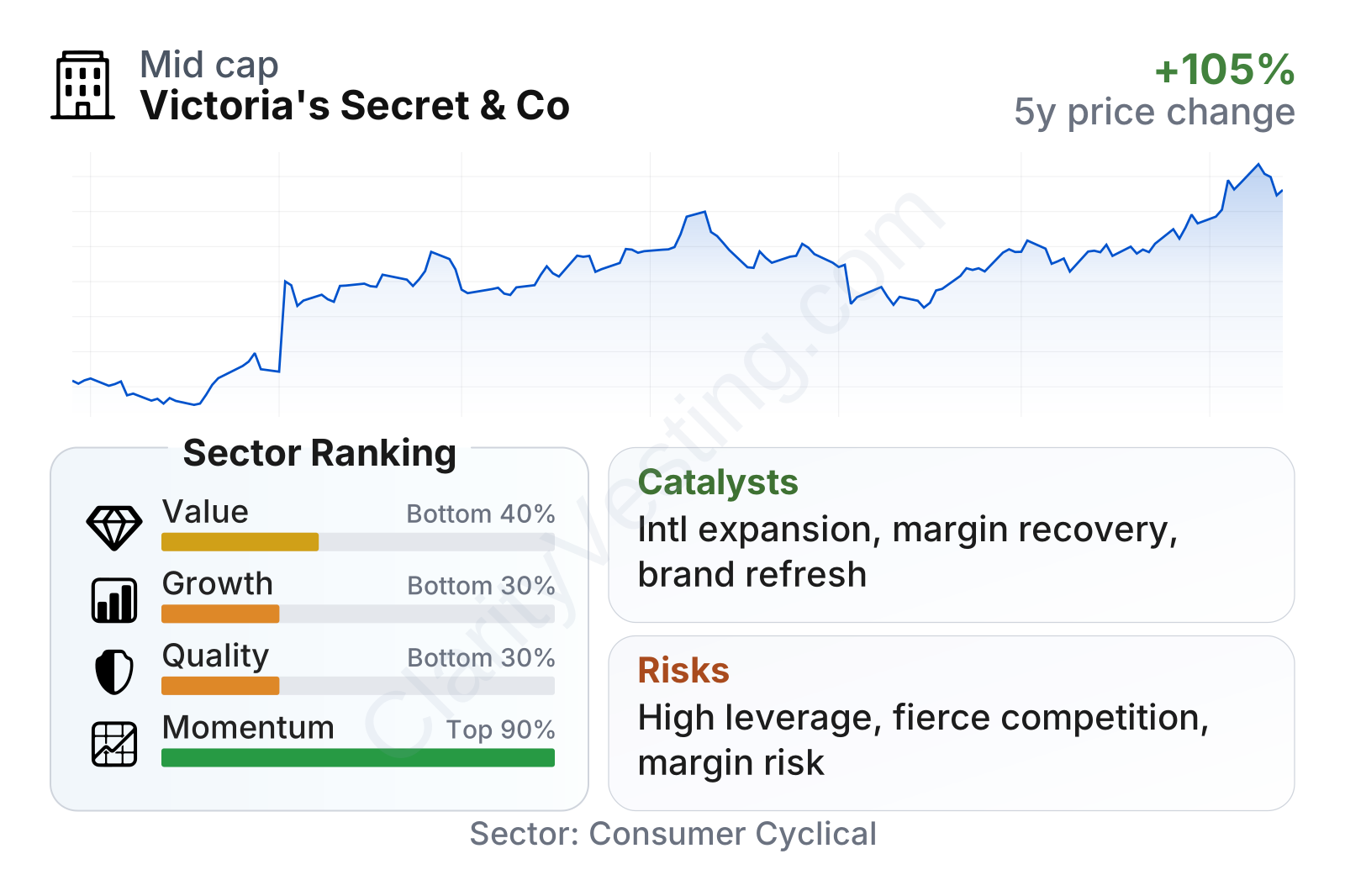
Victoria’s Secret is a mid-sized public retailer with a stock that has been notably volatile, as reflected by a beta above 2. The share price moved sharply higher between late April and late July 2026, which suggests that market expectations can change quickly when operating trends improve. On valuation, earnings-based pricing is close to the broader apparel retail range, but the price-to-book ratio is much higher than the sector median, partly because the balance sheet carries relatively low equity compared with debt. Free cash flow remains meaningful, with annual free cash flow above $500 million, but the overall profile in the table points to a mixed picture: modest value appeal, weaker quality ranking, and uneven longer-term growth characteristics despite a recent rebound in sales.
Growth
Victoria’s Secret operates in a large and enduring category rather than a fast-expanding one. Intimate apparel, sleepwear, and beauty are recurring consumer purchases, which gives the sector staying power, but growth is usually driven more by brand strength, product innovation, pricing, and channel execution than by rapid market expansion. In other words, this is not a business riding a structural boom on its own; it needs to earn growth through better execution.
The current strategy is sensible in that context. Management has emphasized product improvement, broader customer appeal, digital capabilities, international expansion through partners, and a more disciplined brand positioning than in the past. Those priorities match the company’s main challenge: restoring relevance while protecting margins. International expansion is especially attractive because it can extend the brand with less capital intensity than opening and operating every store directly.
Recent sales momentum has improved. Year-over-year revenue growth in 2026 has been running in the low double digits, clearly ahead of the sector median. That matters because Victoria’s Secret has spent several years trying to stabilize the business after a period of brand turbulence and inconsistent performance. The rebound is encouraging, but the longer five-year growth profile still looks modest, which means the company is recovering from a weak base rather than compounding steadily over a long period.
A key potential catalyst is operating leverage. If the company can keep revenue growing while slowing expense growth, even moderately, profitability could improve faster than sales. Another catalyst is category expansion beyond core bras and panties into adjacent products, especially beauty and active-related offerings, where repeat purchase behavior can be favorable. International licensing and partner-led store openings also remain a meaningful opportunity because they can lift brand reach without burdening the balance sheet as much as wholly owned expansion.
Recent company updates in 2026 have also pointed to ongoing efforts around brand partnerships, refreshed merchandise assortments, and broader customer targeting. Those are not guaranteed breakthroughs, but for a consumer brand company, they are practical levers that can move both traffic and pricing power if execution is strong.
Risks
This article is for informational purposes only and does not constitute financial advice. Some content is AI-generated. See Disclaimer