Stock Analysis · Vestis Corporation (VSTS)
Overview
Vestis Corporation is a workplace uniform and supplies company. It rents, cleans, repairs, and delivers uniforms and other essential items used in daily operations by businesses across the United States and Canada. Its customers include companies in manufacturing, hospitality, food service, healthcare, retail, and other service industries that need employees outfitted and workplaces stocked on a recurring basis.
The business model is built around repeat service routes. Instead of selling most products one time, Vestis typically provides scheduled pickup, laundering, maintenance, and redelivery. That creates recurring revenue, but it also makes the company very dependent on route efficiency, retention, labor execution, and cost control.
Based on company disclosures, revenue is primarily generated from uniform rental and workplace supplies and services. A simple way to think about the mix is the following:
- Uniform rental and related services: approximately 70% to 75% of revenue. This includes renting garments, collecting used items, laundering them, repairing them, and returning them to customers on a regular schedule.
- Workplace supplies and related services: approximately 25% to 30% of revenue. This generally includes floor mats, towels, restroom supplies, first-aid and safety products, and other facility-support items bundled into recurring service programs.
That mix matters because uniform rental tends to be the core customer relationship, while add-on supplies can raise revenue per account and improve route economics when execution is strong. Over the last few years, however, the company’s revenue base has been broadly flat to slightly down, while profitability has weakened more noticeably.
The long-term financial flow shows a business that kept annual revenue near the same general range, but with rising operating pressure. Gross profit narrowed after 2023, operating income dropped sharply, and interest expense became much heavier after the separation from its former parent, leaving very little room at the bottom line.
Key Figures
| Metric | Value | Sector ⓘ |
|---|---|---|
| Date | Oct 17, 2026 | |
| Context | ||
| Sector | Industrials | |
| Industry | Rental & Leasing Services | |
| Market Cap ⓘ | $1.89B | |
| Beta ⓘ | 1.07 | |
Value (Cheapness) | ||
| P/E Ratio ⓘ | N/A | 22.10 |
| P/B Ratio ⓘ | 2.14 | 1.97 |
| FCF Yield ⓘ | 7.21% | 6.38% |
| Dividend Yield ⓘ | N/A | 1.94% |
| EBIT / EV ⓘ | 2.73% | 4.79% |
| PEG ⓘ | N/A | |
Growth (Business expansion) | ||
| Revenue Growth ⓘ | -1.80% | 9.30% |
| RPS Growth (5Y CAGR) ⓘ | 2.57% | 7.81% |
| EPS Growth (5Y CAGR) ⓘ | -33.13% | -13.06% |
| BVPS Growth (5Y CAGR) ⓘ | -22.06% | 6.14% |
| Margin Growth (5Y Trend) ⓘ | -2.21% | 0.88% |
| FCF Growth (5Y CAGR) ⓘ | -56.02% | 11.01% |
| DPS Growth (5Y CAGR) ⓘ | -38.42% | 9.48% |
Quality (Business durability) | ||
| ROIC (Latest) ⓘ | 3.61% | 10.84% |
| ROA (Latest) ⓘ | -0.18% | 5.41% |
| ROIC (5Y Median) ⓘ | 4.70% | 9.38% |
| ROA (5Y Median) ⓘ | 2.61% | 4.95% |
| Net Debt / EBIT (Latest) ⓘ | 15.05 | 2.08 |
| Net Debt / EBIT (5Y Median) ⓘ | 6.08 | 2.27 |
| Net Debt / EBITDA (Latest) ⓘ | 5.75 | 1.39 |
| Net Debt / Assets ⓘ | 45.26% | 19.28% |
| EBITDA / Interest ⓘ | 2.54 | 9.58 |
| Operating Margin (Latest) ⓘ | 3.16% | 10.50% |
| Operating Margin (5Y Median) ⓘ | 5.65% | 10.29% |
| Debt to Equity (Latest) ⓘ | 152.54% | 65.48% |
| Profit Margin (Latest) ⓘ | -0.20% | 6.67% |
| Free Cash Flow (Latest) ⓘ | $136.41M | |
Momentum (Price trend) | ||
| 3Y Return ⓘ | -2.32% | +61.68% |
| 12M Return (excl. last month) ⓘ | +207.86% | +12.58% |
| 6M Return ⓘ | +51.52% | 0.00% |
| Price vs. 200-Day MA ⓘ | +27.53% | +0.02% |
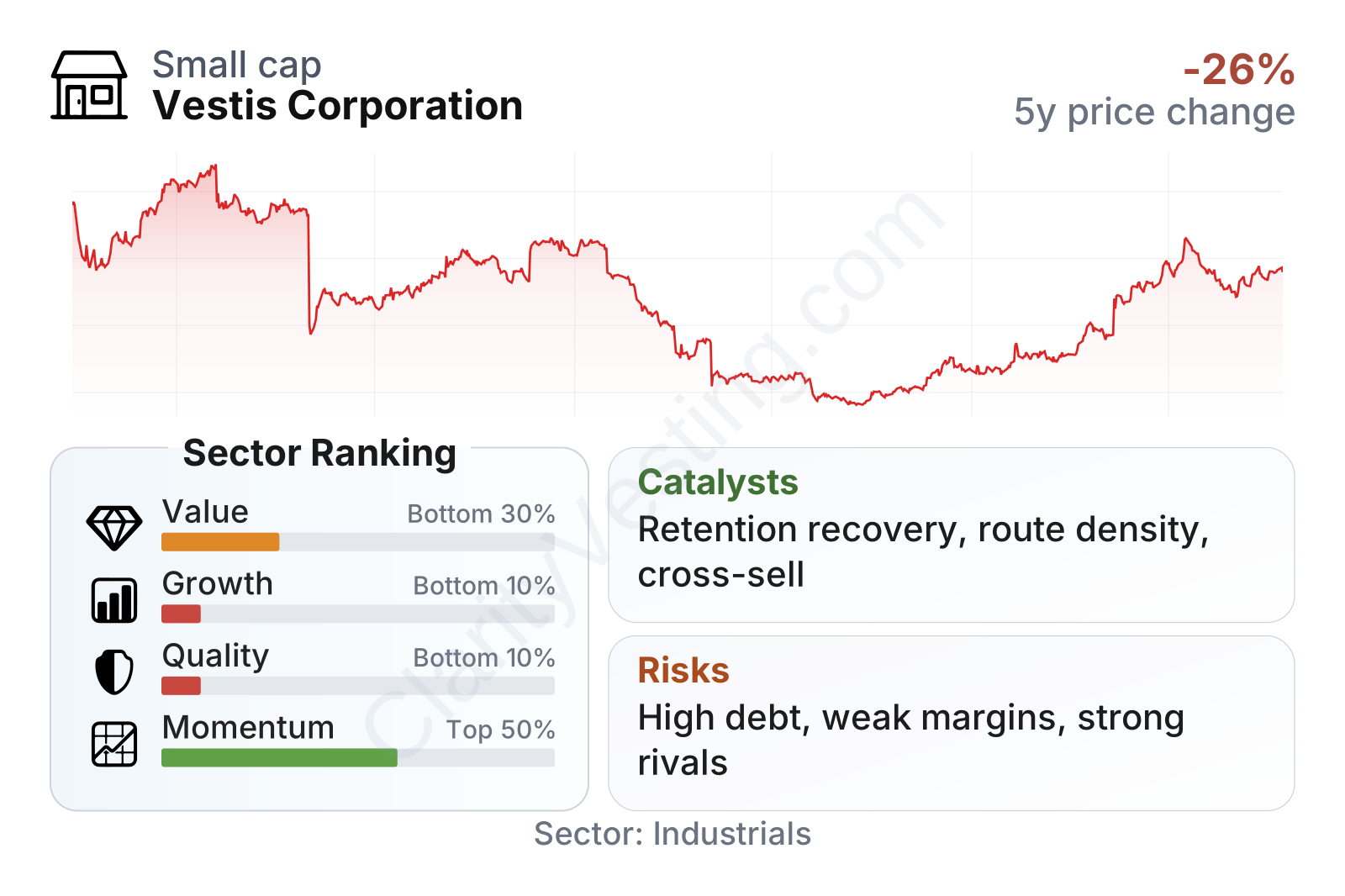
Vestis is a small-cap industrial services company with a stock that has been extremely volatile since becoming a standalone public business. Recent price momentum has improved sharply, but the broader operating profile still looks weak. On the scorecard shown in the table, growth and quality rank near the bottom of the sector, while value is mixed rather than clearly attractive. Free cash flow yield looks better than the sector median, but that is offset by low returns on capital, very high leverage, and profit metrics that remain under pressure.
Growth
Vestis operates in a steady but not especially fast-growing segment of the industrial services market. Uniform rental, facility supplies, and workplace safety services benefit from recurring customer needs, employee turnover, compliance requirements, and outsourcing by businesses that prefer not to manage laundry, inventory, and replenishment in-house. That gives the sector defensive characteristics, but growth usually depends more on execution, route density, customer retention, and cross-selling than on a major industry tailwind.
For Vestis, the strategic logic is reasonable: improve service reliability, retain customers, rebuild sales productivity, and expand wallet share through workplace supplies and safety offerings. The challenge is that these goals only matter if they show up in cleaner revenue trends and healthier margins. So far, the top line has not shown sustained acceleration.
The revenue trend points to a business that has spent most recent quarters in contraction, usually by low-single-digit percentages. There was one temporary return to positive year-over-year growth, but it did not turn into a consistent recovery. That suggests Vestis is still in a stabilization phase rather than a clear expansion phase.
There is still a credible path to better performance if management improves customer retention and route productivity. This kind of business can recover meaningfully when service issues are fixed because customer relationships are recurring and contract-like in practice, even if not all are long-term contracts in a strict legal sense. In addition, a denser route network can lift profitability without requiring dramatic revenue growth.
Cash generation is an important counterbalance. Free cash flow remained positive, but the recent direction has been much weaker than earlier periods. That means Vestis still produces cash, yet the cushion has become thinner at the same time the company is dealing with elevated debt and weak earnings. A more durable improvement would likely require both steadier sales and better operating discipline.
As for recent opportunities, the most important potential catalyst is not a single product launch or a large one-time event. It is operational improvement: better service execution, reduced customer losses, stronger sales conversion, and more effective pricing. If those elements improve together, the business could show meaningful operating leverage because a large route-based infrastructure is already in place.
Risks
This article is for informational purposes only and does not constitute financial advice. Some content is AI-generated. See Disclaimer


