Stock Analysis · Verastem Inc (VSTM)
Overview
Verastem, Inc. is a small biotechnology company focused on developing and commercializing cancer treatments. Its work is centered on precision oncology, which means trying to match drugs to patients whose tumors carry specific molecular features. In practical terms, the company is still in the transition from a development-stage biotech toward a commercial business: it has product-related revenue, but its economics are still dominated by research spending and operating losses.
The company’s strategic focus has recently centered on avutometinib-based combinations, especially in recurrent low-grade serous ovarian cancer, an area with limited treatment options. Verastem has also highlighted broader development opportunities in RAS/MAPK pathway-driven cancers, which is a large area of interest across oncology.
Revenue is still concentrated and relatively small compared with total spending. Based on recent annual results, the main sources are approximately:
- Product revenue: about 100% of total revenue in 2025. This reflects commercial sales tied to the company’s marketed oncology product activities.
- Collaboration or other revenue: minimal to none in the latest annual mix. In earlier periods, Verastem had modest non-product revenue, but recent results indicate the business is now overwhelmingly dependent on product sales rather than diversified partnerships.
That revenue mix matters because it shows both progress and concentration. Sales have moved up from near-zero levels a few years ago, but the company still depends on a narrow base while funding a large clinical pipeline.
The long-term pattern shows revenue improving from very low levels, but operating costs have risen much faster. Research and development has become the largest expense line, which is common for a biotech pursuing multiple clinical and regulatory milestones, yet it also explains why losses have expanded rather than narrowed.
Key Figures
| Metric | Value | Sector ⓘ |
|---|---|---|
| Date | Oct 31, 2026 | |
| Context | ||
| Sector | Healthcare | |
| Industry | Biotechnology | |
| Market Cap ⓘ | $1.17B | |
| Beta ⓘ | 0.39 | |
Value (Cheapness) | ||
| P/E Ratio ⓘ | N/A | 24.88 |
| P/B Ratio ⓘ | 19.35 | 3.16 |
| FCF Yield ⓘ | -13.93% | 2.92% |
| Dividend Yield ⓘ | N/A | 1.78% |
| EBIT / EV ⓘ | -17.57% | 0.56% |
| PEG ⓘ | -1.89 | |
Growth (Business expansion) | ||
| Revenue Growth ⓘ | 1775.40% | 7.50% |
| RPS Growth (5Y CAGR) ⓘ | 33.30% | 8.46% |
| EPS Growth (5Y CAGR) ⓘ | -33.89% | -17.36% |
| BVPS Growth (5Y CAGR) ⓘ | -39.16% | 3.71% |
| Margin Growth (5Y Trend) ⓘ | N/A | -0.61% |
| FCF Growth (5Y CAGR) ⓘ | N/A | 1.10% |
| DPS Growth (5Y CAGR) ⓘ | N/A | 6.66% |
Quality (Business durability) | ||
| ROIC (Latest) ⓘ | -122.05% | 5.22% |
| ROA (Latest) ⓘ | -105.75% | 3.01% |
| ROIC (5Y Median) ⓘ | -76.53% | 4.52% |
| ROA (5Y Median) ⓘ | -72.47% | 1.85% |
| Net Debt / EBIT (Latest) ⓘ | N/A | 1.34 |
| Net Debt / EBIT (5Y Median) ⓘ | N/A | 1.84 |
| Net Debt / EBITDA (Latest) ⓘ | N/A | 0.98 |
| Net Debt / Assets ⓘ | -25.19% | 4.48% |
| EBITDA / Interest ⓘ | N/A | 9.65 |
| Operating Margin (Latest) ⓘ | -229.33% | 9.44% |
| Operating Margin (5Y Median) ⓘ | -2009.94% | 7.33% |
| Debt to Equity (Latest) ⓘ | 168.71% | 27.22% |
| Profit Margin (Latest) ⓘ | -231.59% | 3.41% |
| Free Cash Flow (Latest) ⓘ | -$163.54M | |
Momentum (Price trend) | ||
| 3Y Return ⓘ | +55.31% | +55.86% |
| 12M Return (excl. last month) ⓘ | -8.33% | +16.75% |
| 6M Return ⓘ | +78.89% | +14.89% |
| Price vs. 200-Day MA ⓘ | +56.96% | +7.77% |
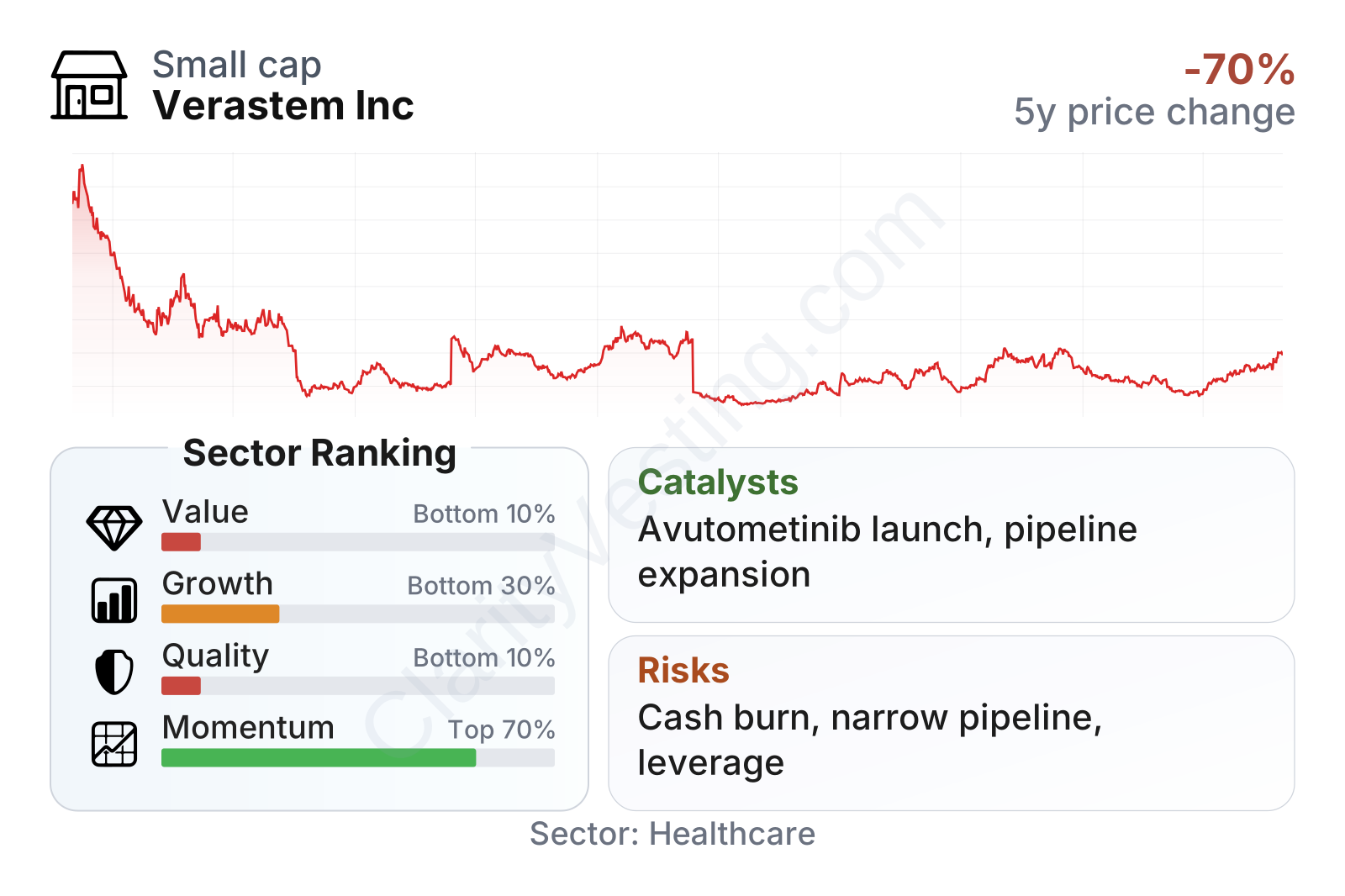
The overall profile is mixed. Growth indicators are strong on the revenue side, but value and quality metrics rank near the bottom of the healthcare sector because the company remains deeply unprofitable and consumes cash. The business is now around small- to mid-cap biotech size, and its recent share-price rebound has been much stronger than the sector over the past six months, showing that the market is reacting to clinical and regulatory expectations rather than current earnings power.
The share-price history also shows how event-driven this stock has been. It has moved through very large swings over the past few years, which is typical for biotech companies where trial results, regulatory decisions, and financing events can rapidly change expectations.
Growth
Verastem operates in a sector with real long-term growth potential. Oncology remains one of the largest and most active areas in biotechnology, and precision cancer drugs continue to attract investment because they can address high unmet medical needs and often support premium pricing if they show meaningful benefit. Within that space, the company’s emphasis on genetically defined tumors is strategically logical: smaller patient groups can still support meaningful commercial opportunities when competition is limited and treatment options are weak.
The biggest question is whether Verastem can turn promising science into durable commercialization. Its strategy makes sense on paper. It is targeting a niche indication where a successful launch does not require the same scale as a mass-market primary care drug, and it is also trying to build additional uses around the same scientific platform. That can improve the return on research spending if one approval opens the door to follow-on indications.
Revenue growth has been highly uneven, which is not surprising given the company’s small base and shifting business mix. The latest year-over-year reading is very strong, clearly above the sector median, but earlier periods were extremely volatile. For a company at this stage, growth should be read less as a stable trend and more as evidence that the revenue base is starting to form.
One of the clearest catalysts is the regulatory and commercial path for avutometinib combinations in low-grade serous ovarian cancer. Public company communications in 2026 have continued to emphasize launch preparation and execution-related milestones tied to that franchise. If uptake in the initial indication is solid, the company could move from being valued mostly on pipeline expectations toward being judged partly on commercial performance.
Another important catalyst is pipeline expansion. Verastem has discussed additional studies involving RAS/MAPK pathway-driven tumors, and that matters because the company is too small to rely on a single product opportunity forever. Investors looking at the long term will likely care less about one quarter of revenue and more about whether the company can create a repeatable oncology platform.
The weak point is that growth is not yet funding itself. Free cash flow has remained deeply negative and has worsened over time, showing that the company is still spending far more than it brings in. That does not cancel the growth opportunity, but it does mean future progress must eventually show up in either much higher revenue or tighter expense discipline.
Risks
This article is for informational purposes only and does not constitute financial advice. Some content is AI-generated. See Disclaimer


