Stock Analysis · Vista Oil & Gas S.A.B. de C.V (VSOGF)
Overview
Vista Oil & Gas S.A.B. de C.V., usually known as Vista, is an independent oil and gas producer focused mainly on Latin America, with its core operations in Argentina’s Vaca Muerta shale formation and an expanding position in Mexico. In simple terms, the company drills wells, produces crude oil and natural gas, and then sells those hydrocarbons into domestic and export markets. Its business is upstream energy, which means it makes money primarily from finding and extracting oil and gas rather than refining fuels or operating service stations.
The company’s revenue is heavily concentrated in hydrocarbon sales, with crude oil clearly representing the dominant contributor. Based on recent company reporting, the mix is approximately as follows:
- Crude oil sales: about 85% to 90% of revenue. This is the main earnings engine and includes production sold locally and into export channels.
- Natural gas sales: about 8% to 12% of revenue. This reflects gas delivered into regional markets and is usually less profitable than oil.
- LPG and other products/services: about 1% to 5% of revenue. This includes liquids derived from gas processing and smaller ancillary items.
What makes Vista notable is that it has built a concentrated operating base in one of the world’s better-known shale oil regions outside North America. That concentration has allowed it to scale production quickly, keep operating margins high, and focus capital on a relatively small set of high-potential assets. Over the last several years, revenue and earnings expanded sharply as production increased and oil remained the core mix driver.
The financial flow also shows a business that has grown much larger in a short time. Revenue has risen from roughly $0.6 billion in 2021 to more than $2.6 billion by 2025, while net income has climbed materially as operating income stayed strong. The broad picture is favorable on profitability, although the cost base and interest burden have also moved higher as the company expanded.
Key Figures
| Metric | Value | Sector ⓘ |
|---|---|---|
| Date | Oct 03, 2026 | |
| Context | ||
| Sector | Energy | |
| Industry | Oil & Gas E&P | |
| Market Cap ⓘ | $7.99B | |
| Beta ⓘ | -0.47 | |
Value (Cheapness) | ||
| P/E Ratio ⓘ | 9.51 | 14.47 |
| P/B Ratio ⓘ | 2.48 | 1.70 |
| FCF Yield ⓘ | 3.61% | 8.66% |
| Dividend Yield ⓘ | N/A | 3.77% |
| EBIT / EV ⓘ | 13.03% | 7.46% |
| PEG ⓘ | N/A | |
Growth (Business expansion) | ||
| Revenue Growth ⓘ | 102.30% | 27.35% |
| RPS Growth (5Y CAGR) ⓘ | 37.34% | 6.75% |
| EPS Growth (5Y CAGR) ⓘ | 9.12% | -15.45% |
| BVPS Growth (5Y CAGR) ⓘ | 40.25% | 5.85% |
| Margin Growth (5Y Trend) ⓘ | 3.64% | 0.75% |
| FCF Growth (5Y CAGR) ⓘ | N/A | 3.62% |
| DPS Growth (5Y CAGR) ⓘ | N/A | 16.85% |
Quality (Business durability) | ||
| ROIC (Latest) ⓘ | 17.08% | 11.33% |
| ROA (Latest) ⓘ | 10.49% | 6.03% |
| ROIC (5Y Median) ⓘ | 21.56% | 10.16% |
| ROA (5Y Median) ⓘ | 13.98% | 5.34% |
| Net Debt / EBIT (Latest) ⓘ | 2.50 | 1.62 |
| Net Debt / EBIT (5Y Median) ⓘ | 1.56 | 1.91 |
| Net Debt / EBITDA (Latest) ⓘ | 1.52 | 1.06 |
| Net Debt / Assets ⓘ | 39.06% | 17.29% |
| EBITDA / Interest ⓘ | 8.55 | 9.64 |
| Operating Margin (Latest) ⓘ | 41.19% | 16.32% |
| Operating Margin (5Y Median) ⓘ | 39.94% | 19.53% |
| Debt to Equity (Latest) ⓘ | 112.57% | 54.41% |
| Profit Margin (Latest) ⓘ | 23.56% | 8.79% |
| Free Cash Flow (Latest) ⓘ | $288.81M | |
Momentum (Price trend) | ||
| 3Y Return ⓘ | +189.00% | +62.93% |
| 12M Return (excl. last month) ⓘ | +59.27% | +44.83% |
| 6M Return ⓘ | +5.11% | -1.62% |
| Price vs. 200-Day MA ⓘ | +7.58% | +5.18% |
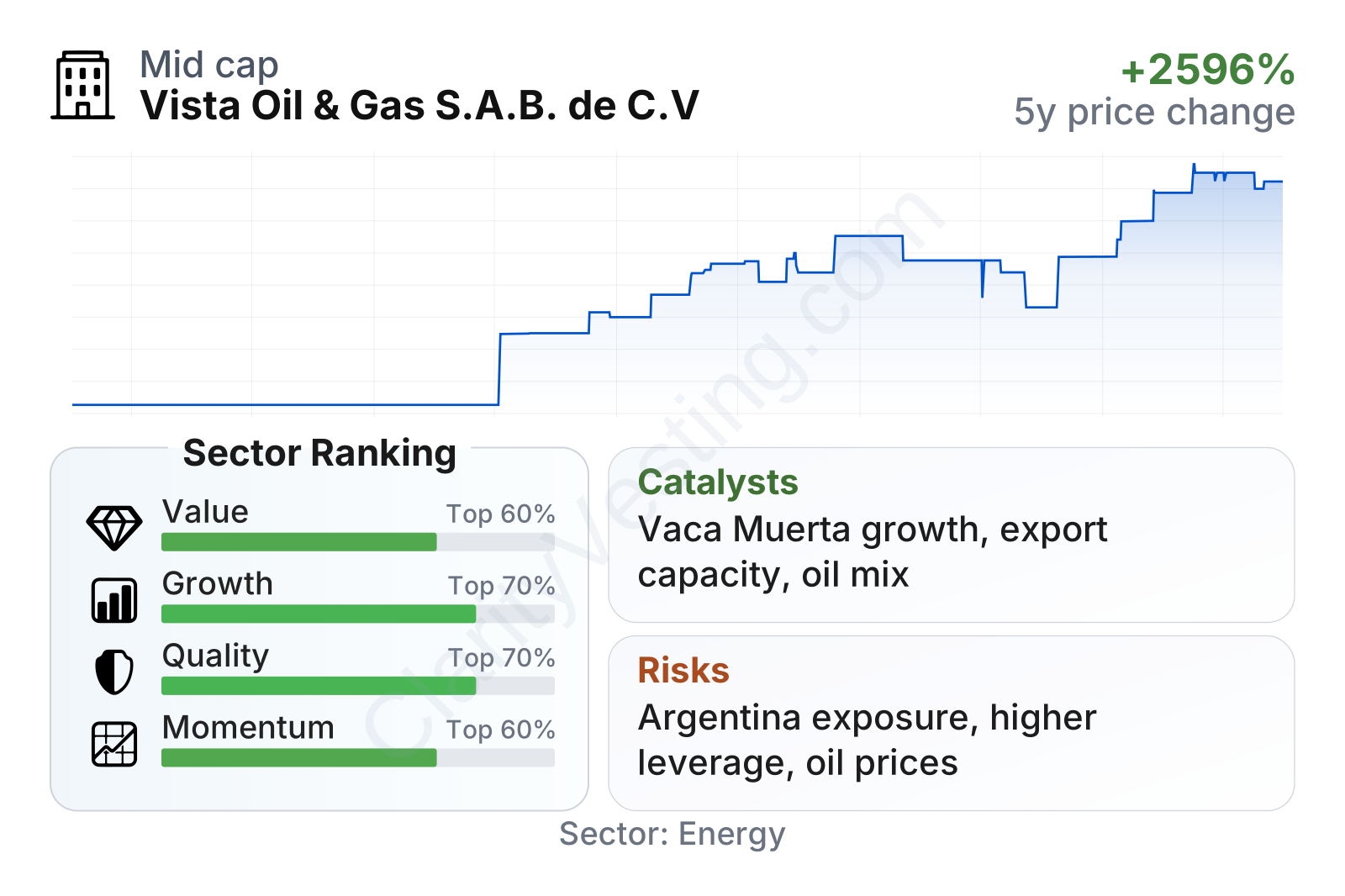
Vista sits in the mid-sized range within listed energy producers, with a market value around $8 billion. The stock’s long-term share price move has been exceptionally strong, especially since late 2023, reflecting rapid business expansion and improving market recognition. In the factor table, the company looks strongest on profitability and operating efficiency, with returns on capital and margins well above the sector median. Growth metrics are also robust, particularly on revenue, book value per share, and multi-year per-share expansion.
Valuation is more mixed than the operating profile. The earnings multiple is below the sector median, which can make the stock appear inexpensive at first glance, but the price-to-book ratio is higher than the sector median and free cash flow yield is weaker. That combination suggests the market is giving Vista credit for the quality of its assets and growth trajectory, while also recognizing that heavy reinvestment is absorbing cash.
Growth
Vista operates in a sector that still has long-term demand, but the more important point is where it is positioned inside that sector. Vaca Muerta remains one of the most important unconventional oil and gas basins outside the United States, and it continues to attract capital because of its large resource base and improving infrastructure. For a company like Vista, that matters more than the broad “energy sector” label: the real growth case depends on its ability to keep increasing production from shale acreage with attractive well economics.
The company’s strategy is coherent for future expansion. It has focused on scaling production in its highest-return blocks, improving drilling efficiency, and increasing oil exposure because oil generally carries better margins than gas. It has also pursued acquisitions and development activity that deepen its inventory of future drilling locations. This kind of strategy can work very well when execution is disciplined, because each successful step adds reserves, production, and operating leverage.
Revenue growth has been volatile, which is normal in upstream energy, but the overall direction has been strong. Recent year-over-year growth has been far ahead of the sector median, and the five-year record also points to unusually fast expansion for a producer of this size. That suggests Vista is not just benefiting from commodity prices; it has also been adding meaningful production and scaling its asset base.
The weaker point in the growth picture is cash generation after capital spending. Free cash flow has turned negative in recent periods, which indicates the company is in an intensive investment phase. For a growing producer, negative free cash flow is not automatically a warning sign if the spending is going into productive wells, infrastructure, and acreage that can expand future output. Still, it means growth is currently being funded with less room for error.
A key catalyst is the continued development of Vaca Muerta and the infrastructure that supports it, including export capacity and evacuation routes for higher oil volumes. If regional takeaway capacity keeps improving, Vista’s resource base becomes more valuable because the company can move more barrels to stronger-priced markets. Recent company communications have also emphasized production growth, operating efficiency, and portfolio expansion, all of which reinforce the idea that Vista still has visible runway rather than being a mature producer with limited upside.
Risks
This article is for informational purposes only and does not constitute financial advice. Some content is AI-generated. See Disclaimer