Stock Analysis · Versant Media Group Inc (VSNT)
Overview
Versant Media Group Inc operates in entertainment and media. Based on its public financial profile and segment presentation, the company generates revenue from a mix of content, distribution, and advertising-related activities. In simple terms, it owns or controls media assets that make money by distributing programming, licensing content, and selling access to audiences.
The business appears to have a fairly diversified revenue base, but also one that has been under pressure in recent years. Total revenue declined from about $7.8 billion in 2022 to about $6.7 billion in 2025, which suggests that the company is navigating a mature or challenged part of the media landscape rather than a fast-expanding one.
Publicly available filings do not provide enough detail here to present a precise current revenue split by operating line with confidence. At a high level, the company’s revenue sources likely include the following areas, listed from largest to smaller based on the structure typical of entertainment media groups and the company’s reported business mix:
- Distribution and affiliate-related revenue — fees paid by distributors, platforms, or partners to carry channels or content.
- Advertising revenue — sales tied to audience reach across media properties.
- Content licensing and other media revenue — licensing of programming, intellectual property, and related services.
The profit structure is still meaningful despite shrinking sales. Gross profit remained above $3.7 billion in 2025, and the company stayed profitable on both an operating and net income basis. That matters for long-term analysis because it shows the business is not simply losing scale without retaining earnings power.
The multi-year trend also shows some resilience in direct costs: revenue has declined over the period, but cost of revenue has also moved lower. The bigger issue has been pressure below gross profit, especially a rise in selling and administrative expense in 2025 and a marked drop in operating income and net income versus earlier years.
The broad picture is a company with real cash generation and established media assets, but one that is currently dealing with contraction rather than expansion.
Key Figures
| Metric | Value | Sector ⓘ |
|---|---|---|
| Date | Oct 17, 2026 | |
| Context | ||
| Sector | Communication Services | |
| Industry | Entertainment | |
| Market Cap ⓘ | $4.26B | |
| Beta ⓘ | N/A | |
Value (Cheapness) | ||
| P/E Ratio ⓘ | 5.77 | 17.78 |
| FCF Yield ⓘ | 53.33% | 14.20% |
| Dividend Yield ⓘ | 2.45% | 2.74% |
| EBIT / EV ⓘ | 18.84% | 4.52% |
| PEG ⓘ | 0.64 | |
Growth (Business expansion) | ||
| Revenue Growth ⓘ | -3.70% | 5.50% |
| RPS Growth (5Y CAGR) ⓘ | -5.13% | 4.55% |
| EPS Growth (5Y CAGR) ⓘ | N/A | -18.24% |
| Margin Growth (5Y Trend) ⓘ | -12.21% | 1.03% |
| FCF Growth (5Y CAGR) ⓘ | -8.78% | 5.96% |
| DPS Growth (5Y CAGR) ⓘ | N/A | 5.00% |
Quality (Business durability) | ||
| ROIC (Latest) ⓘ | N/A | 8.59% |
| ROIC (5Y Median) ⓘ | N/A | 8.24% |
| Net Debt / EBIT (Latest) ⓘ | 1.28 | 1.89 |
| Net Debt / EBIT (5Y Median) ⓘ | -0.00 | 2.81 |
| Net Debt / EBITDA (Latest) ⓘ | 0.67 | 1.14 |
| Net Debt / Assets ⓘ | 11.59% | 18.62% |
| EBITDA / Interest ⓘ | N/A | 8.36 |
| Operating Margin (Latest) ⓘ | 17.52% | 15.53% |
| Operating Margin (5Y Median) ⓘ | 26.95% | 13.39% |
| Debt to Equity (Latest) ⓘ | 36.41% | 59.53% |
| Profit Margin (Latest) ⓘ | 11.48% | 8.77% |
| Free Cash Flow (Latest) ⓘ | $2.27B | |
Momentum (Price trend) | ||
| 3Y Return ⓘ | N/A | +44.75% |
| 12M Return (excl. last month) ⓘ | N/A | +2.72% |
| 6M Return ⓘ | -22.21% | +1.84% |
| Price vs. 200-Day MA ⓘ | -14.00% | +1.21% |
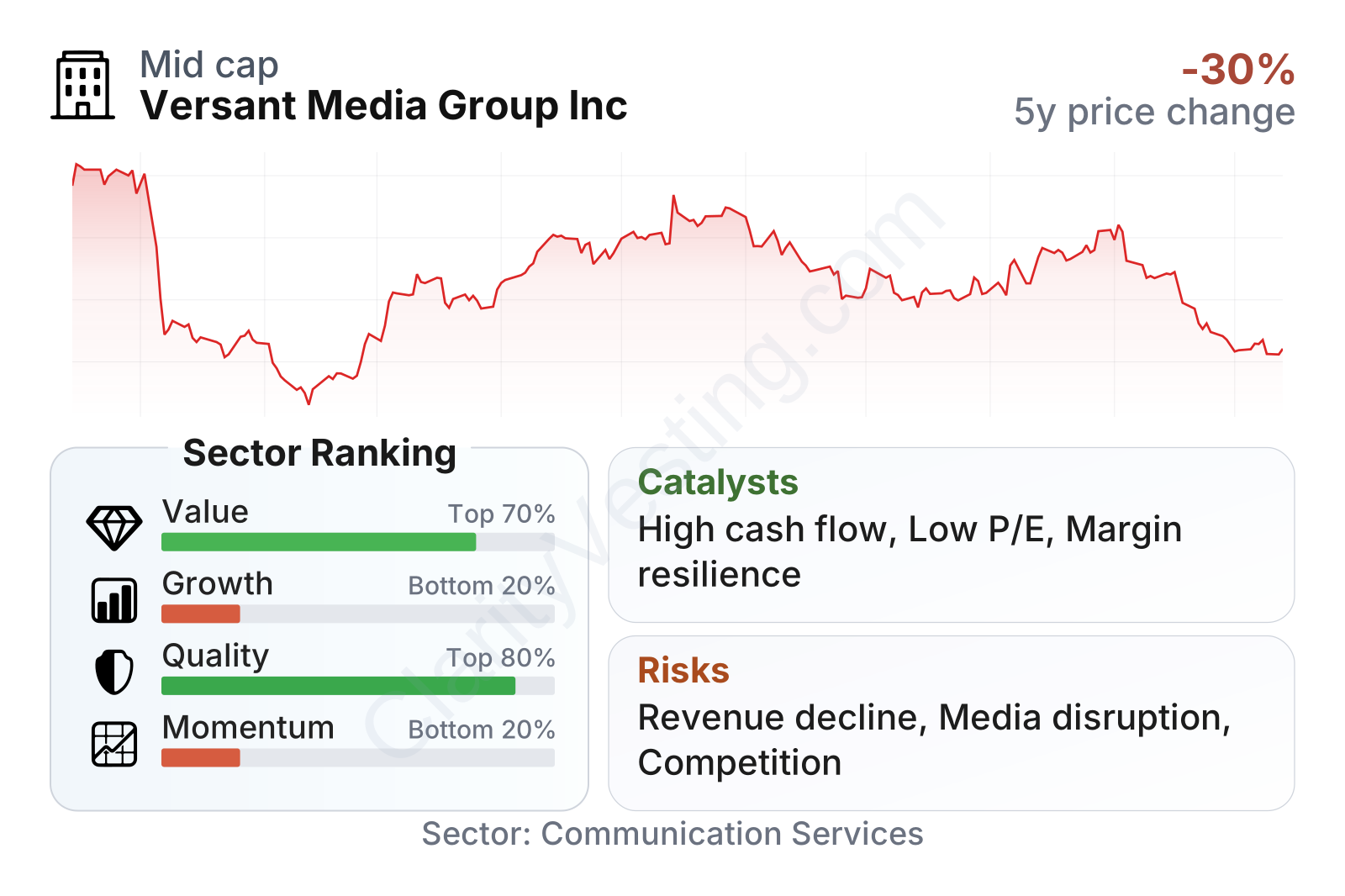
The key metrics paint a mixed but clear picture. On valuation and cash generation, Versant stands out favorably: its earnings multiple is well below the sector median, free cash flow yield is exceptionally high, and operating profitability is above the sector median. On balance-sheet quality, leverage is moderate, with debt-to-equity around 36% and net debt ratios below typical sector levels. The weak point is growth. Revenue has been shrinking year over year, five-year revenue per share has trended downward, and margin trends over five years have also deteriorated. Market performance has reflected that tension, with recent share-price momentum lagging much of the sector.
Growth
The company operates in a sector that still has durable demand for content and audience aggregation, but the more traditional parts of entertainment and media are no longer automatic growth engines. Advertising can be cyclical, linear distribution revenue can face structural pressure, and content businesses need either strong franchises, pricing power, or digital expansion to regain momentum.
Versant’s strategy only makes sense for long-term growth if it can stabilize revenue and protect margins while shifting its business toward more resilient income streams. The current financial profile suggests management has preserved profitability better than it has preserved top-line growth. That can be useful in the short run, but over a longer period the main question is whether earnings are being defended through efficiency alone or through a business model that can eventually return to expansion.
A potential catalyst is the company’s cash generation. Trailing free cash flow is very strong relative to its market value, which gives the company flexibility for debt reduction, dividends, share repurchases, or selective reinvestment. A second catalyst is valuation: when a profitable media company trades at a low earnings multiple, the market is usually signaling skepticism about future growth. If operating performance stabilizes even without rapid expansion, that skepticism can narrow.
Another possible opportunity comes from the broader industry need for premium and reusable content libraries. Media companies with recognizable assets can still create value through licensing, bundling, partnerships, and disciplined cost management, even in slow-growth environments. For Versant, that means future upside depends less on dramatic sector growth and more on better monetization of what it already owns.
No major publicly documented 2026 event from the company’s official materials, based on the available sources used here, clearly changes the growth profile overnight. The more important signal is operational: despite falling revenue over the last several years, the company remains solidly profitable and cash generative, which keeps strategic options open.
Risks
This article is for informational purposes only and does not constitute financial advice. Some content is AI-generated. See Disclaimer


