Stock Analysis · VSE Corporation (VSEC)
Overview
VSE Corporation is an aerospace and defense services company focused mainly on aftermarket support. In simple terms, it helps aircraft operators, government customers, and other transportation users keep equipment working through parts distribution, repair services, maintenance support, logistics, and technical services. Over the last few years, the business has become more concentrated around aviation, especially the supply and servicing of parts used after an aircraft has already been built.
The company’s revenue mix has shifted meaningfully through acquisitions and portfolio changes. Based on recent company filings and investor materials, the business is now primarily tied to aviation aftermarket activities, with the remainder coming from fleet and government-related support operations. The broad revenue sources can be summarized as follows:
- Aviation: approximately 75% to 85% of revenue recently, depending on the period. This includes distribution of aircraft parts, maintenance, repair, overhaul support, engine and component accessories, and services for commercial, business, and government aviation customers.
- Fleet: approximately 15% to 25% of revenue recently. This business supports vehicle fleets and other transportation assets through parts, maintenance-related services, and logistics programs, including work linked to government customers.
That mix matters because aviation aftermarket tends to be more specialized and can benefit from recurring demand: planes need to be maintained regardless of whether airlines are buying many new aircraft in a given year. VSE is no longer a broadly diversified industrial services company in the old sense; it is increasingly an aviation-focused aftermarket operator.
The multi-year financial flow also shows a clear pattern: revenue has climbed from roughly $0.75 billion in 2021 to above $1.1 billion in 2025, while gross profit has improved faster than sales. Net income, however, has been more uneven because interest expense and integration-related pressures have absorbed part of that operating progress.
Key Figures
| Metric | Value | Sector ⓘ |
|---|---|---|
| Date | Oct 17, 2026 | |
| Context | ||
| Sector | Industrials | |
| Industry | Aerospace & Defense | |
| Market Cap ⓘ | $4.45B | |
| Beta ⓘ | 1.27 | |
Value (Cheapness) | ||
| P/E Ratio ⓘ | 50.69 | 22.10 |
| P/B Ratio ⓘ | 1.70 | 1.97 |
| FCF Yield ⓘ | -0.03% | 6.38% |
| Dividend Yield ⓘ | 0.24% | 1.94% |
| EBIT / EV ⓘ | 2.00% | 4.79% |
| PEG ⓘ | 3.00 | |
Growth (Business expansion) | ||
| Revenue Growth ⓘ | 65.00% | 9.30% |
| RPS Growth (5Y CAGR) ⓘ | -3.10% | 7.81% |
| EPS Growth (5Y CAGR) ⓘ | 0.09% | -13.06% |
| BVPS Growth (5Y CAGR) ⓘ | 19.68% | 6.14% |
| Margin Growth (5Y Trend) ⓘ | 5.19% | 0.88% |
| FCF Growth (5Y CAGR) ⓘ | N/A | 11.01% |
| DPS Growth (5Y CAGR) ⓘ | 2.66% | 9.48% |
Quality (Business durability) | ||
| ROIC (Latest) ⓘ | 3.60% | 10.84% |
| ROA (Latest) ⓘ | 2.51% | 5.41% |
| ROIC (5Y Median) ⓘ | 5.19% | 9.38% |
| ROA (5Y Median) ⓘ | 2.84% | 4.95% |
| Net Debt / EBIT (Latest) ⓘ | 7.96 | 2.08 |
| Net Debt / EBIT (5Y Median) ⓘ | 5.60 | 2.27 |
| Net Debt / EBITDA (Latest) ⓘ | 5.36 | 1.39 |
| Net Debt / Assets ⓘ | 21.61% | 19.28% |
| EBITDA / Interest ⓘ | 14.40 | 9.58 |
| Operating Margin (Latest) ⓘ | 8.79% | 10.50% |
| Operating Margin (5Y Median) ⓘ | 8.01% | 10.29% |
| Debt to Equity (Latest) ⓘ | 34.96% | 65.48% |
| Profit Margin (Latest) ⓘ | 5.53% | 6.67% |
| Free Cash Flow (Latest) ⓘ | -$1.12M | |
Momentum (Price trend) | ||
| 3Y Return ⓘ | +198.64% | +61.68% |
| 12M Return (excl. last month) ⓘ | +14.27% | +12.58% |
| 6M Return ⓘ | -28.58% | 0.00% |
| Price vs. 200-Day MA ⓘ | -19.96% | +0.02% |
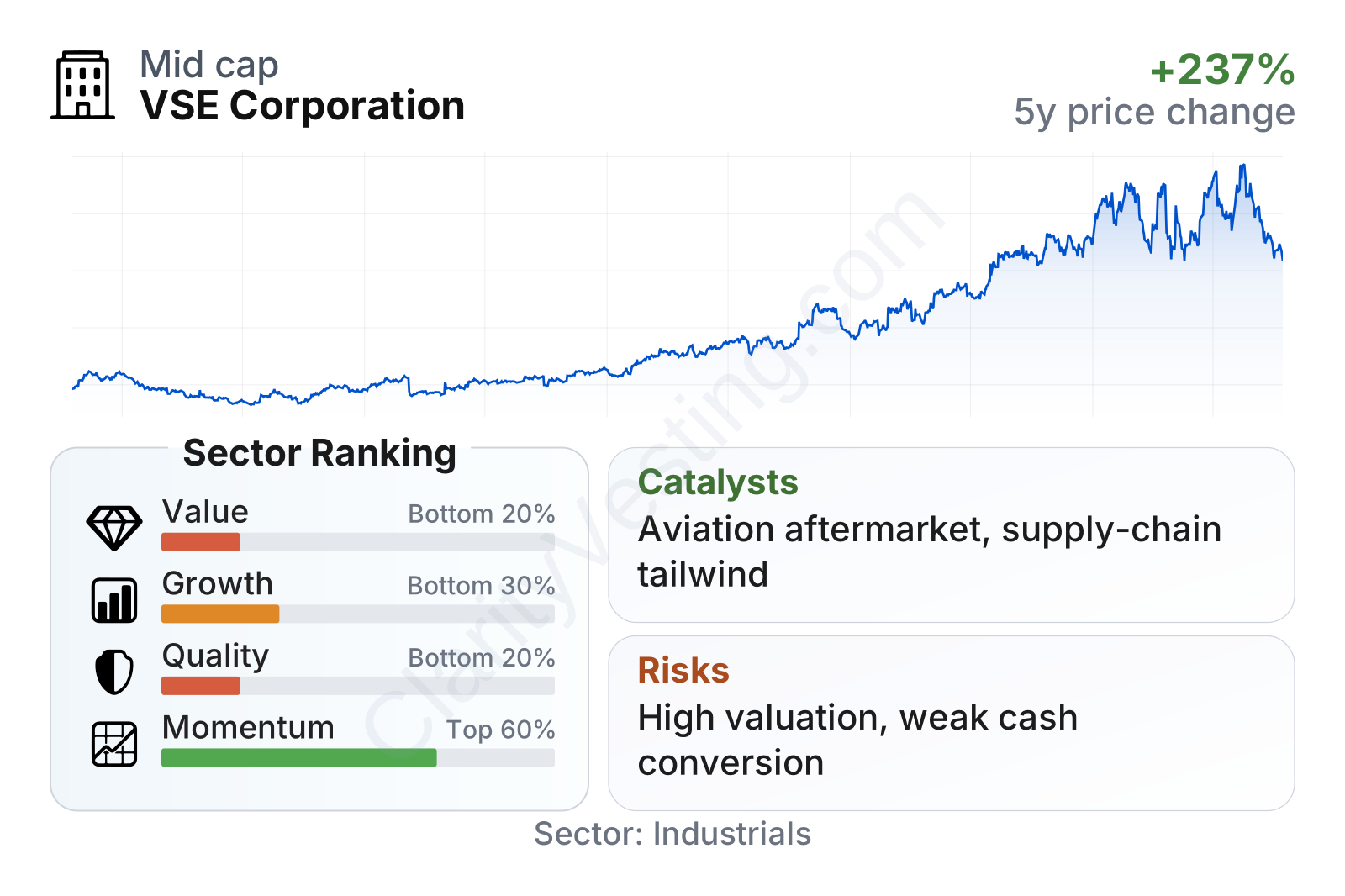
VSE is now a mid-sized aerospace and defense company with a market value around the mid-single-digit billions of dollars and a stock that has been much stronger than most of its sector over the last three years. The share price rise has been dramatic, but the underlying factor profile is more mixed. Momentum is strong relative to peers, while value, growth, and quality rank weaker on a sector basis. That combination usually means the market is already giving substantial credit for future improvement.
Several operating metrics also show the current tension in the investment case. Revenue growth has recently been very strong, and margin trends over five years have improved, but returns on capital remain below industry norms. Debt-to-equity looks moderate at about 35%, better than the sector median, yet net debt relative to earnings remains elevated. Free cash flow is close to break-even but still slightly negative on a trailing basis, which helps explain why the valuation profile screens as expensive despite a large strategic shift toward aviation.
Growth
The company operates in a favorable long-term niche. Aerospace aftermarket demand is supported by aging fleets, rising flight activity over time, and the practical need to keep aircraft available for service. Even when new aircraft deliveries are delayed, operators still need spare parts, repair capabilities, and technical support. In that sense, VSE is exposed to a part of aviation that can stay active across different industry cycles.
Its strategy also has a clear industrial logic. Management has spent the last several years reshaping the company toward higher-value aviation aftermarket operations and away from less differentiated activities. That can improve revenue quality because parts distribution and repair support often create repeat business, customer relationships, and technical know-how that are harder to replace than basic project work.
Recent growth has been powerful on a year-over-year basis, with the latest reading far above the sector median. However, the path has not been smooth. Revenue growth has swung between declines and sharp rebounds in recent years, reflecting acquisitions, portfolio changes, and timing effects rather than a perfectly steady organic trend. For long-term analysis, the important point is that the company is now operating on a materially larger revenue base than it was a few years ago.
Cash generation is the main area where the growth case still needs more proof. Free cash flow has improved from deeper negative levels, but it has not yet become consistently positive. For a company expanding through acquisitions and integration, that is a meaningful checkpoint: strong sales growth becomes more convincing when it turns into durable cash generation.
One notable catalyst is the broader supply-chain strain affecting aircraft availability and new deliveries. While that can hurt some aerospace businesses, it may support aftermarket demand because airlines and other operators keep existing fleets flying longer and need more replacement parts and maintenance support. VSE’s concentration in aviation aftermarket means it is positioned to benefit if that pattern persists. Another important catalyst is the company’s ability to cross-sell acquired product lines and services across a wider aviation customer base.
Risks
This article is for informational purposes only and does not constitute financial advice. Some content is AI-generated. See Disclaimer


