Stock Analysis · Virbac SA (VRBCF)
Overview
Virbac is a French animal health company focused on products for pets and livestock. It develops, manufactures, and sells veterinary medicines, vaccines, parasite-control treatments, dental care products, diagnostic tools, and nutrition-related solutions. Its business is centered on animal health rather than human pharmaceuticals, which gives it exposure to long-term trends such as higher pet ownership, growing spending on companion animal care, and the need to improve livestock productivity and disease prevention.
The company operates globally, with a particularly broad presence across Europe, the Americas, and emerging markets. Its model is diversified across species and product categories, which matters because demand drivers are not exactly the same for dogs and cats as for cattle, swine, poultry, or aquaculture. Companion animals tend to benefit from recurring care and premiumization, while farm animals are more influenced by herd economics, disease cycles, and agricultural conditions.
Virbac does not report a simple public revenue split in the same standardized way as some larger peers, but its business mix is commonly described around species and veterinary treatment categories. Based on company disclosures, public presentations, and business descriptions, the main sources of revenue can be summarized as follows:
- Companion animal products: likely the largest contributor, estimated at roughly 55% to 65% of revenue. This includes medicines and care products for dogs and cats, such as dermatology, antiparasitics, dental care, and chronic-condition treatments.
- Livestock and production animal products: estimated at roughly 35% to 45% of revenue. This includes cattle, swine, poultry, and other farm-animal health products, including vaccines, anti-infectives, reproductive management, and herd-care solutions.
- By product family, revenue is spread across pharmaceuticals, biological products such as vaccines, specialty care, diagnostics, and animal nutrition-related products, but public filings do not consistently provide a precise percentage split for each of these categories.
What stands out in the business model is that Virbac is not trying to compete only on one blockbuster product. It sells a broad portfolio to veterinarians, clinics, and animal health channels, which can make the revenue base more resilient than a single-product model. The profit flow over recent years also shows a business that has expanded revenue while keeping a solid share of sales as operating income and net income, although 2025 line items appear less directly comparable in the available series and should be read with caution.
Over the 2021 to 2024 period, revenue moved from a little above $1.0 billion to nearly $1.4 billion, while operating income and net income also increased. That points to a company that has not only grown sales, but has also preserved healthy economics along the way.
Key Figures
| Metric | Value | Sector ⓘ |
|---|---|---|
| Date | Oct 17, 2026 | |
| Context | ||
| Sector | Healthcare | |
| Industry | Drug Manufacturers - General | |
| Market Cap ⓘ | $3.21B | |
| Beta ⓘ | 0.79 | |
Value (Cheapness) | ||
| P/E Ratio ⓘ | 17.69 | 24.79 |
| P/B Ratio ⓘ | 2.65 | 3.08 |
| FCF Yield ⓘ | 6.67% | 3.15% |
| Dividend Yield ⓘ | 0.38% | 1.94% |
| EBIT / EV ⓘ | N/A | 0.57% |
| PEG ⓘ | N/A | |
Growth (Business expansion) | ||
| Revenue Growth ⓘ | 4.00% | 7.45% |
| RPS Growth (5Y CAGR) ⓘ | 8.49% | 8.61% |
| EPS Growth (5Y CAGR) ⓘ | N/A | -17.81% |
| BVPS Growth (5Y CAGR) ⓘ | 11.80% | 3.72% |
| Margin Growth (5Y Trend) ⓘ | -0.62% | -0.62% |
| FCF Growth (5Y CAGR) ⓘ | 5.72% | 1.04% |
| DPS Growth (5Y CAGR) ⓘ | 17.83% | 6.77% |
Quality (Business durability) | ||
| ROIC (Latest) ⓘ | N/A | 3.24% |
| ROA (Latest) ⓘ | 14.68% | 3.01% |
| ROIC (5Y Median) ⓘ | 14.28% | 4.60% |
| ROA (5Y Median) ⓘ | 8.79% | 1.89% |
| Net Debt / EBIT (Latest) ⓘ | 0.40 | 1.34 |
| Net Debt / EBIT (5Y Median) ⓘ | -0.39 | 1.84 |
| Net Debt / EBITDA (Latest) ⓘ | 0.32 | 1.00 |
| Net Debt / Assets ⓘ | 9.06% | 5.45% |
| EBITDA / Interest ⓘ | 25.92 | 9.64 |
| Operating Margin (Latest) ⓘ | 16.00% | 9.27% |
| Operating Margin (5Y Median) ⓘ | 15.10% | 7.38% |
| Debt to Equity (Latest) ⓘ | 29.54% | 28.58% |
| Profit Margin (Latest) ⓘ | 10.43% | 3.59% |
| Free Cash Flow (Latest) ⓘ | $214.12M | |
Momentum (Price trend) | ||
| 3Y Return ⓘ | -2.98% | +42.80% |
| 12M Return (excl. last month) ⓘ | +11.22% | +18.50% |
| 6M Return ⓘ | +0.02% | +7.57% |
| Price vs. 200-Day MA ⓘ | +1.32% | +5.12% |
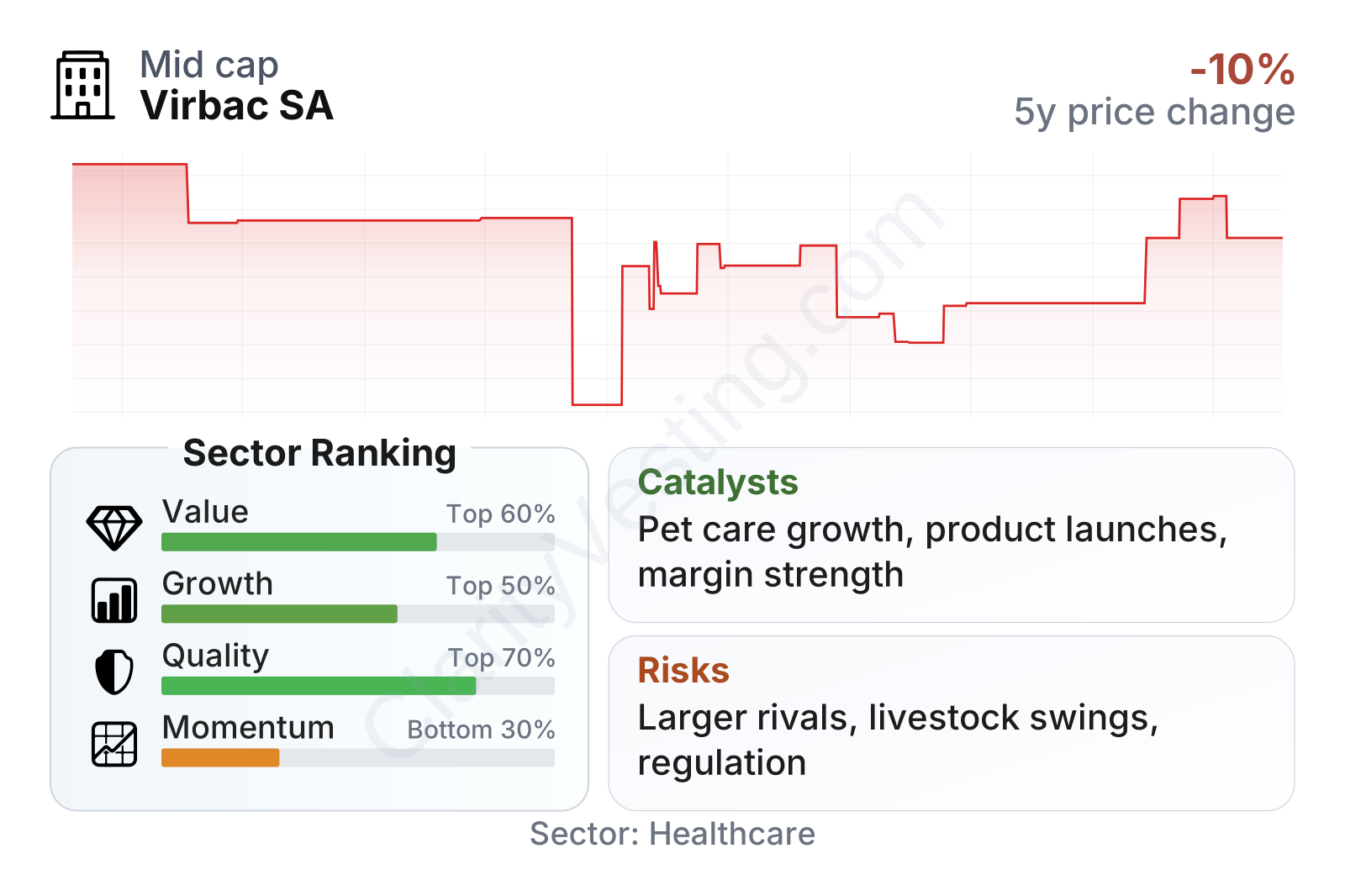
Virbac is a mid-sized animal health company with relatively low share-price volatility, as suggested by a beta below 1. Its quality profile is the strongest part of the picture: profitability ratios are well above the sector median, operating margins are notably stronger than many healthcare peers in the same broad group, and leverage remains moderate. Interest coverage is also very comfortable, which reduces pressure from financing costs.
The valuation profile looks mixed but not stretched on every measure. Earnings and book-value multiples are below the sector median, and free-cash-flow yield is clearly stronger than typical sector levels. Growth metrics are more balanced than exceptional: recent revenue growth is positive but slower than the sector median, while longer-term free-cash-flow and book-value expansion are much better. Momentum is the weakest area, with stock performance over the last several years trailing the broader sector even after a recovery in 2026.
The share-price chart suggests a stock that surged strongly in 2021 and 2022, then went through a long consolidation period before rebounding in 2026. That pattern often reflects a business that kept performing decently while market expectations cooled from earlier highs.
Growth
Animal health is generally an attractive long-term sector. Pet ownership expanded in many regions over the last decade, and owners increasingly treat animal care as essential rather than discretionary, especially for chronic conditions, parasite prevention, dental care, and specialized treatments. On the livestock side, the need for disease management, productivity, and food-chain efficiency remains a structural driver, even if that market is more cyclical.
Virbac’s strategy makes industrial sense for future growth because it is built on a broad product range, geographic diversification, and direct relationships with veterinary professionals. The company is large enough to have global reach, but still specialized enough to remain focused on animal health instead of being a small division inside a human-pharma group. That focus can help with product development, sales execution, and brand credibility with veterinarians.
Another positive point is the balance between growth and financial discipline. Over the last five years, revenue per share has compounded at roughly 8% to 9%, free cash flow has grown at a mid-single-digit pace, and book value per share has expanded at a double-digit pace. Even more important, this has happened alongside strong operating margins and low net debt relative to earnings. That combination gives the company room to fund expansion, product launches, manufacturing investments, and selective acquisitions without obvious balance-sheet stress.
A meaningful catalyst is the continued shift toward companion animals, where pricing tends to be better and customer relationships can be more recurring. Virbac has also emphasized innovation in areas such as parasiticides, dermatology, dentistry, and specialty care, which are categories where vets often value established brands and clinical familiarity. In livestock, opportunities can come from expanding preventive care and biosecurity solutions in regions where animal-protein demand is still rising.
Recent company communications have also highlighted ongoing commercial development across geographies and portfolio expansion through new products and lifecycle management. For a company like Virbac, growth does not need one single transformative event; it can come from many smaller advances across countries, channels, and species.
Risks
This article is for informational purposes only and does not constitute financial advice. Some content is AI-generated. See Disclaimer


