Stock Analysis · Voyager Technologies Inc (VOYG)
Overview
Voyager Technologies Inc operates in the aerospace and defense industry. The company is best known for space-related engineering, mission services, and technology platforms used by government and commercial customers. Its activities span areas such as space infrastructure, national security-related systems, and specialized technology services. In simple terms, Voyager is trying to position itself as a builder and operator of tools, components, and service capabilities that support activity in orbit and other advanced aerospace missions.
Based on the company’s recent public filings and investor materials, revenue appears to come primarily from contract-driven programs and technical services rather than from a broad consumer business. Voyager’s mix can shift as contracts are won, delayed, or completed, so exact percentages are not always stable enough to present with confidence. Broadly, its revenue sources can be described as follows:
- Government and defense-related contracts — the largest source, incorporating engineering services, mission support, and programs tied to civil space and national security customers.
- Space infrastructure and technology solutions — hardware, systems, and specialized products used in spacecraft, orbital systems, and related missions.
- Commercial partnerships and other technical services — smaller contributions from commercial space customers, collaborative programs, and other aerospace support work.
One important pattern in the business is that revenue has been growing, but profitability has moved in the opposite direction. Over the last few years, sales expanded from roughly $136 million to about $166 million, while gross profit became more volatile and operating losses widened sharply. Selling and administrative costs have risen significantly faster than revenue, which helps explain why a growing top line has not yet translated into stronger earnings.
The business mix shows a company that is still scaling. Revenue has moved upward over time, but costs have absorbed most of that progress. In particular, overhead and other operating expenses have become a major pressure point, leaving Voyager in a phase where execution matters more than simple sales growth.
Key Figures
| Metric | Value | Sector ⓘ |
|---|---|---|
| Date | Oct 17, 2026 | |
| Context | ||
| Sector | Industrials | |
| Industry | Aerospace & Defense | |
| Market Cap ⓘ | $1.61B | |
| Beta ⓘ | N/A | |
Value (Cheapness) | ||
| P/E Ratio ⓘ | N/A | 22.10 |
| P/B Ratio ⓘ | 5.50 | 1.97 |
| FCF Yield ⓘ | -17.87% | 6.38% |
| Dividend Yield ⓘ | N/A | 1.94% |
| EBIT / EV ⓘ | -6.88% | 4.79% |
| PEG ⓘ | N/A | |
Growth (Business expansion) | ||
| Revenue Growth ⓘ | 15.50% | 9.30% |
| RPS Growth (5Y CAGR) ⓘ | 10.44% | 7.81% |
| EPS Growth (5Y CAGR) ⓘ | N/A | -13.06% |
| BVPS Growth (5Y CAGR) ⓘ | N/A | 6.14% |
| Margin Growth (5Y Trend) ⓘ | N/A | 0.88% |
| FCF Growth (5Y CAGR) ⓘ | N/A | 11.01% |
| DPS Growth (5Y CAGR) ⓘ | N/A | 9.48% |
Quality (Business durability) | ||
| ROIC (Latest) ⓘ | -14.55% | 10.84% |
| ROA (Latest) ⓘ | -15.77% | 5.41% |
| ROIC (5Y Median) ⓘ | N/A | 9.38% |
| ROA (5Y Median) ⓘ | N/A | 4.95% |
| Net Debt / EBIT (Latest) ⓘ | N/A | 2.08 |
| Net Debt / EBIT (5Y Median) ⓘ | N/A | 2.27 |
| Net Debt / EBITDA (Latest) ⓘ | N/A | 1.39 |
| Net Debt / Assets ⓘ | 11.65% | 19.28% |
| EBITDA / Interest ⓘ | N/A | 9.58 |
| Operating Margin (Latest) ⓘ | -80.34% | 10.50% |
| Operating Margin (5Y Median) ⓘ | -38.37% | 10.29% |
| Debt to Equity (Latest) ⓘ | 150.77% | 65.48% |
| Profit Margin (Latest) ⓘ | -78.61% | 6.67% |
| Free Cash Flow (Latest) ⓘ | -$287.53M | |
Momentum (Price trend) | ||
| 3Y Return ⓘ | N/A | +61.68% |
| 12M Return (excl. last month) ⓘ | +11.82% | +12.58% |
| 6M Return ⓘ | -14.33% | 0.00% |
| Price vs. 200-Day MA ⓘ | -19.21% | +0.02% |
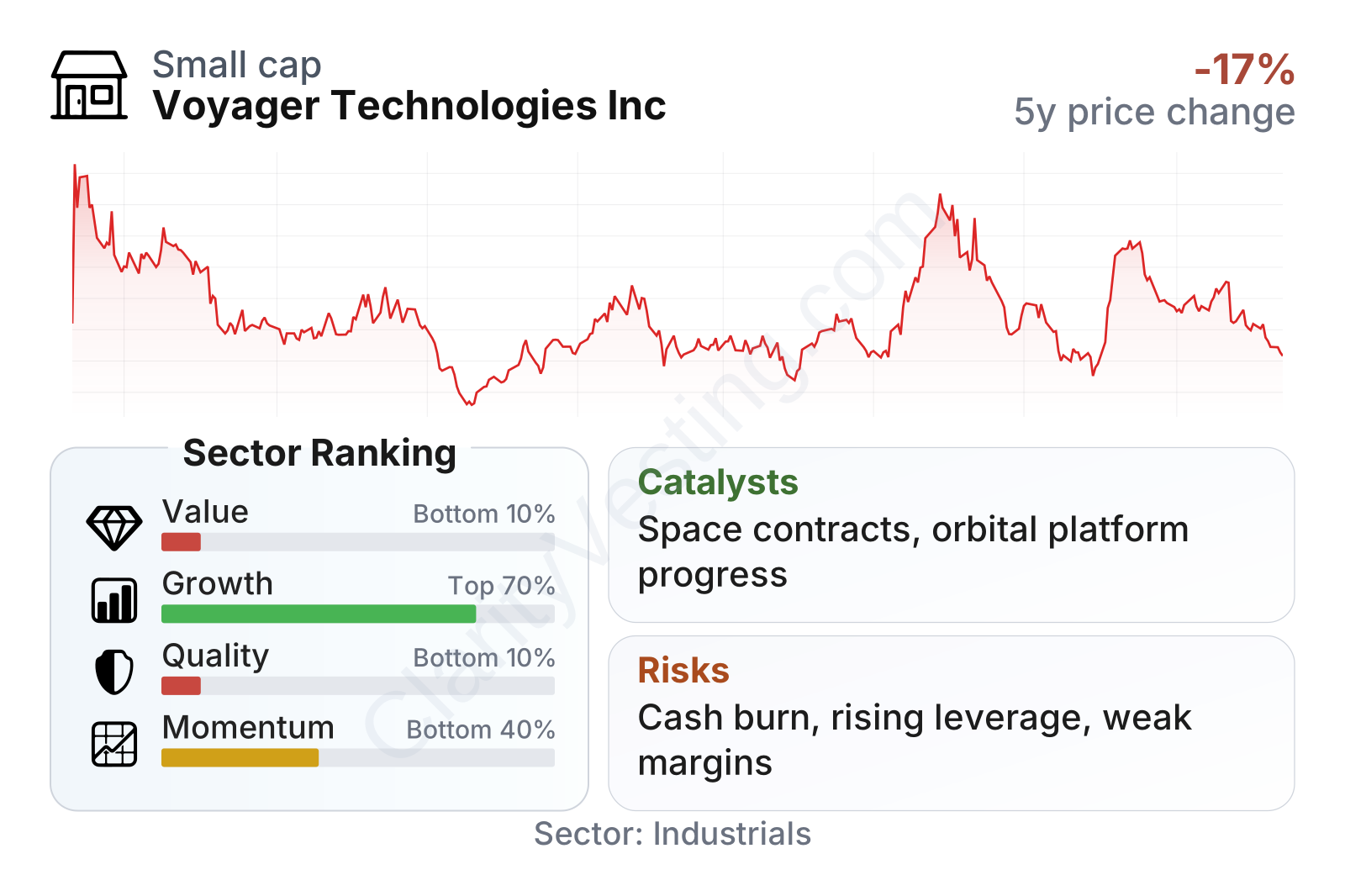
Voyager is a small-cap aerospace and defense company, and the overall profile is unusual compared with the broader sector. Growth metrics are somewhat better than the industry median, helped by revenue expansion above sector norms over both the last year and the last five years. However, value and quality metrics rank near the bottom of the sector because the company is still deeply unprofitable and burning cash. The stock has also been volatile: it had a powerful rise during part of 2026 before giving back a meaningful portion of that move, which suggests sentiment can shift quickly around contract news, strategic announcements, or financing expectations.
Growth
The company operates in a sector with long-term structural support. Space activity, defense modernization, satellite infrastructure, and government demand for resilient orbital capabilities all point to a market that is likely to remain active for years. That broad backdrop is favorable for companies with credible technology and strong customer relationships. Voyager’s strategy also fits that theme: it is building capabilities around mission-critical aerospace systems rather than chasing low-barrier markets.
Recent growth has been real, even if uneven. Revenue growth accelerated from a low single-digit pace early in 2026 to about 15% by midyear, which is better than the sector median. Over a five-year period, revenue per share growth also appears to be ahead of the typical aerospace and defense peer. This indicates that the company is participating in a growing market and has been able to expand its business base.
There are also strategic reasons the growth case gets attention. Voyager has sought to build a portfolio connected to high-priority space programs, including orbital platforms, advanced components, and government-linked missions. If these programs mature into larger production or service contracts, the company could move from a development-heavy model toward more recurring and scaled revenue streams. For a business of this size, even a few meaningful contract wins or program milestones can materially change the financial picture.
At the same time, growth is not yet self-funding. Free cash flow remains deeply negative and has worsened into 2026, showing that expansion currently requires substantial cash support. That does not erase the opportunity, but it does mean future growth needs to become more efficient to create lasting business value.
The main near-term catalyst is therefore not just higher revenue, but evidence that new business can be converted into better margins and lower cash burn. In a company like Voyager, contract momentum matters, but disciplined execution matters even more.
Risks
This article is for informational purposes only and does not constitute financial advice. Some content is AI-generated. See Disclaimer


