Stock Analysis · Voya Financial Inc (VOYA)
Overview
Voya Financial is a diversified financial services company focused mainly on retirement, workplace benefits, and investment management. In practical terms, it helps employers and employees manage retirement savings plans, provides employee benefit products such as life and disability coverage, and manages money for institutions and individuals through its asset management business. The company is much more specialized than a traditional bank or broad insurance conglomerate, with its business centered on long-term savings and workplace financial products.
Based on Voya’s recent reporting structure, revenue and earnings mainly come from fee-based and spread-based activities tied to retirement assets, employee benefits, and investment management. Exact revenue mix can shift from quarter to quarter because financial companies report a combination of premiums, fees, net investment income, and mark-to-market effects, but the operating business is broadly concentrated in the following areas:
- Health Solutions: a major contributor, driven by stop-loss insurance, group benefits, and related workplace protection products sold mainly to employers.
- Wealth Solutions: another major contributor, including retirement plan administration, recordkeeping, advisory services, and wealth-related products tied to employer-sponsored plans and rollovers.
- Investment Management: a meaningful but smaller share, consisting of asset management fees earned by Voya Investment Management from institutional, intermediary, and private client assets.
That mix gives Voya a business model with recurring fee income, insurance underwriting income, and investment income. It also means results are influenced by several moving parts at once: asset balances, market levels, benefit claims, interest rates, and employer demand for workplace products.
The broader income flow shows a company that expanded total revenue strongly between 2021 and 2024, then saw some moderation in 2025, while operating income and net income remained positive throughout the period. Profitability has been steadier than headline revenue, which is common in financial firms where accounting revenue can be volatile.
The longer-term picture suggests that Voya’s business has become larger over the last several years, but the path has not been smooth. Revenue growth has outpaced earnings growth, which points to a company still balancing expansion, pricing, claims trends, and capital efficiency.
Key Figures
| Metric | Value | Sector ⓘ |
|---|---|---|
| Date | Oct 17, 2026 | |
| Context | ||
| Sector | Financial Services | |
| Industry | Financial Conglomerates | |
| Market Cap ⓘ | $8.62B | |
| Beta ⓘ | 0.89 | |
Value (Cheapness) | ||
| P/E Ratio ⓘ | 16.07 | 12.26 |
| P/B Ratio ⓘ | 3.38 | 1.23 |
| FCF Yield ⓘ | 13.83% | 10.40% |
| Dividend Yield ⓘ | 1.95% | 3.02% |
| EBIT / EV ⓘ | 8.58% | 8.14% |
| PEG ⓘ | 1.19 | |
Growth (Business expansion) | ||
| Revenue Growth ⓘ | -4.30% | 9.35% |
| RPS Growth (5Y CAGR) ⓘ | 31.52% | 12.19% |
| EPS Growth (5Y CAGR) ⓘ | -15.89% | -9.53% |
| BVPS Growth (5Y CAGR) ⓘ | -18.07% | 4.99% |
| Margin Growth (5Y Trend) ⓘ | -30.14% | -3.86% |
| FCF Growth (5Y CAGR) ⓘ | 23.37% | 4.81% |
| DPS Growth (5Y CAGR) ⓘ | 25.09% | 8.79% |
Quality (Business durability) | ||
| ROIC (Latest) ⓘ | 9.96% | 9.49% |
| ROE (Latest) ⓘ | 21.87% | 13.90% |
| ROA (Latest) ⓘ | 0.34% | 1.55% |
| ROIC (5Y Median) ⓘ | 12.02% | 7.86% |
| ROE (5Y Median) ⓘ | 22.60% | 12.17% |
| ROA (5Y Median) ⓘ | 0.41% | 1.30% |
| Net Debt / EBIT (Latest) ⓘ | 3.01 | 0.96 |
| Net Debt / EBIT (5Y Median) ⓘ | 2.15 | 0.73 |
| Net Debt / EBITDA (Latest) ⓘ | 3.01 | 0.92 |
| Operating Margin (Latest) ⓘ | 13.00% | 22.30% |
| Operating Margin (5Y Median) ⓘ | 13.21% | 24.63% |
| Debt to Equity (Latest) ⓘ | 84.16% | 58.56% |
| Profit Margin (Latest) ⓘ | 7.45% | 26.57% |
| Free Cash Flow (Latest) ⓘ | $1.19B | |
Momentum (Price trend) | ||
| 3Y Return ⓘ | +50.04% | +88.33% |
| 12M Return (excl. last month) ⓘ | +36.09% | +19.38% |
| 6M Return ⓘ | +30.88% | +4.75% |
| Price vs. 200-Day MA ⓘ | +12.46% | +3.50% |
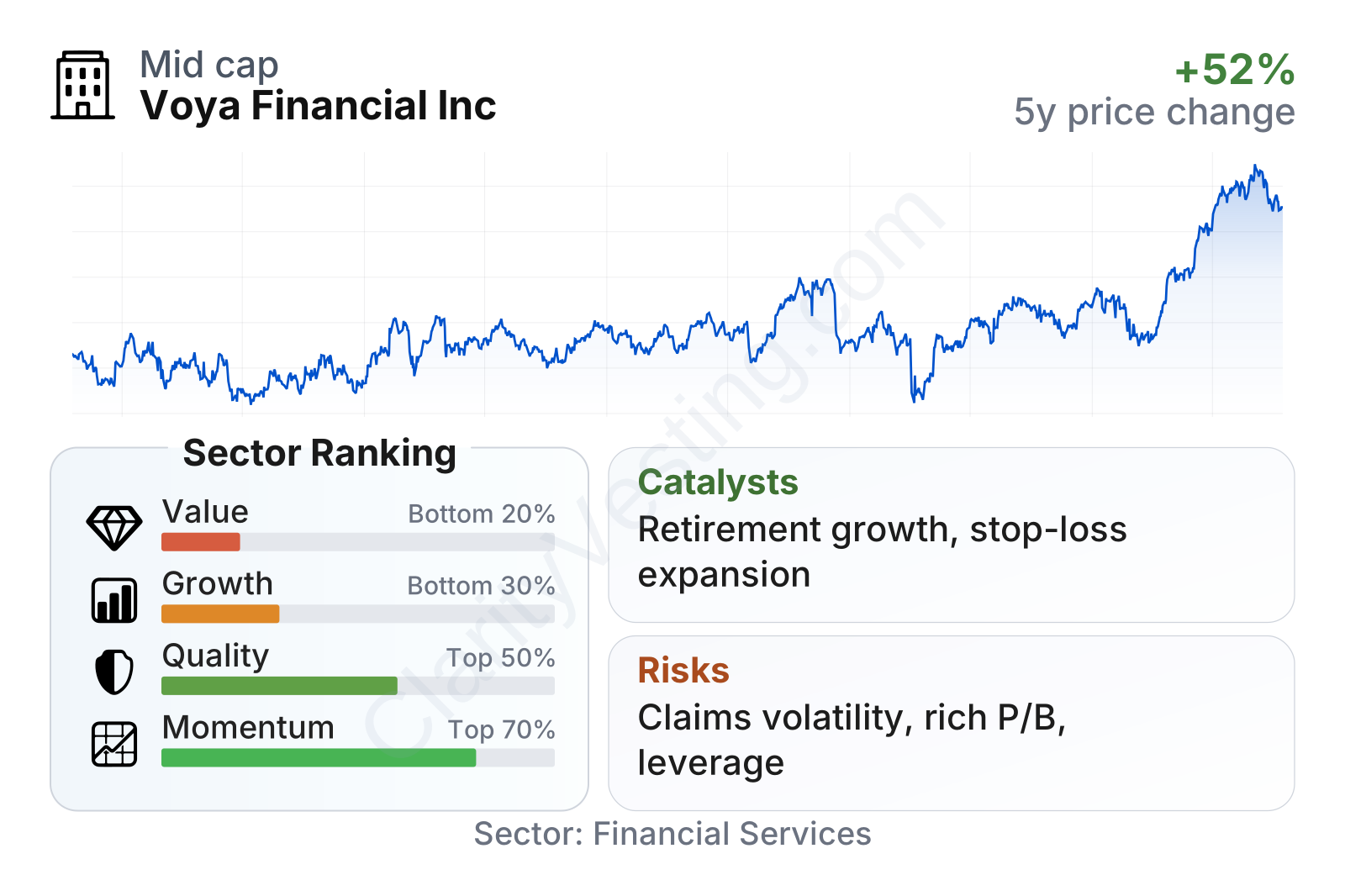
Voya is a mid-sized financial company with a market value of roughly $9 billion and a beta below 1, which suggests its share price has historically been somewhat less volatile than the overall market. The stock has been strong over the last 6 to 12 months, clearly outperforming the sector median in recent momentum measures, although the longer 3-year return still trails many financial peers.
On valuation, the picture is mixed. The company screens weakly on conventional value measures because its price-to-earnings and especially price-to-book ratios sit above sector medians. At the same time, cash generation looks solid, with free cash flow yield above the sector median and trailing free cash flow around $1.2 billion.
Quality metrics are more favorable than the valuation metrics. Return on equity is notably above the sector median, both on a trailing basis and over five years, while return on invested capital is also slightly ahead of the typical peer. However, margins are lower than sector medians, leverage is somewhat higher, and return on assets is clearly below the sector norm, which is an important counterbalance.
Growth
Voya operates in parts of financial services that have long-duration demand drivers. Retirement plans benefit from the aging U.S. population, the shift of retirement responsibility toward individuals, and the need for plan administration and advice. Workplace benefits can grow as employers continue outsourcing more employee protection products. Asset management also has a structural opportunity if the company gathers more client assets and keeps investment performance competitive.
Its strategy broadly makes sense for future growth because it is focused on areas where employers, plan sponsors, and institutions often prefer scale, compliance capabilities, and integrated platforms. Voya is not trying to be everything in finance; it is concentrating on categories where recurring relationships matter and where cross-selling can help. A company that already serves employers through retirement or benefits products can potentially deepen those relationships over time.
Still, the recent growth profile is uneven. Year-over-year revenue is down modestly, and the company ranks in the lower part of the sector on broad growth factors. That said, some underlying long-term indicators are better than they first appear: revenue per share growth over five years is far above the sector median, free cash flow growth has also been strong, and dividend growth has been robust. This suggests that the business has had some real expansion, even if earnings and margins have not compounded as smoothly.
Earnings per share have moved up and down rather than rising in a straight line. The pattern points to a business that can generate solid profits but is exposed to insurance claims experience, market conditions, and capital market variables. For a long-term reader, the key question is less about one weak or strong year and more about whether Voya can convert revenue and assets into more consistent earnings growth.
Book value per share has fallen sharply from earlier levels before partially recovering, which is a notable issue for a financial company. Part of that reflects the complexity of balance sheet marks, capital actions, and the structure of the business, but it still matters because long-term compounding in financials often depends on steadily building per-share book value or sustaining very high returns on equity.
Recent company updates in 2026 have continued to emphasize capital returns, business simplification, and focus on higher-return segments. In the current environment, a strong catalyst would be continued growth in Wealth Solutions and Health Solutions, plus stable or improving net flows and asset levels in Investment Management. Higher interest rates can also support some spread-based earnings, although that benefit is not pure upside because rates can create pressure elsewhere on the balance sheet and on customer activity.
Risks
This article is for informational purposes only and does not constitute financial advice. Some content is AI-generated. See Disclaimer


