Stock Analysis · Vor Biopharma Inc (VOR)
Overview
Vor Biopharma is a clinical-stage biotechnology company focused on blood cancers. Its core idea is to change the way leukemia and related diseases are treated by combining engineered stem cell transplants with targeted therapies. The company’s platform is designed to protect healthy donor blood cells from cancer drugs that would normally damage them, with the goal of allowing more selective and potentially stronger treatment after transplant.
The company’s lead programs have centered on acute myeloid leukemia, or AML, one of the most difficult blood cancers to treat. Vor’s approach has included genetically modified hematopoietic stem cells and donor-derived CAR-T programs. This places the company in a specialized part of biotech where value depends less on current sales and more on clinical progress, regulatory execution, and the ability to move products through trials.
At this stage, Vor Biopharma does not operate like a mature pharmaceutical company. Based on recent SEC filings, it has not yet established recurring product revenue. Its economic profile is therefore very simple today:
- Product revenue: 0% — the company does not currently market an approved drug.
- Collaboration or licensing revenue: not a meaningful recurring source in recent results — no large, stable commercial partnership stream appears to support operations at this time.
- Cash and financing activities: effectively the main funding source — operations have been funded primarily through cash on hand and capital raising rather than business-generated income.
This also explains the company’s expense mix. Most spending goes into research and development, with a smaller but still material share going to general and administrative costs. Over the last several years, research spending has consistently represented the largest operating outlay, which is typical for a biotech company still trying to turn scientific programs into approved medicines.
The financial flow is dominated by operating losses and heavy development spending rather than sales. Research and development has remained the central cost driver, and the sharp jump in total expenses in 2025 stands out as a major shift that deserves attention when assessing the business.
Key Figures
| Metric | Value | Sector ⓘ |
|---|---|---|
| Date | Oct 17, 2026 | |
| Context | ||
| Sector | Healthcare | |
| Industry | Biotechnology | |
| Market Cap ⓘ | $1.11B | |
| Beta ⓘ | 1.78 | |
Value (Cheapness) | ||
| P/E Ratio ⓘ | 0.10 | 24.79 |
| P/B Ratio ⓘ | N/A | 3.08 |
| FCF Yield ⓘ | -12.72% | 3.15% |
| Dividend Yield ⓘ | N/A | 1.94% |
| EBIT / EV ⓘ | 94.14% | 0.57% |
| PEG ⓘ | N/A | |
Growth (Business expansion) | ||
| Revenue Growth ⓘ | N/A | 7.45% |
| RPS Growth (5Y CAGR) ⓘ | N/A | 8.61% |
| EPS Growth (5Y CAGR) ⓘ | -57.23% | -17.81% |
| BVPS Growth (5Y CAGR) ⓘ | N/A | 3.72% |
| Margin Growth (5Y Trend) ⓘ | N/A | -0.62% |
| FCF Growth (5Y CAGR) ⓘ | N/A | 1.04% |
| DPS Growth (5Y CAGR) ⓘ | N/A | 6.77% |
Quality (Business durability) | ||
| ROIC (Latest) ⓘ | N/A | 3.24% |
| ROA (Latest) ⓘ | 191.02% | 3.01% |
| ROIC (5Y Median) ⓘ | -57.09% | 4.60% |
| ROA (5Y Median) ⓘ | -46.29% | 1.89% |
| Net Debt / EBIT (Latest) ⓘ | -0.16 | 1.34 |
| Net Debt / EBIT (5Y Median) ⓘ | N/A | 1.84 |
| Net Debt / EBITDA (Latest) ⓘ | -0.16 | 1.00 |
| Net Debt / Assets ⓘ | -21.82% | 5.45% |
| EBITDA / Interest ⓘ | N/A | 9.64 |
| Operating Margin (Latest) ⓘ | N/A | 9.27% |
| Operating Margin (5Y Median) ⓘ | N/A | 7.38% |
| Debt to Equity (Latest) ⓘ | -1.44% | 28.58% |
| Profit Margin (Latest) ⓘ | N/A | 3.59% |
| Free Cash Flow (Latest) ⓘ | -$141.11M | |
Momentum (Price trend) | ||
| 3Y Return ⓘ | -56.44% | +42.80% |
| 12M Return (excl. last month) ⓘ | -30.25% | +18.50% |
| 6M Return ⓘ | +23.97% | +7.57% |
| Price vs. 200-Day MA ⓘ | +13.81% | +5.12% |
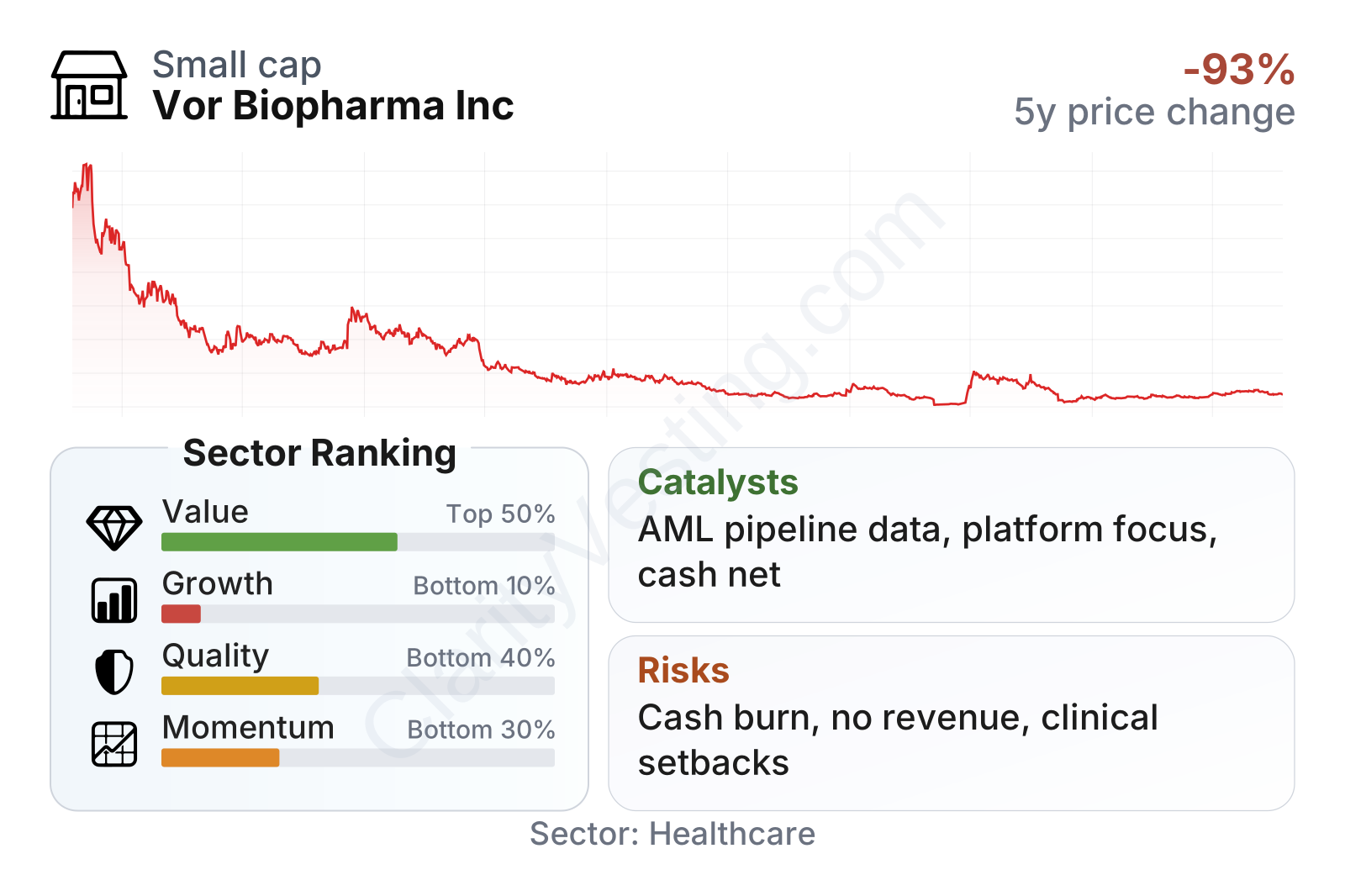
Vor Biopharma is a small-cap biotechnology company with a volatile trading profile, reflected in a beta well above 1. The share price history shows how event-driven the stock has been: it has lost a large amount of value over the last several years, despite occasional sharp rebounds. In the latest factor snapshot, valuation screens can look unusually favorable on some measures, but those readings are not very informative for a pre-revenue biotech with persistent losses. More useful signals are the weak growth ranking, below-average quality profile, and soft momentum versus much of the healthcare sector.
The strongest part of the balance sheet is not profitability but the absence of heavy net debt. That matters because early-stage biotech companies often fail because financing flexibility disappears before clinical value is proven. For Vor, the market is still valuing future trial outcomes far more than current business performance.
Growth
Vor Biopharma operates in a sector with genuine long-term expansion potential. Cell therapy, gene-edited transplants, and targeted blood cancer treatment remain active areas of drug development because existing outcomes in diseases such as AML are still far from ideal. If a company can improve post-transplant relapse prevention or enable safer use of potent anti-cancer agents, the commercial opportunity can be meaningful even before reaching the size of broad primary-care markets.
The strategic logic behind Vor’s platform is clear. Instead of attacking only the cancer, it also attempts to engineer healthy donor cells so they can better withstand treatment. In principle, that could create a more durable treatment framework and could differentiate the company from standard single-drug approaches. That said, the strategy is ambitious and scientifically complex, so promise does not automatically translate into development success.
Recent company updates have been important because they shape whether Vor still has a realistic path to creating long-term value from its pipeline. For a company at this stage, the biggest catalysts are not quarterly revenue beats but clinical readouts, regulatory alignment, trial enrollment progress, and any signs that a lead program can move more efficiently toward later-stage development or partnership interest.
The cash flow trend shows a business that is still consuming substantial amounts of cash, with outflows worsening over time. That is common in clinical-stage biotech, but it also means growth is tied to scientific milestones and financing capacity rather than self-funded expansion. If future updates show cleaner execution, narrower program focus, or external validation from collaborators, that could significantly improve how the market views the company’s growth path.
Risks
This article is for informational purposes only and does not constitute financial advice. Some content is AI-generated. See Disclaimer


