Stock Analysis · Viper Energy Ut (VNOM)
Overview
Viper Energy is a mineral and royalty company focused mainly on oil and natural gas properties in the United States, with a strong concentration in the Permian Basin. In simple terms, it owns rights to receive a share of production revenue from wells drilled on land tied to its mineral interests. That model is different from a traditional exploration and production company because Viper generally does not operate the wells itself, does not carry the full drilling burden on most royalty acreage, and has a relatively lean corporate structure.
The business is closely linked to drilling activity by third-party operators, especially Diamondback Energy, which has historically been the most important operator on Viper’s acreage. As production grows on its mineral position, Viper collects more royalty income. It also has some working-interest exposure, which can increase upside when commodity prices are favorable, but that portion also carries direct operating and capital costs.
Its revenue mix is primarily tied to oil, followed by natural gas and natural gas liquids. Based on recent company disclosures, production and revenue sources can be summarized approximately as follows:
- Oil revenue: about 65% to 75% of total hydrocarbon revenue. This is the most important earnings driver and reflects crude production from royalty and mineral interests.
- Natural gas revenue: about 15% to 25%. This comes from associated gas produced alongside oil, especially in the Permian.
- Natural gas liquids revenue: about 10% to 15%. This includes products such as propane, butane, and other liquids separated from gas streams.
- Royalty income: the dominant economic source, generated from mineral and royalty acreage where third parties drill and produce.
- Working-interest income: a smaller but more variable source, tied to assets where Viper participates more directly and therefore bears a larger share of costs.
For long-term readers, the important point is that Viper is not mainly a pipeline operator despite some classifications placing it in midstream. Economically, it behaves more like a royalty owner on premier shale acreage. That gives it exposure to production growth with a lighter operating footprint than many upstream peers.
The long-term pattern shows a business that has expanded revenue materially over the past several years, while profitability has been more volatile. Revenue moved from roughly the low hundreds of millions earlier in the cycle to well above $1 billion more recently, but earnings have not followed in a straight line. That reflects the mix of commodity prices, acquisition activity, non-cash accounting effects, and interest costs.
Key Figures
| Metric | Value | Sector ⓘ |
|---|---|---|
| Date | Oct 17, 2026 | |
| Context | ||
| Sector | Energy | |
| Industry | Oil & Gas Midstream | |
| Market Cap ⓘ | $15.93B | |
| Beta ⓘ | 0.31 | |
Value (Cheapness) | ||
| P/E Ratio ⓘ | N/A | 15.44 |
| P/B Ratio ⓘ | 1.57 | 1.73 |
| FCF Yield ⓘ | 1.24% | 8.20% |
| Dividend Yield ⓘ | 5.65% | 3.59% |
| EBIT / EV ⓘ | 2.69% | 7.46% |
| PEG ⓘ | 0.98 | |
Growth (Business expansion) | ||
| Revenue Growth ⓘ | 115.20% | 26.90% |
| RPS Growth (5Y CAGR) ⓘ | 6.38% | 6.90% |
| EPS Growth (5Y CAGR) ⓘ | -9.70% | -15.73% |
| BVPS Growth (5Y CAGR) ⓘ | -1.12% | 6.07% |
| Margin Growth (5Y Trend) ⓘ | -67.53% | 0.58% |
| FCF Growth (5Y CAGR) ⓘ | N/A | 1.86% |
| DPS Growth (5Y CAGR) ⓘ | -2.84% | 16.79% |
Quality (Business durability) | ||
| ROIC (Latest) ⓘ | 3.60% | 11.40% |
| ROA (Latest) ⓘ | 0.46% | 6.06% |
| ROIC (5Y Median) ⓘ | 20.88% | 10.30% |
| ROA (5Y Median) ⓘ | 5.80% | 5.42% |
| Net Debt / EBIT (Latest) ⓘ | 6.23 | 1.64 |
| Net Debt / EBIT (5Y Median) ⓘ | 2.18 | 1.83 |
| Net Debt / EBITDA (Latest) ⓘ | 1.49 | 1.08 |
| Net Debt / Assets ⓘ | 13.28% | 17.29% |
| EBITDA / Interest ⓘ | 9.03 | 9.64 |
| Operating Margin (Latest) ⓘ | 12.89% | 16.27% |
| Operating Margin (5Y Median) ⓘ | 57.95% | 20.39% |
| Debt to Equity (Latest) ⓘ | 33.33% | 54.76% |
| Profit Margin (Latest) ⓘ | 3.05% | 8.82% |
| Free Cash Flow (Latest) ⓘ | $198.00M | |
Momentum (Price trend) | ||
| 3Y Return ⓘ | +80.09% | +67.38% |
| 12M Return (excl. last month) ⓘ | +22.57% | +49.19% |
| 6M Return ⓘ | +0.93% | +7.07% |
| Price vs. 200-Day MA ⓘ | +2.71% | +9.56% |
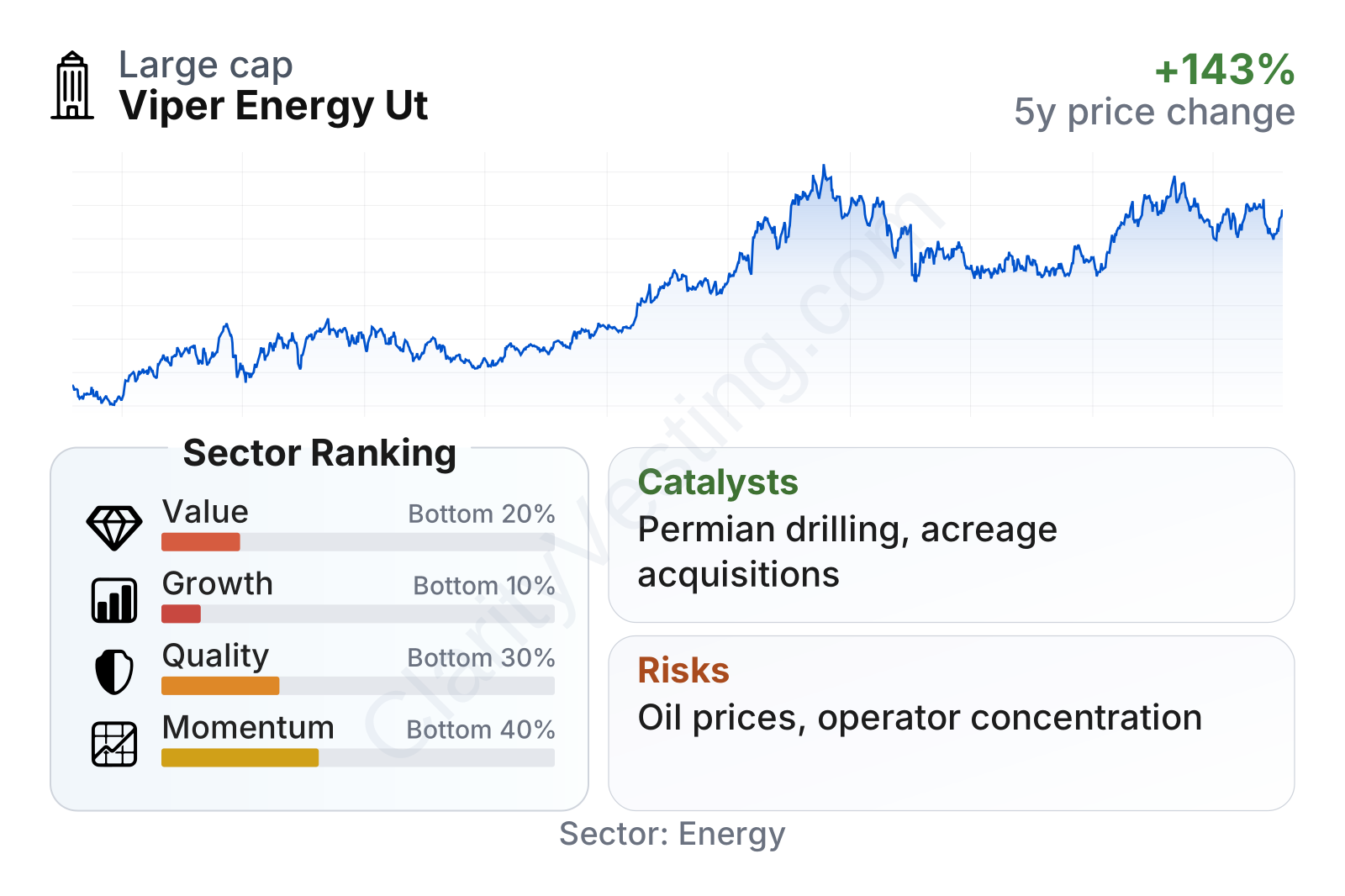
Viper is now a large publicly traded energy name, but the table points to a mixed profile. On valuation, it screens weaker than the sector median on cash-flow-based measures, even though its book-value multiple is close to the industry norm and its trailing dividend yield remains above the sector median. On quality, leverage relative to equity looks moderate at about 33%, better than the sector median, but returns on capital and assets are currently below typical energy peers. Growth measures are distorted by very strong recent revenue expansion, while several five-year trends remain less impressive. Price performance over three years has been solid, yet shorter-term momentum has cooled.
Growth
Viper operates in a sector that still matters for long-term energy supply, especially in the Permian Basin, which remains one of the lowest-cost and most productive oil regions in North America. That is an important advantage because the best acreage tends to attract capital even during weaker commodity periods. A royalty company attached to high-quality land can therefore keep participating in drilling activity without needing to fund every well itself.
The company’s strategy is straightforward: expand and optimize its mineral position in productive areas, maintain alignment with active operators, and convert production growth into royalty cash flow. That logic makes sense for long-term growth because royalty interests can scale without requiring the same operating workforce, equipment, or full-cycle capital intensity of a producer. The model can become especially attractive when large operators keep consolidating acreage and drilling longer laterals on top-tier rock.
Recent growth has been unusually strong. Year-over-year revenue has accelerated sharply again after a more uneven period in 2023 and 2024. That suggests a mix of higher contribution from acquired assets, production additions, and supportive product pricing. Still, energy growth rates should be read carefully: they can swing heavily from one year to another depending on oil prices, volumes, and deal timing.
The bigger caution is cash conversion. Free cash flow has been volatile and, at points, deeply negative on a trailing basis before improving to a positive level more recently. That pattern often happens when a company is actively acquiring assets or when timing differences in capital spending and collections move around the reported numbers. For a royalty-focused business, investors usually expect cleaner cash generation than for drillers, so restoring steadier free cash flow matters to the long-term growth case.
A meaningful catalyst is continued development of the Permian Basin by well-capitalized operators. Viper benefits when more wells are drilled on its acreage, when existing wells outperform, and when inventory life extends. Another possible tailwind is industry consolidation, because larger operators often bring more efficient drilling programs and can unlock acreage synergies. In recent years, Viper has also used acquisitions and simplification steps to increase scale and broaden its asset base, which can improve resilience over time if integration stays disciplined.
Risks
This article is for informational purposes only and does not constitute financial advice. Some content is AI-generated. See Disclaimer


