Stock Analysis · Vivmark Residential (VMRK)
Overview
Vivmark Residential is a large U.S. apartment real estate investment trust, or REIT. In simple terms, it owns, develops, redevelops, and manages residential communities, mainly in coastal and high-income metropolitan areas. The business model is straightforward: acquire or build apartment properties, keep occupancy high, raise rents over time when the market allows, and use scale to operate those properties efficiently.
The company’s revenue is primarily recurring and comes from residents paying to live in its communities. Based on its recent annual reporting structure and the way residential REITs present results, the main revenue sources are concentrated in property operations rather than a wide mix of businesses.
- Rental and other residential income: approximately 95% to 98% of total revenue. This includes apartment rent, parking, pet fees, utilities reimbursement, storage, and other property-level income tied to residents.
- Management, development, and other ancillary income: approximately 2% to 5% of total revenue. This can include fee-based services, transaction-related items, and other smaller non-rental activities depending on the year.
That concentration is important for long-term analysis: the company is not highly diversified by business line, but it benefits from a very predictable demand base because housing is a basic need. Revenue has also moved gradually upward over the last several years, while profitability has remained strong, showing that the portfolio has been able to grow without losing operating discipline.
The business has shown a generally rising revenue base since 2021, and operating income has also improved over time. One notable point is that interest expense has remained meaningful, which is normal for a property owner using debt, so financing costs remain a key part of the earnings picture.
Key Figures
| Metric | Value | Sector ⓘ |
|---|---|---|
| Date | Oct 24, 2026 | |
| Context | ||
| Sector | Real Estate | |
| Industry | REIT - Residential | |
| Market Cap ⓘ | $47.97B | |
| Beta ⓘ | 0.57 | |
Value (Cheapness) | ||
| P/E Ratio ⓘ | 23.75 | 17.85 |
| P/B Ratio ⓘ | 2.37 | 0.87 |
| FCF Yield ⓘ | 2.45% | 7.30% |
| Dividend Yield ⓘ | N/A | 4.83% |
| EBIT / EV ⓘ | 2.23% | 3.78% |
| PEG ⓘ | 6.97 | |
Growth (Business expansion) | ||
| Revenue Growth ⓘ | 3.30% | 5.35% |
| RPS Growth (5Y CAGR) ⓘ | 5.87% | 6.02% |
| EPS Growth (5Y CAGR) ⓘ | -30.08% | -10.65% |
| BVPS Growth (5Y CAGR) ⓘ | -0.36% | 0.43% |
| Margin Growth (5Y Trend) ⓘ | 17.55% | -0.69% |
| FCF Growth (5Y CAGR) ⓘ | 4.26% | 5.40% |
| DPS Growth (5Y CAGR) ⓘ | 3.72% | 5.07% |
Quality (Business durability) | ||
| ROIC (Latest) ⓘ | 6.01% | 5.69% |
| ROE (Latest) ⓘ | 8.27% | 7.37% |
| ROA (Latest) ⓘ | 4.23% | 2.85% |
| ROIC (5Y Median) ⓘ | N/A | 4.26% |
| ROE (5Y Median) ⓘ | 9.36% | 6.04% |
| ROA (5Y Median) ⓘ | 5.07% | 2.45% |
| Net Debt / EBIT (Latest) ⓘ | 6.76 | 7.55 |
| Net Debt / EBIT (5Y Median) ⓘ | 9.46 | 8.26 |
| Net Debt / EBITDA (Latest) ⓘ | 3.75 | 5.26 |
| Net Debt / Assets ⓘ | 42.07% | 37.45% |
| EBITDA / Interest ⓘ | 6.97 | 4.11 |
| Operating Margin (Latest) ⓘ | 40.21% | 33.86% |
| Operating Margin (5Y Median) ⓘ | 29.68% | 37.49% |
| Debt to Equity (Latest) ⓘ | 81.46% | 88.76% |
| Profit Margin (Latest) ⓘ | 33.25% | 18.94% |
| Free Cash Flow (Latest) ⓘ | $1.18B | |
Momentum (Price trend) | ||
| 3Y Return ⓘ | +27.87% | +36.33% |
| 12M Return (excl. last month) ⓘ | -0.20% | +4.32% |
| 6M Return ⓘ | +5.34% | -1.74% |
| Price vs. 200-Day MA ⓘ | +1.40% | -1.42% |
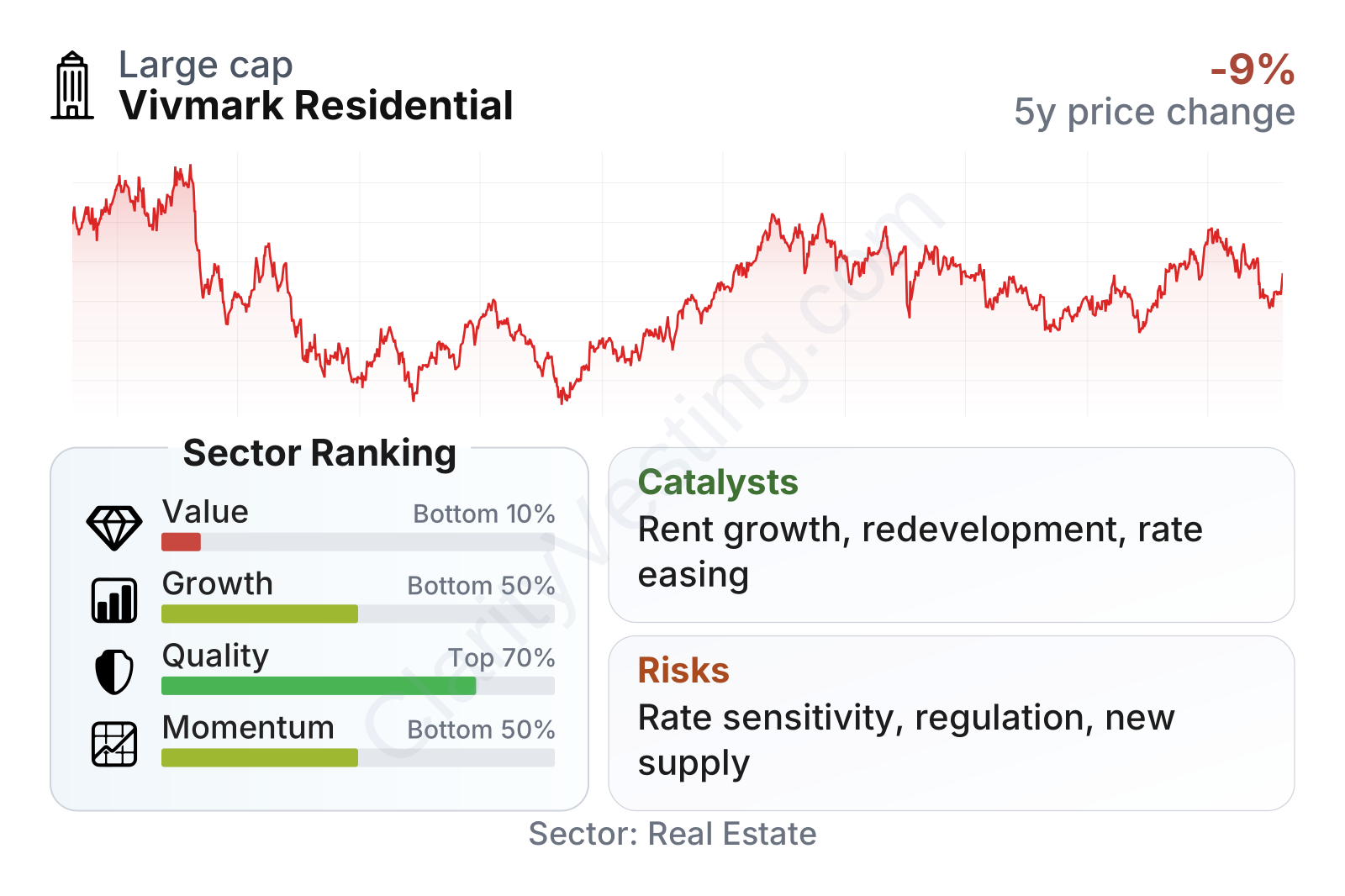
Vivmark Residential stands out more for business quality than for cheap valuation or fast growth. Profitability is healthy versus the residential REIT sector, with returns on assets and equity above typical peers and strong interest coverage. On the other hand, the stock trades at richer earnings and book-value multiples than the sector median, while revenue growth is only modest and recent share-price performance has been mixed rather than clearly leading.
The stock-price history reflects the broader pattern often seen in apartment REITs: a strong period before and during early inflationary rent growth, a correction as rates moved up, and a more recent recovery. The company’s beta is low, which suggests the shares have historically moved less than the broader market, but lower volatility does not remove the impact of interest-rate cycles on real estate valuations.
Growth
The company operates in a sector with durable long-term demand. Residential housing remains undersupplied in many major U.S. markets, especially in places where land is scarce, regulation is tighter, and homeownership is expensive. Those conditions can support apartment occupancy and rent growth over long periods, even if year-to-year performance moves with the economy.
Vivmark Residential’s strategy also fits that backdrop. Large apartment REITs typically focus on high-quality assets in markets with strong employment, wage growth, and barriers to new supply. That approach can create steadier rent growth and better pricing power than a broad, lower-quality portfolio. The company’s size gives it access to development, redevelopment, financing, and operating capabilities that smaller landlords usually cannot match.
Revenue per share has followed a steady upward path over the last five years, which is one of the cleaner signs of business expansion. The pace is not especially fast, but it is consistent, and that matters in real estate where long-duration cash generation is often more important than sudden growth bursts.
Dividend per share has also climbed gradually over time. That supports the view that underlying cash generation has been resilient, although the latest metrics table showing a zero trailing dividend yield appears inconsistent with the historical dividend trend and may reflect a timing or classification issue rather than a complete disappearance of distributions.
Potential catalysts for future growth include redevelopment of existing communities, selective new development deliveries, and stabilization of financing conditions. If interest rates stop rising or begin to ease, apartment REITs can benefit in two ways at once: lower pressure on valuation multiples and a friendlier environment for external growth. A second useful catalyst is limited new housing supply in some of the company’s key markets, which can strengthen rent renewal trends when demand holds up.
Risks
This article is for informational purposes only and does not constitute financial advice. Some content is AI-generated. See Disclaimer


