Stock Analysis · Vulcan Materials Company (VMC)
Overview
Vulcan Materials Company is one of the largest producers of construction aggregates in the United States. Aggregates are basic crushed stone, sand, and gravel used to build roads, highways, bridges, airports, data centers, factories, and housing developments. The company also sells asphalt and ready-mixed concrete in selected markets, mainly as downstream products that use its own aggregates.
Its business is relatively simple to understand: Vulcan owns reserves, quarries, and distribution assets near large and growing metropolitan areas, then sells heavy building materials into local construction markets. Because these materials are expensive to transport over long distances, location matters a lot. That gives established quarry operators a meaningful advantage in the regions where they already have permitted sites and logistics networks.
Based on the latest annual filing, Vulcan’s revenue mix is dominated by aggregates, with smaller contributions from asphalt and concrete.
- Aggregates: about 79% of revenue. This includes crushed stone, sand, and gravel sold for public infrastructure, nonresidential construction, and residential construction.
- Asphalt: about 13% of revenue. This business produces paving materials, often tied to roadwork and public infrastructure projects.
- Concrete: about 8% of revenue. This includes ready-mixed concrete used in local construction projects.
The mix shows why Vulcan is often viewed first as an aggregates company rather than a broad building-products manufacturer. Aggregates generate most of the revenue and typically anchor the company’s profitability and long-term strategic value.
The business has expanded revenue meaningfully over the past several years, while profitability has improved faster than sales. Operating income and net income have grown more strongly than revenue since 2021, which suggests that pricing, operating discipline, and mix have mattered as much as volume.
Key Figures
| Metric | Value | Sector ⓘ |
|---|---|---|
| Date | Oct 24, 2026 | |
| Context | ||
| Sector | Basic Materials | |
| Industry | Building Materials | |
| Market Cap ⓘ | $33.94B | |
| Beta ⓘ | 1.05 | |
Value (Cheapness) | ||
| P/E Ratio ⓘ | 30.89 | 16.92 |
| P/B Ratio ⓘ | 4.10 | 1.66 |
| FCF Yield ⓘ | 3.03% | 5.83% |
| Dividend Yield ⓘ | 0.78% | 2.07% |
| EBIT / EV ⓘ | 5.10% | 6.38% |
| PEG ⓘ | 1.65 | |
Growth (Business expansion) | ||
| Revenue Growth ⓘ | 2.50% | 11.25% |
| RPS Growth (5Y CAGR) ⓘ | 9.65% | 4.49% |
| EPS Growth (5Y CAGR) ⓘ | -6.75% | -15.24% |
| BVPS Growth (5Y CAGR) ⓘ | 7.16% | 5.49% |
| Margin Growth (5Y Trend) ⓘ | 4.64% | -1.54% |
| FCF Growth (5Y CAGR) ⓘ | 19.29% | 0.37% |
| DPS Growth (5Y CAGR) ⓘ | 7.56% | 5.91% |
Quality (Business durability) | ||
| ROIC (Latest) ⓘ | 11.36% | 9.59% |
| ROA (Latest) ⓘ | 6.70% | 4.92% |
| ROIC (5Y Median) ⓘ | 8.64% | 7.91% |
| ROA (5Y Median) ⓘ | 5.76% | 3.92% |
| Net Debt / EBIT (Latest) ⓘ | 2.53 | 1.36 |
| Net Debt / EBIT (5Y Median) ⓘ | 3.86 | 1.69 |
| Net Debt / EBITDA (Latest) ⓘ | 1.83 | 0.93 |
| Net Debt / Assets ⓘ | 28.53% | 13.69% |
| EBITDA / Interest ⓘ | 5.54 | 12.38 |
| Operating Margin (Latest) ⓘ | 22.86% | 13.24% |
| Operating Margin (5Y Median) ⓘ | 18.43% | 11.82% |
| Debt to Equity (Latest) ⓘ | 57.72% | 40.30% |
| Profit Margin (Latest) ⓘ | 13.75% | 6.38% |
| Free Cash Flow (Latest) ⓘ | $1.03B | |
Momentum (Price trend) | ||
| 3Y Return ⓘ | +34.26% | +73.47% |
| 12M Return (excl. last month) ⓘ | -16.71% | +27.59% |
| 6M Return ⓘ | -8.62% | -4.02% |
| Price vs. 200-Day MA ⓘ | -5.69% | -0.65% |
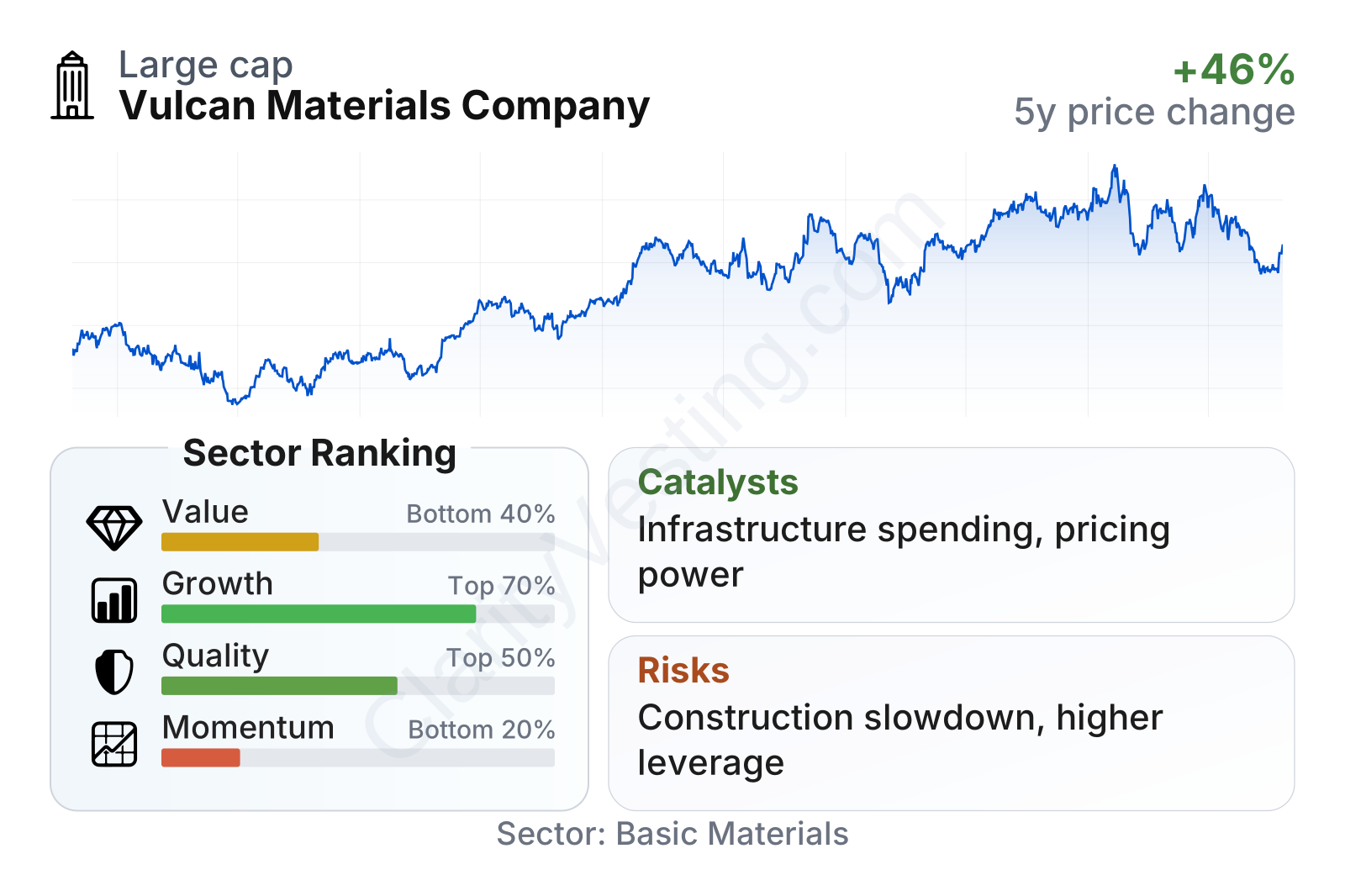
Vulcan is a large-cap building materials company with a stock that has generally trended upward over several years, even though recent price momentum has been weaker than much of the sector. The table points to a mixed profile: valuation metrics sit below the sector on attractiveness, while quality is solid and growth is better over a multiyear view than the latest one-year revenue figure alone would suggest. Profitability stands out positively, but the stock’s recent trading performance has been soft.
The company’s return on invested capital is above the sector median, and operating margin is notably stronger than many peers. Free cash flow has also grown well over time. On the other hand, the share price reflects a premium on common valuation measures such as earnings and book value, while leverage is higher than the sector median. In short, the operating business looks stronger than the stock’s current value profile.
Growth
Vulcan operates in a sector with durable long-term demand drivers. The United States needs ongoing spending on highways, bridges, airports, utilities, industrial projects, and site development. Aggregates are not a discretionary product in that process; they are essential inputs. That does not mean growth is always smooth, but it does mean demand is supported by structural needs that extend well beyond a single economic cycle.
The company’s strategy also makes sense for future growth. It focuses on high-growth states and metropolitan areas, reserve ownership, distribution reach, and pricing discipline. In this industry, opening a new quarry is difficult because of permitting, zoning, and environmental hurdles. As a result, companies with existing reserves in attractive locations often have a stronger position than new entrants. Vulcan has spent years building that footprint.
Recent revenue growth has moderated sharply from the unusually strong gains seen earlier in the cycle. The latest year-over-year pace is positive but modest, around the low single digits, and below the broader sector median. Even so, the longer-term picture is healthier: revenue per share has compounded close to 10% over five years, showing that growth has not depended only on short-lived spikes.
Cash generation is one of the more encouraging trends. Free cash flow has climbed materially in recent years and now sits above $1 billion on a trailing basis. That matters because it gives the company more flexibility to fund capital spending, acquisitions, dividends, and debt management without relying as heavily on outside financing.
An important catalyst is public infrastructure spending in the United States, especially road and transportation work that tends to require large volumes of aggregates and asphalt. Another support comes from manufacturing, logistics, and data center projects, which continue to drive site preparation and heavy construction activity in many of Vulcan’s markets. The company has also used acquisitions to deepen its network, and those deals can strengthen pricing power and local scale when integrated well.
More recent company updates have continued to emphasize pricing strength, disciplined cost management, and healthy public-sector demand. For a business like Vulcan, price realization can be just as important as shipment growth, because aggregates markets are local and well-located capacity is hard to replace.
Risks
This article is for informational purposes only and does not constitute financial advice. Some content is AI-generated. See Disclaimer


