Stock Analysis · Valero Energy Corporation (VLO)
Overview
Valero Energy Corporation is one of the largest independent petroleum refiners in North America. The company buys crude oil and other feedstocks, processes them in refineries, and sells finished products such as gasoline, diesel, jet fuel, asphalt, petrochemicals, and renewable diesel. Its system includes refineries in the United States, Canada, and the United Kingdom, as well as logistics assets and a large renewable fuels platform.
For long-term analysis, Valero is best understood as a downstream energy company whose earnings depend less on finding oil and more on the spread between input costs and refined product prices. That makes the business highly sensitive to refining margins, fuel demand, maintenance cycles, and regulation.
Based on the company’s recent annual reporting structure, revenue is mainly generated from three operating segments:
- Refining: about 90% to 95% of revenue. This is the core business and includes gasoline, distillates such as diesel and jet fuel, asphalt, petrochemicals, and other refined petroleum products sold in domestic and export markets.
- Renewable Diesel: about 3% to 6% of revenue. This segment is operated through Diamond Green Diesel and produces renewable diesel and related low-carbon fuels, with economics influenced by feedstock costs and government credit programs.
- Ethanol: about 2% to 4% of revenue. This includes ethanol production and sales of related co-products such as distillers grains and corn oil.
Valero also owns logistics interests, including pipelines and terminals, that support the movement and storage of crude oil and refined products. These assets are strategically important, although they are not the largest direct revenue contributor compared with refining itself.
The business flow shows a very cost-heavy model, which is normal for refining: revenue is very large, but most of it is absorbed by raw material and operating costs. A notable pattern over the last several years is that profits surged in the exceptional margin environment of 2022 and 2023, then normalized sharply in 2024 and 2025 as conditions became less favorable.
Key Figures
| Metric | Value | Sector ⓘ |
|---|---|---|
| Date | Oct 17, 2026 | |
| Context | ||
| Sector | Energy | |
| Industry | Oil & Gas Refining & Marketing | |
| Market Cap ⓘ | $131.43B | |
| Beta ⓘ | 0.59 | |
Value (Cheapness) | ||
| P/E Ratio ⓘ | 19.03 | 15.44 |
| P/B Ratio ⓘ | 6.22 | 1.73 |
| FCF Yield ⓘ | 7.70% | 8.20% |
| Dividend Yield ⓘ | 1.07% | 3.59% |
| EBIT / EV ⓘ | 9.12% | 7.46% |
| PEG ⓘ | 1.85 | |
Growth (Business expansion) | ||
| Revenue Growth ⓘ | 51.70% | 26.90% |
| RPS Growth (5Y CAGR) ⓘ | 9.12% | 6.90% |
| EPS Growth (5Y CAGR) ⓘ | -13.81% | -15.73% |
| BVPS Growth (5Y CAGR) ⓘ | 10.48% | 6.07% |
| Margin Growth (5Y Trend) ⓘ | 1.02% | 0.58% |
| FCF Growth (5Y CAGR) ⓘ | N/A | 1.86% |
| DPS Growth (5Y CAGR) ⓘ | 3.67% | 16.79% |
Quality (Business durability) | ||
| ROIC (Latest) ⓘ | 22.42% | 11.40% |
| ROA (Latest) ⓘ | 11.70% | 6.06% |
| ROIC (5Y Median) ⓘ | 9.80% | 10.30% |
| ROA (5Y Median) ⓘ | 4.50% | 5.42% |
| Net Debt / EBIT (Latest) ⓘ | 0.34 | 1.64 |
| Net Debt / EBIT (5Y Median) ⓘ | 0.60 | 1.83 |
| Net Debt / EBITDA (Latest) ⓘ | 0.26 | 1.08 |
| Net Debt / Assets ⓘ | 5.37% | 17.29% |
| EBITDA / Interest ⓘ | 24.04 | 9.64 |
| Operating Margin (Latest) ⓘ | 7.66% | 16.27% |
| Operating Margin (5Y Median) ⓘ | 3.28% | 20.39% |
| Debt to Equity (Latest) ⓘ | 45.39% | 54.76% |
| Profit Margin (Latest) ⓘ | 5.45% | 8.82% |
| Free Cash Flow (Latest) ⓘ | $10.12B | |
Momentum (Price trend) | ||
| 3Y Return ⓘ | +296.11% | +67.38% |
| 12M Return (excl. last month) ⓘ | +149.53% | +49.19% |
| 6M Return ⓘ | +96.85% | +7.07% |
| Price vs. 200-Day MA ⓘ | +70.35% | +9.56% |
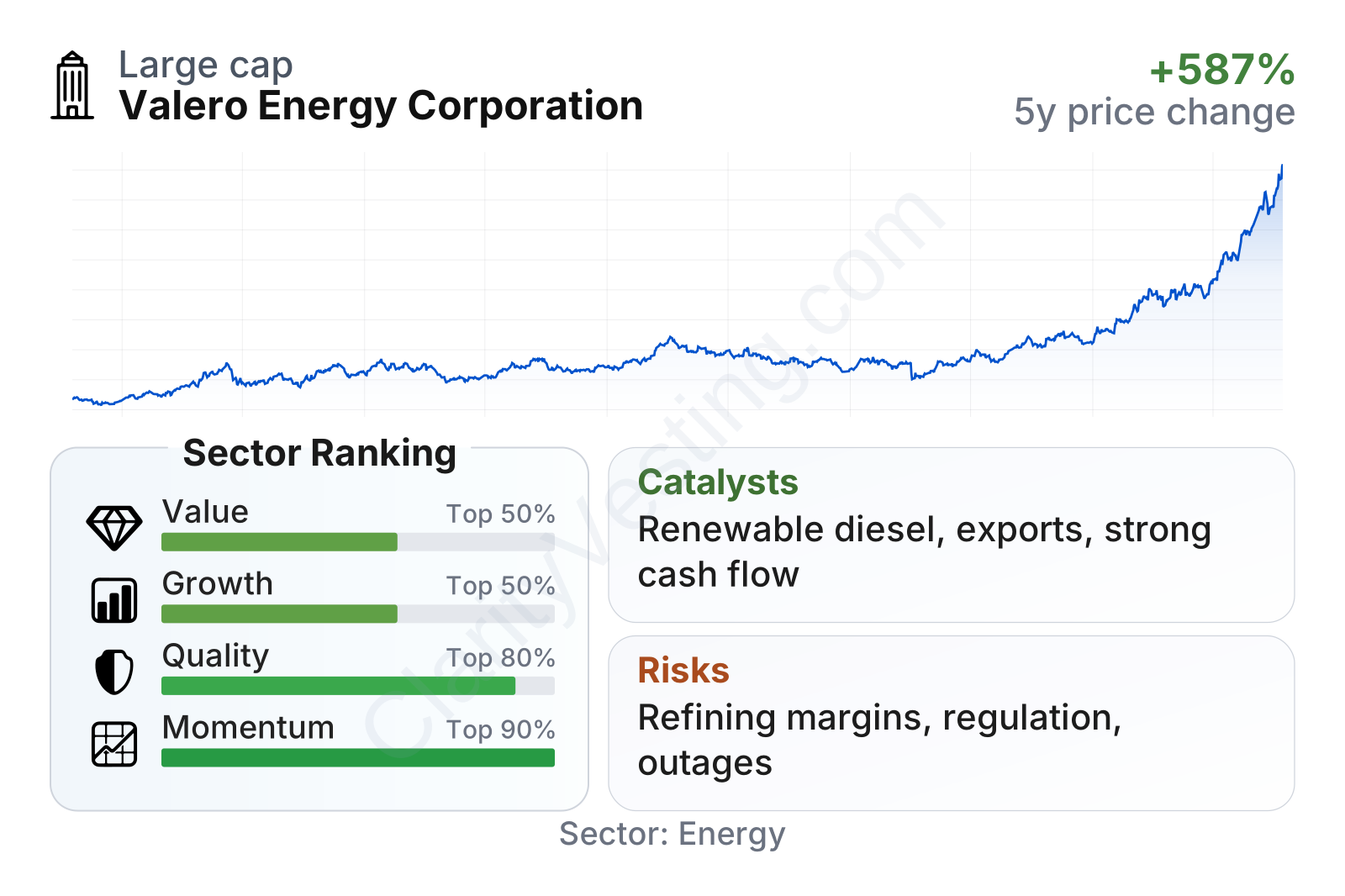
Valero is a very large energy company with lower share-price volatility than many energy peers, as shown by a beta well below 1. In the factor breakdown, quality stands out more than growth: returns on capital and asset efficiency are strong, while leverage remains moderate for a cyclical refining business. Growth is more mixed because refining results can swing sharply from one year to another, which makes multi-year trends uneven even when long-term operating execution is solid.
Valuation metrics are not stretched on an operating basis. The earnings multiple sits around the sector median, while free cash flow yield and EBIT relative to enterprise value are somewhat stronger than the median. The main point of caution is that the price-to-book ratio is much higher than the sector median, which reflects both strong market performance and the market’s willingness to pay more for Valero’s asset base and profitability profile than for many peers.
Recent stock performance has been exceptionally strong over 6 months, 12 months, and 3 years compared with the broader energy group. That strength signals confidence in the company’s current earnings power, but it also means expectations are no longer low.
Growth
Valero operates in a mature sector rather than a classic high-growth one. Fuel refining is essential infrastructure, but long-term demand growth is usually modest in developed markets. That said, the sector still offers opportunities through export demand, refinery closures in some regions, tighter product supply, and the ability of efficient operators to gain share when weaker assets exit the market.
Valero’s strategy for future growth makes sense because it is not relying only on rising fuel consumption. The company has focused on operational reliability, disciplined capital allocation, and expanding lower-carbon fuel exposure through renewable diesel. That approach is practical for a refiner: instead of chasing volume growth alone, it aims to improve margin quality and preserve cash generation across the cycle.
Revenue growth has been volatile, which is typical for refiners because revenue moves with both commodity prices and product demand. After a period of contraction, the latest year-over-year trend has turned positive again, suggesting a better operating backdrop than in the weaker part of 2024 and 2025. Over five years, revenue per share growth has also outpaced the sector median, which points to a business that has expanded more effectively than many peers despite the cyclical swings.
Free cash flow has remained substantial even after coming down from earlier peak levels. That matters because it shows Valero can still produce meaningful cash outside extraordinary margin years. Strong cash generation supports refinery upgrades, renewable investments, balance-sheet flexibility, dividends, and share repurchases without requiring aggressive borrowing.
A key catalyst is renewable diesel. Valero’s Diamond Green Diesel platform gives it exposure to one of the few parts of the fuel market with structural policy support. Demand for lower-carbon fuels, combined with federal and state credit systems, can create a second earnings engine alongside traditional refining. Another positive is Valero’s export position: Gulf Coast refining assets are well placed to serve Latin America and other markets where demand for transportation fuels and refined products remains resilient.
Recent company updates have also highlighted continued capital returns, steady operations, and a disciplined approach to spending. For a long-term view, the most important growth signal is not rapid sales expansion but Valero’s ability to convert its scale and asset quality into durable cash generation through changing market conditions.
Risks
This article is for informational purposes only and does not constitute financial advice. Some content is AI-generated. See Disclaimer


